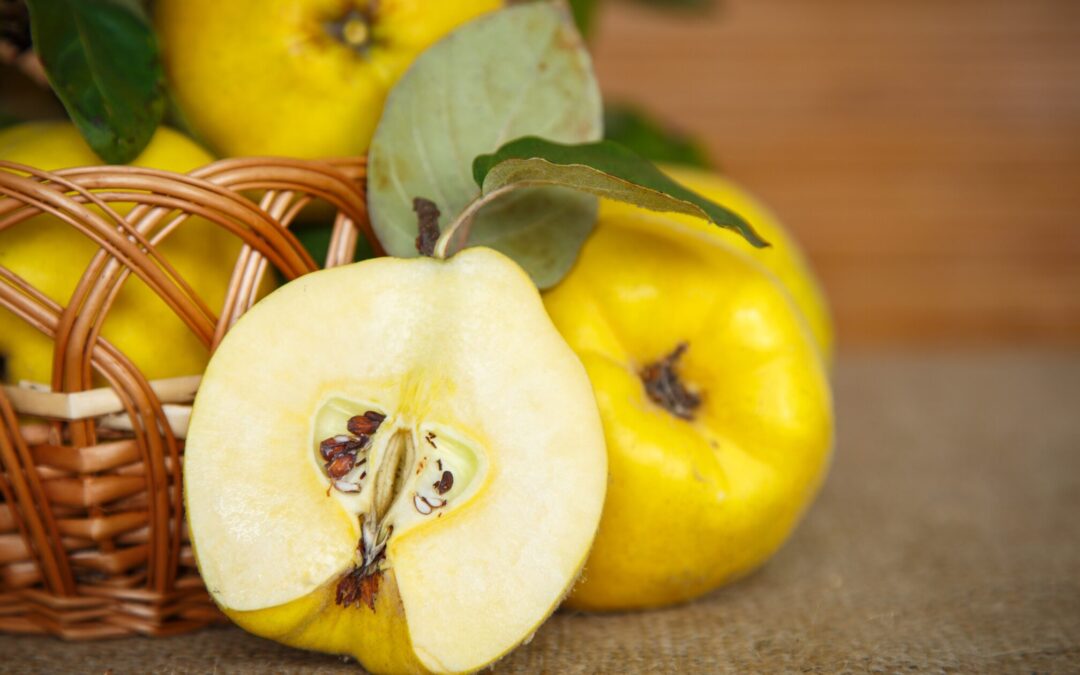
Once the apples, plums, and pears are harvested, once all the nuts are dried and in bags for storage, and the vegetable garden is cleaned up for winter, we are blessed with one last fruit: the quince. Looking like a knobbly apple but smelling deliciously aromatic, quinces transform from hard and astringent into sweet or savoury preserves and dishes. For decades, quinces were regarded as old-fashioned, but their unique flavour has been rediscovered for preserving and seasonal cooking. Unlike apples and pears, to which they are related, quinces can’t be eaten raw. Through preservation, however, they transform their colour and release their wonderful fragrance, a mixture of apples, pears and roses. Whether you’ve discovered these golden beauties at a local farmers’ market or are lucky enough to have a quince tree in your garden, I show you five foolproof ways to preserve their unique charm.
From classic jellies to Spanish membrillo (a quince paste) that pairs wonderfully with cheese, these recipes will help you capture the essence of autumn’s golden fruit in jars. Even if you are an absolute beginner and have never preserved fruit before, these step-by-step methods will ensure success in the kitchen.
A Brief History of Quince
Quince is the sole member of the genus Cydonia of the Rosaceae family (source: Wikipedia). As I said before, quinces are related to apples and pears, which are Rosaceae, as well. Originally, quince is native to the region of the Caspian Sea, but it thrives in a variety of climates, even cold ones.
In ancient Greece, quinces were attributed to Aphrodite and often called “golden apples”, which shows how cherished they were even then. But also in Europe, quinces were highly esteemed and for some time even a status symbol for wealth.
Typically, quinces are available from late September through December. While apples and pears store very well and thus can be consumed almost year-round, fresh quinces cannot be stored very long. If we want to extend their enjoyment throughout the entire year, we have to preserve it.
Unique Transformation Process
Raw quinces are hard, astringent and inedible. By cooking and preserving, however, they undergo a remarkable change:
Their colour transforms from a pale yellow to a beautiful rose-pink to red.
Their hard flesh becomes tender and succulent.
Harsh tannins, which are responsible for the astringent effect, develop into a honeylike sweetness.
Their fragrance and flavour intensify.
Culinary Versatility
So, why would we make the effort to preserve quinces? The answer is easy: preserved quinces are more versatile than fresh ones. Quince jelly, for example, brightens your morning toast and pairs very well with roasted meats. Membrillo, a Spanish quince paste, is essential for cheese boards. Preserved quince in syrup can be added to desserts all year round. And have you ever tasted how dried quince can enhance a winter stew!
Apart from adding to your stockpile, home-preserved quince products can also make unique and appreciated gifts for loved ones. Speciality quince preserves may be expensive to buy ready-made, but are affordable to make at home.
Last but not least, quinces are beneficial to our health: they are rich in vitamin C, dietary fibres, as well as antioxidants. Furthermore, they have natural compounds that aid digestion. Best of all, these beneficial properties are retained by our preservation methods.
Before You Begin
Selecting and Preparing Quince
To get the best preserves, you must make sure that you have the best fruit. Quinces are usually ripe between the end of September and the end of October. Only choose firm, ripe quinces without any blemishes. Look for a yellow-gold colour; green quinces are not ripe yet.
If you can’t process the quinces right after harvest, you may store them in a cool and dark place at room temperature, i.e. 13 – 15 °C (55 – 60 °F) for 1 – 2 weeks.
You can also store them in the fridge: wrap them individually in newspaper and put them in the crisper drawer. That way, they’ll last for 2 months.
If you have a very cold basement or a root cellar, you can store quinces in shallow boxes layered with newspaper. At a temperature of 0 – 4 °C (32 – 40 °F) and a humidity of 85 %, they’ll last 3 – 4 months.
Never store quinces in plastic bags as they will retain too much moisture and mould!
Basic preparation steps
There are some basic steps for preparing quinces. First of all, remove the downy fuzz by rubbing it off with a wet cloth. This is an important step as the fuzz causes a bitter taste.
Afterwards, wash the quinces and dry them thoroughly.
Depending on what you want to make, you’ll have to peel the fruits. This is best done with a potato peeler. Then quarter the quinces and remove the core. This may be a bit tricky as the quinces are relatively hard. Be careful with your fingers.
How to preserve quince: preserving methods
There are various methods for preserving quinces, ranging from cooking to juicing and even drying. Let’s break down every method:
Classic Quince Jelly
Angela Braun
Classic Quince Jelly
Classic quince jelly is easy to make, but requires juicing first.
To make quince jelly, we have to make juice first. For that purpose, rub off the downy fuzz, then wash the quinces and cut them into quarters. For making juice, it’s not necessary to peel the quinces or remove the core. On the contrary: as the peels contain a large amount of pectin, it’s advantageous to leave them on.
There are two methods for making juice from quinces (or apples or pears, for that matter): with a steam juicer or with a normal pot.
If you use a steam juicer, fill the bottom pot with water to the mark. Put on the juicer pot and insert the fruit basket in which you put all the quince quarters. Close the lid and heat the water. The hot water vapour will gently cook the fruits and release their juice, which gathers in the juice pot. From there, it can be extracted via the attached tube and filled into sterilised glass bottles or jars.
However, a steam juicer is not the only tool you can use to make juice from quinces. A simple (large) pot with a lid is also ok. In that case, chop the quinces into quarters, put them into the pot and fill it up with water until all the fruits are under the brim. Bring the water to the boil and let it simmer for 45 – 60 minutes. Afterwards, strain the juice through a colander that you layered with a cheesecloth. To squeeze out every last drop of the juice, gently press the quinces. Fill the hot juice into sterilised bottles or jars.
Cooking the jelly
To make the jelly, measure one litre of the quince juice. Put it into a pot and add 500 g of preserving sugar 2:1 or 500 g of normal sugar and one sachet of pectin.
Mix it all very well until the sugar has dissolved, and bring this syrup to a boil. Let it boil for 4 minutes and test its consistency by dropping a spoonful of liquid onto a plate. Tilt the plate and let the mixture run. Wipe through the jelly trail with your finger. If it sets, it’s ready to be poured into jam jars. If not, let it boil for another minute and repeat the test.
When the jelly’s ready, carefully ladle it into jars of 250 ml. Fasten the lid and put the glasses upside down on a dishcloth. After 15 – 20 minutes, put the jars upright again.
Let the jelly cool down completely, label the jars and store them in a cool, dark place for up to one year.
If you like this quince jelly, you’ll wan to try out these recipes as well:
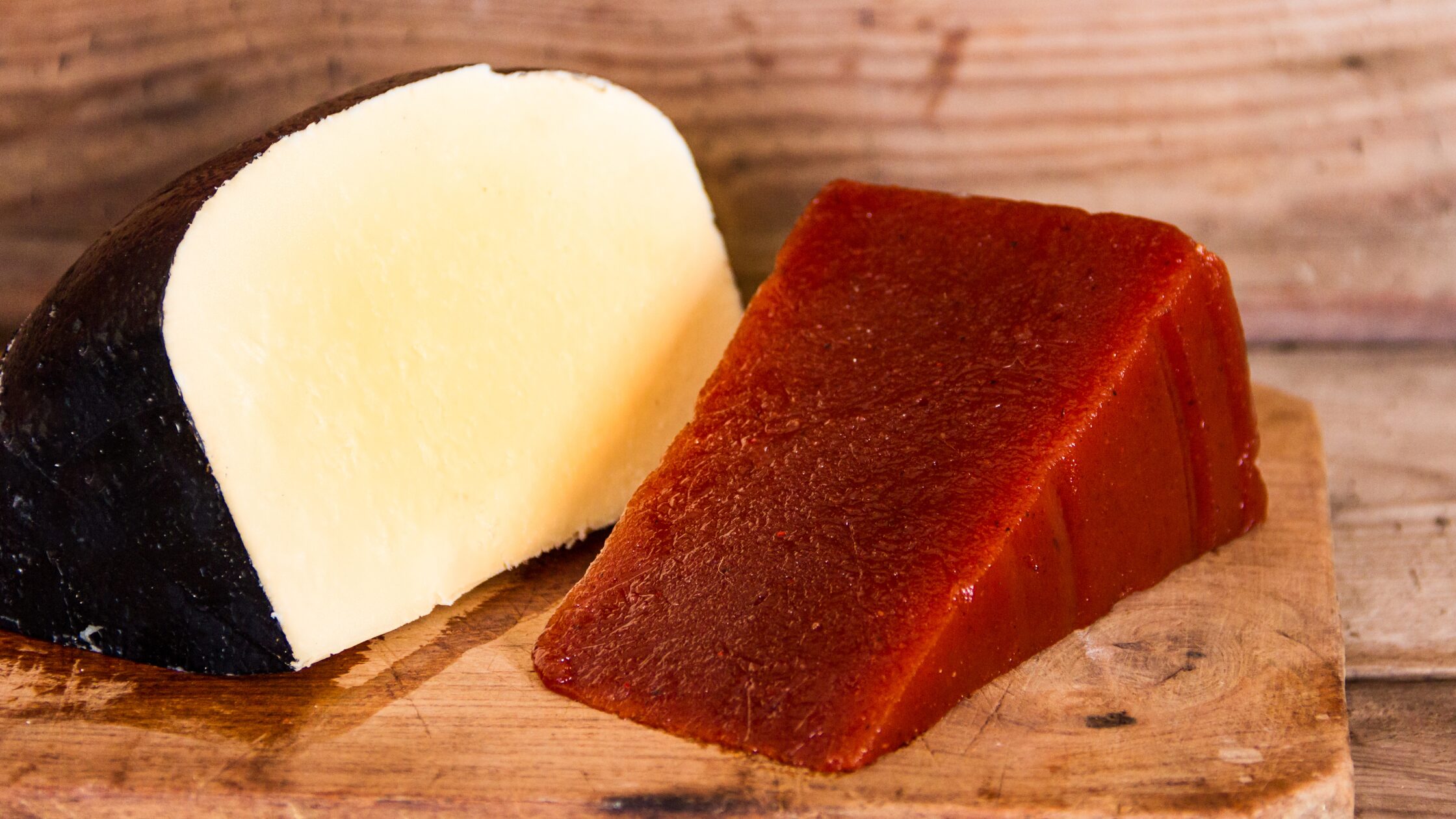
Shortly put, membrillo is a quince paste, known in France as cotignac and in Germany as Quittenkäse (“quince cheese”). The basic principle is always the same: cook quince with sugar, blend it, then let it set and – optionally – dry it. Easy, isn’t it? Let’s break the process down.
Angela Braun
Membrillo
Membrillo, also known as cotignac (France) or Quittenkäse (Germany) is a paste made of quinces.
Rub the fuzz off the quinces and wash them thoroughly.
Quarter the quinces, peel them and remove the cores and any hard or “grainy” parts. You can use undamaged peels and the cores to make quince vinegar. If you want to know more about that, hop over to this article on apple vinegar. The process is the same, and you’ll get a marvellous homemade vinegar from scraps!
Weigh the cut quinces before cooking and put them in a pot. Add 1 litre of water and bring it all to a boil. Let it simmer until the quinces are tenderly cooked. This will take 30 – 45 minutes.
Puree the fruit with a kitchen blender until you get a smooth mass. Add the sugar to the quince puree and let it all cook while constantly stirring. The colour will progressively change from yellow to a brownish-red. Keep stirring well to prevent burning the paste.
When the dough releases from the sides of the pot, you can ladle it into a square or rectangular form, lined with baking paper.
Let it cool down completely. When it’s firmly set, you can drop it out of the form.
If you want to store it, leave it in that shape and cover it with powdered sugar. Afterwards, wrap it in greaseproof paper and store it in the fridge where it will last for at least 3 months. Alternatively, you can freeze membrillo for up to one year.
Notes
Serving suggestions:To serve the membrillo, cut slices of about 1 cm and chop them into small squares. It pairs wonderfully with hard or semi-hard cheese like Manchego or brie. Alternatively, membrillo can also be used as an ingredient in various dishes, such as a filling for tarts and pastries, or as a glaze for meats.
Quince in Syrup
Similar to pears, quinces can be canned in syrup. They pair marvellously with rice pudding or can be used as a filling for cakes and pies. And if you haven’t tried quince crumble yet, I sincerely recommend baking one with these quinces in syrup as a base!
Rub the fuzz off the quinces and wash them thoroughly.
Put some water into a bowl and add the lemon juice or apple vinegar
Quarter the quinces, peel them and remove the cores and any hard or “grainy” parts. Either leave the quince quarters or chop them into cubes of about 2 – 4 cm (1 inch). Put the quinces into the acidified water so that they won’t turn brown.
When all the quinces are done, prepare the syrup:
Put the water and sugar into a pot and stir until the sugar has partly dissolved. Slice the vanilla bean lengthwise and scrape the vanilla out with a knife. Add the vanilla seeds, the sliced pod and the cinnamon stick to the sugar water.
Bring all to a boil and stir until the sugar has dissolved completely. Let the syrup simmer for 5 minutes.
Now drain the quince (cubes) and add them to the simmering syrup. Bring it to a boil once again and let it simmer until the quinces are tender (about 45 – 60 minutes). They should have turned a beautiful rose-pink colour by now.
Pack the quinces into the sterilised jars.
Remove the cinnamon stick and vanilla bean from the syrup and carefully fill the jars up with syrup, leaving 1 cm (½ inch) of headspace. Immediately seal the jars tightly with the lids.
Let the jars cool down completely and check the lids for tightness.
Quinces in syrup can be stored up to one year in a cool and dark place. Once opened, put the jar in the fridge where it may last up to 1 month.
Notes
Serving suggestions
Serve quinces in syrup as a dessert together with whipped cream, vanilla ice cream or yoghurt. It’s also great as a topping to cheesecake, rice pudding or on your morning porridge.Use the syrup to flavour tea, cocktails or sparkling water.
Rub the fuzz off the quinces and wash them thoroughly.
Put some water into a bowl and add the lemon juice or apple vinegar
Quarter the quinces, peel them and remove the cores and any hard or “grainy” parts. Chop the quarters into cubes of about 2 – 4 cm (1 inch). Put the quince cubes into the acidified water so that they won’t turn brown.
Drain the quinces and put them into a pot. Add the water, sugar and spices and bring all to a boil. Let the quinces simmer until they’re soft (20 – 30 minutes).
You can eat the compote just like that, or you can put it still hot into the sterilised jars with ½ inch (1 cm) headspace. Secure the lids tightly. To prolong its shelf-life, can the compote for 30 minutes at 80 °C in a water-bath canner.
Notes
When canned, quince compote can be stored in a cool and dark place for up to one year. Alternatively, fill the cooled compote in portions in plastic bags and put them in the freezer.If you like, mix the quinces with apples before cooking.
Serving suggestions
Serve quince compote with your morning porridge or granola. It also makes a great topping for waffles and French toast. Or just stir it into yoghurt to make a quick and yummy dessert.
Dried Quince
Who would have thought that you could dry quinces? For a long time, I believed that quinces had to be cooked to become edible, but obviously, drying them is also a great method for preserving them. Dried quince is a delicious snack to go, but can also be used in stews, cakes or even as tea!
Rub the fuzz off the quinces and wash them thoroughly.
Put some water into a bowl and add the lemon juice or apple vinegar
Peel the quinces if you like, but it’s not essential. Quarter them and remove the cores and any hard or “grainy” parts.
Cut the quinces into slices of about ¼ inch (6mm) and put them into the lemon water to prevent browning.
Drain the quince slices and dab them dry.
You can either dry the quinces in the oven or a dehydrator.
Dehydrator
Clean the dehydrator trays and arrange the quince slices so that they don’t overlap. Start the dehydrator at 60 °C (135 °F) and dry the slices until they’re leathery.
Oven
Line parchment paper on trays or racks and arrange the quince slices so that they don’t overlap.
Set your oven to 60 °C / 140 °F (fan oven) and put the racks or trays with the quinces in. Prop the door slightly open by sticking a wooden spoon into the opening. That way, the condensation water can evaporate.
Dry the quinces for 6 – 12 hours.
Note: it’s impossible to give you an exact drying time as it depends on many factors like air humidity, room temperature, thickness of the slices and the overall moisture content of the fruit.
How to determine whether your quinces are dry enough
First, properly dried quince should be leathery and pliable, not sticky or tacky to the touch. When you cut or squeeze them, there mustn’t be any moisture.
Storage
The most important point is to let the dried quinces cool completely before storing. Once they are cool, put them into airtight containers or vacuum-sealed bags. Stored in a cool and dark place, they will last for 6 - 12 months if properly dried.
Notes
How to use dried quince
The most common (and fastest) use is to snack on dried quinces directly as they are. You can also add them to your morning granola or mix them with nuts for a healthy snack mix.You can, however, also use dried quince in a more versatile way in sweet and savoury dishes:- Soak them in hot water, tea or wine, for example, until they are soft again (approx 15 – 30 minutes). Then use the soaking liquid in recipes as it contains flavour and nutrients.- Add dried quinces to food like Middle Eastern stews (especially khoresh), Moroccan tagines or Turkish compotes. It’s also a great component of European meat dishes, pairs well with savoury dishes like rice pilaf or can be part of stuffing mixtures.- Chop your dried quince and add it to your oatmeal or porridge. It adds a delicious flavour (and some nutrients) to yoghurt and breakfast cereals. Also, dried quince can be baked very well into muffins, scones or bread. Use it in fruit cakes or spiced holiday desserts as well as in ice cream or frozen yoghurt.- Use dried quince for beverages. For example, steep it in hot water for a fruity tea. You may also add it to mulled wine or cider to add a fruity flavour.
Quinces are Great!
The versatility of quinces makes them a rewarding fruit to preserve, whether you’re drawn to the ruby-red glow of poached quinces, the sweet intensity of membrillo, or the delicate flavour of quince jelly. While these ancient fruits require more time and patience than modern quick-preserving methods, the results are truly worth the effort. The transformation of hard, astringent quinces into tender, aromatic preserves is a wonderful tradition that connects us to generations of home preservers before us.
Whether you’re an experienced preserver or trying quince for the first time, remember that the key to success lies in selecting ripe, fragrant fruit and taking the time to prepare it properly. Your reward will be a pantry stocked with preserved quinces to enjoy throughout the year, adding their unique flavour to cheese boards, desserts, or simply spread on fresh bread.
If you are lucky enough to have a quince tree in your yard or know someone with a quince tree who is eager to share their harvest with you, don’t hesitate to try preserving them! Not only will you be participating in an age-old culinary tradition, but you’ll also be creating something truly special that can’t be found on supermarket shelves.
Do you want more autumn fruit recipes? Try out these:
Originally published October 12, 2025 · Updated July 23, 2026
Garlic is one of the easiest vegetables you’ll ever grow. Plant one clove in autumn, give it a sunny spot, and by next summer you’ll harvest an entire bulb packed with flavour—often far better than anything you can buy in the supermarket.
In this complete beginner’s guide, you’ll learn when and how to plant garlic, how to care for it through the seasons, solve common problems, and harvest bulbs that store for months.
Following these steps gives you the best possible chance of harvesting beautiful, healthy bulbs.
Quick Overview on planting garlic
Difficulty
Easy
Best planting time
October (or early spring)
Sun
Full sun
Soil
Fertile, well- drained
Spacing
10 cm (4 inches)
Harvest
June - July
Suitable for Containers
Yes
When to plant garlic
At a glance
✅ Best: October
✅ Second choice: February
✅ Needs winter cold
✅ Autumn planting = larger bulbs
There are two possibilities for when to plant garlic:
Autumn
Planting garlic cloves between the end of September and the beginning of November will give them a head start. They’ll grow until it becomes too cold, overwinter and restart growing in spring. That way, the bulbs will be much larger, and that’s why I recommend planting garlic in autumn.
Spring
If you didn’t plant garlic in autumn, you can still do so in early spring. Plant the cloves as soon as the soil is workable. Depending on your growth zone, that’s between mid-February and late March.
Garlic needs some cold to develop bulbs and not shoot into bloom; therefore, you must plant it early enough to catch some of the cold weather still.
Garlic planted in spring will develop equally fine bulbs, albeit smaller ones, that you can harvest the same year.
Choosing your garlic
Hardneck vs Softneck
Garlic is divided into two groups: hardneck and softneck varieties.
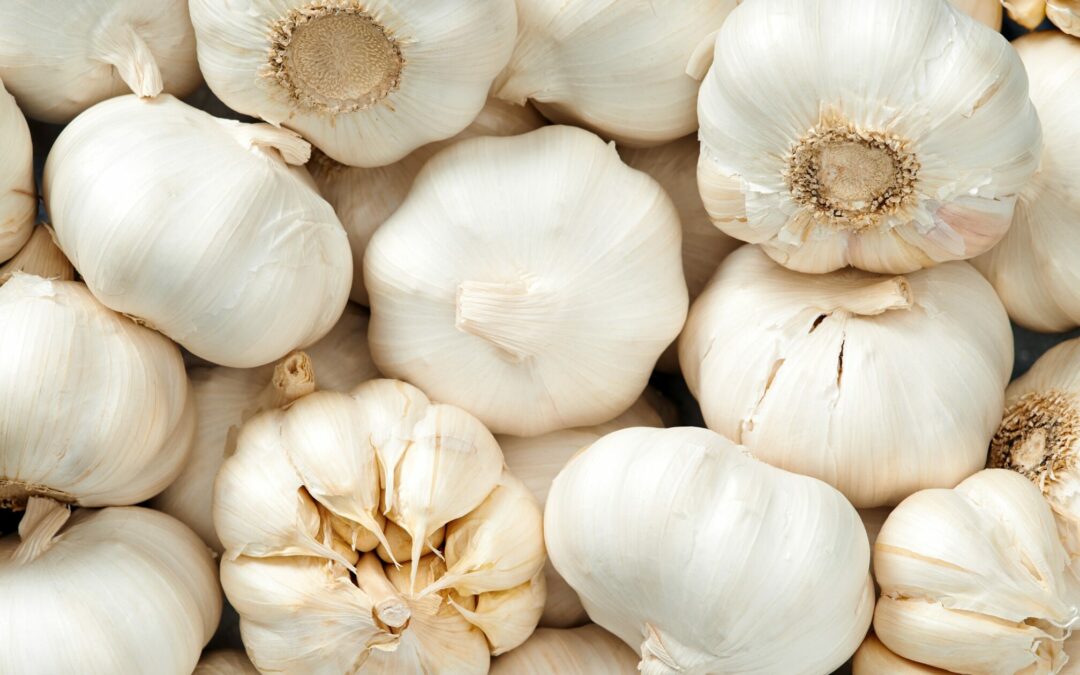
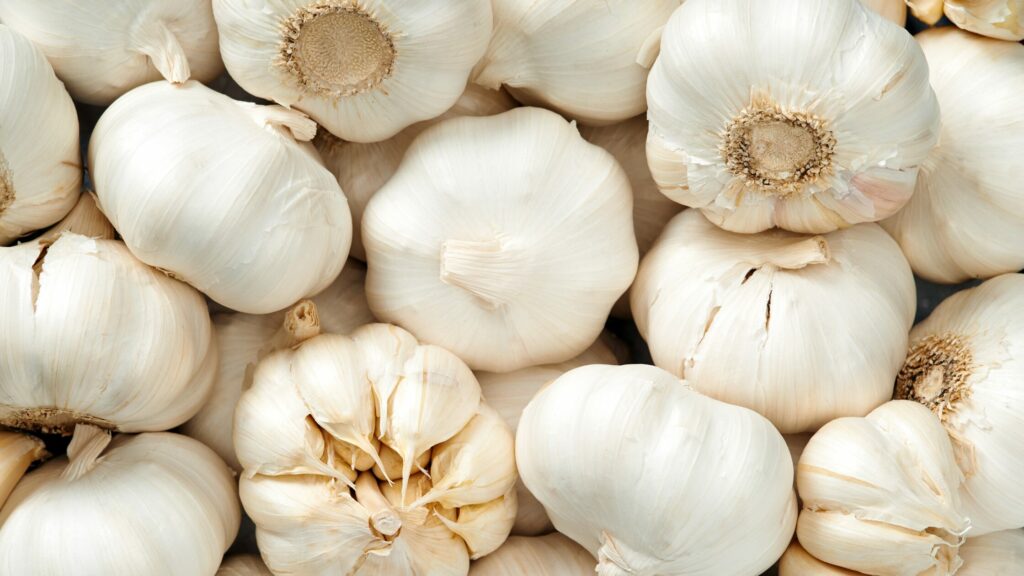
Hardnecks, as the name indicates, develop a hard flower stem or scape, which is edible, as well. Their bulbs form a single ring of large, easy-to-peel cloves around a central stem and, in general, the bulbs (and cloves) are larger than those of softnecks. The outer peel colour can vary from white to violet.
Hardnecks are more cold-tolerant than softnecks, which makes them wonderful for planting in autumn, and they have a strong, sharp flavour.
My favourite hardneck varieties are ‘Ajo Rosa’, ‘Deutscher Porzellan’ and ‘Chesnok Wight’.
Softneck varieties, on the other hand, build a soft stalk, which makes them suitable for braids. The bulb usually consists of several layers of cloves in a concentric circle around the stalk. The outer peel is usually white or beige; the cloves are beige or light brown.
Softneck varieties are better suited for warmer climates or spring cultivation (although it’s possible to plant them in autumn, as well).
The garlic found in stores is usually a softneck variety, as these types are better suited for machine handling. Softneck varieties I like are ‘Thermidrome’, ‘Germidour’ and ‘Cledor’.
If you’re new to growing garlic, I recommend starting with hardneck varieties. They’re more reliable, produce bigger cloves, and you get the bonus of garlic scapes to cook with.
Even though its name suggests otherwise, elephant garlic is not a garlic variety but a leek relative. Nevertheless, it can be harvested and used just like real garlic.
Cloves vs Bulbils
There are two different ways of planting garlic:
The first option is planting cloves. You simply put single cloves into the earth, and each clove grows into a garlic bulb. It’s simple, easy and the fastest way to get a good harvest.
Option number two is planting bulbils.
When we let garlic blossom, it will produce tiny mini-cloves or bulbils on the scape. You can plant them as well, but in their first year, they may produce a small, undivided round. Often, it’ll produce a bulb in the second year, but depending on the variety and growing conditions, it may take longer than two seasons to produce a fully sized, divided bulb.
Cultivating garlic from bulbils is more cumbersome and takes longer to produce a harvest. On the pro side, you don’t have to sacrifice cloves from your harvest. I mostly choose the faster way of planting cloves, but this year, I’ve let some garlic develop bulbils, which I harvested and put right back into the soil of a seed tray. I’ll keep you updated.
Where to buy seed garlic
It seems easy to buy some garlic in the supermarket and plant it in your garden. However, supermarket garlic usually comes from sites in very warm climates. If your climate is colder (like mine), store-bought cloves won’t grow very well in your garden.
Furthermore, and even more important, supermarket garlic may have been treated to delay sprouting, and imported varieties may not be well adapted to your climate.
If you must buy garlic for growing in the supermarket, go for organic garlic, which is less likely to have been treated with an inhibitor.
A better possibility to get good garlic seeds for planting is to look for local seed manufacturers. Their cloves are well-adjusted to your climate. Or ask friends who already cultivate garlic if they’ll give you a few cloves for planting.
I always set the largest bulbs of my garlic harvest aside and use their cloves for planting. That way, I develop and gather garlic cloves that are perfectly adjusted to my garden conditions.
Choosing the right planting site for garlic
Sunlight
First of all, select an area that gets at least 6 – 8 hours of full sunlight per day. Light shade is ok, but the bulbs and thus the yield will be smaller. The best position for planting garlic is on a south-facing bed without any tree shade.
The most important factor for where to grow garlic is drainage. Garlic will rot in waterlogged soil, so good drainage is essential.
Garlic doesn’t compete well with weeds, so make sure that the bed you want to cultivate garlic in is weed-free.
Also, mixing in compost won’t hurt, as it’ll help to improve the soil structure, drainage and fertility.
Only use mature compost, though. Fresh manure, for example, is not suitable for the soil you want to plant garlic in, as it causes bulb splitting.
If your garden doesn’t provide good conditions for garlic, think about creating a raised bed or planting it in pots.
Growing garlic in containers
If you don’t have a garden space, you can still grow your own garlic in containers. In fact, it’s quite easy to cultivate garlic without a garden bed, making it the perfect crop for people who only have a patio or a balcony.
There are, however, a few things you need to observe when growing garlic in containers.
Container requirements
The container you want to grow garlic in should be at least 30 cm (12 inches) deep to give the roots enough space. The width is not that important; any size will do. The wider your container is, the more cloves you can plant.
The material does not matter. Your planting container can be made from terracotta, plastic or even fabric; all pots work.
What is essential, however, is that the container has some holes in it to ensure good drainage. Garlic is much more likely to rot in poorly drained soil, so it’s important that water can drain off quickly.
Spacing
When planting garlic cloves in containers, you must observe the same spacing as in a garden bed. Put the cloves 10 – 15 cm (4 – 6 inches) apart. If you just have small one-litre pots, put one clove per pot. In a larger pot with a diameter of 40 cm, you can put 6 – 9 cloves.
Container care differences
Caring for garlic in containers is slightly different from a garden bed.
For example, containers tend to dry out faster. For that reason, you must check the soil regularly, at best daily, and water if necessary.
Use a good-quality, multi-purpose compost mixed with 20% perlite or grit for drainage. Replace or refresh the potting mix before growing garlic in the same container again to reduce disease problems.
Also, garlic in containers may need a light feeding in spring as the container soil has limited nutrients.
If you plant your garlic in autumn, which I recommend, you must put the container against a wall or insulate it if the weather gets very cold.
In general, put the containers in a place with full sun. Move them to track the sun if possible.
Leave the containers outside all winter to give your garlic that cold kick it needs for forming bulbs.
Planting and harvesting timing are the same as for garlic cultivated in patches.
Crop rotation
Crop rotation is essential for a sustainable gardening practice; it balances soil nutrients and thus improves soil health in the long run.
As with most vegetables, it’s not advisable to plant garlic in the same place year after year. Not only would it leach out the soil, but it would pave the path for pests and diseases.
Instead, wait at least 3 – 4 years before replanting garlic in the same spot and don’t plant it where any other members of the allium family (onions, leeks or shallots) have grown this season or the season before.
Unfortunately, if white rot becomes established, avoid growing garlic, onions, leeks or shallots in that spot for at least 15 years.
Companion planting
Like in human life, vegetables also don’t love each other unconditionally. Some will always be BFFs, and others don’t get on that well if planted in close vicinity.
As I already told you, garlic shouldn’t be planted near members of its own family, like onions, leeks, or shallots, as they would compete for the same nutrients.
Other plants that don’t grow well with garlic are peas and beans, potatoes, parsley and sage.
It fits conveniently, though, between many slower-growing or widely spaced crops, including
strawberries
raspberries
cucumbers
peppers
tomatoes
eggplants
lettuce
carrots
parsnips
cellery/celeriac
dill
spinach
beetroot
You’ve learned all about the requirements for a good garlic harvest. Now, let’s dive right into planting!
How to plant garlic: step-by-step
If you follow this step-by-step guide, you’ll be rewarded with an abundance of garlic next summer!
How to plant garlic
Soil preparation
Before planting, thoroughly remove any weeds from the patch as they compete for nutrients.
If you have it, add some mature compost to the patch to enhance nutrients and organic matter in the soil.
Loosen the soil with a garden fork by digging into it and wiggling the fork a bit. That way, the garlic can set its roots deeply into the ground, and it may even be easier to harvest the bulbs in summer.
Both the compost and the loosening of the soil support good drainage and soil structure.
Planting garlic
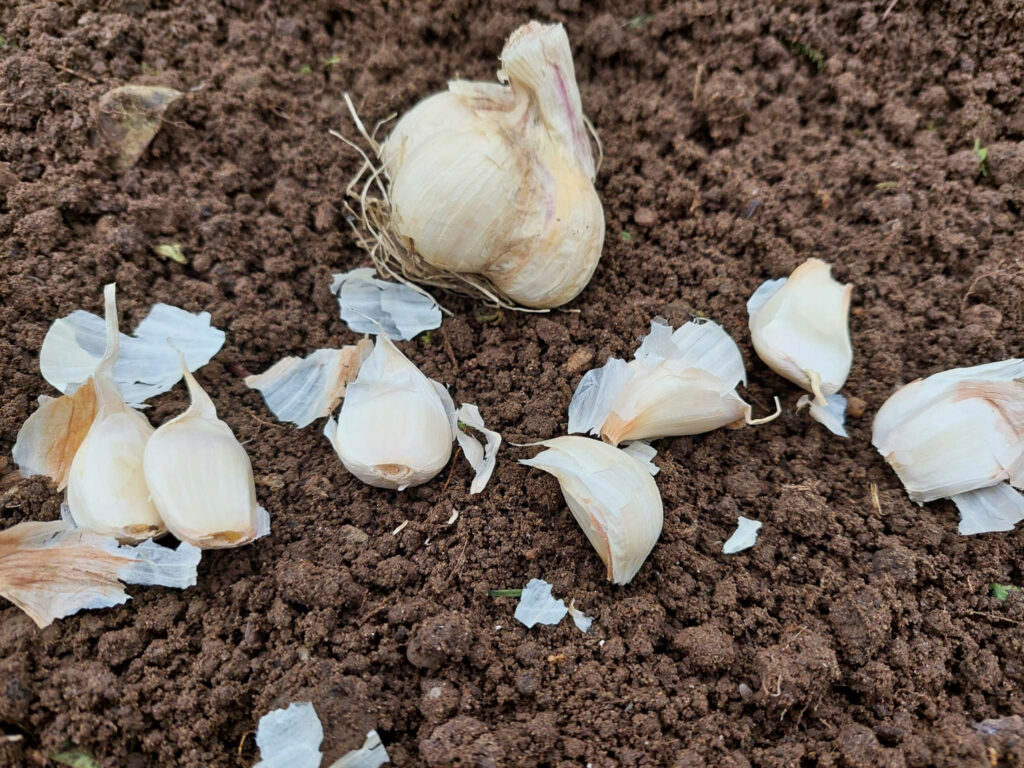
The easiest and most common way is to break up the bulb and stick the single cloves into the soil.
Break up the bulb so that you get out the single cloves.
Use the largest and healthiest cloves – usually the outer ones – and leave the papery skin on as it protects the clove from rot and disease. Discard any cloves that are soft or squishy, discoloured, diseased or in any other way damaged.
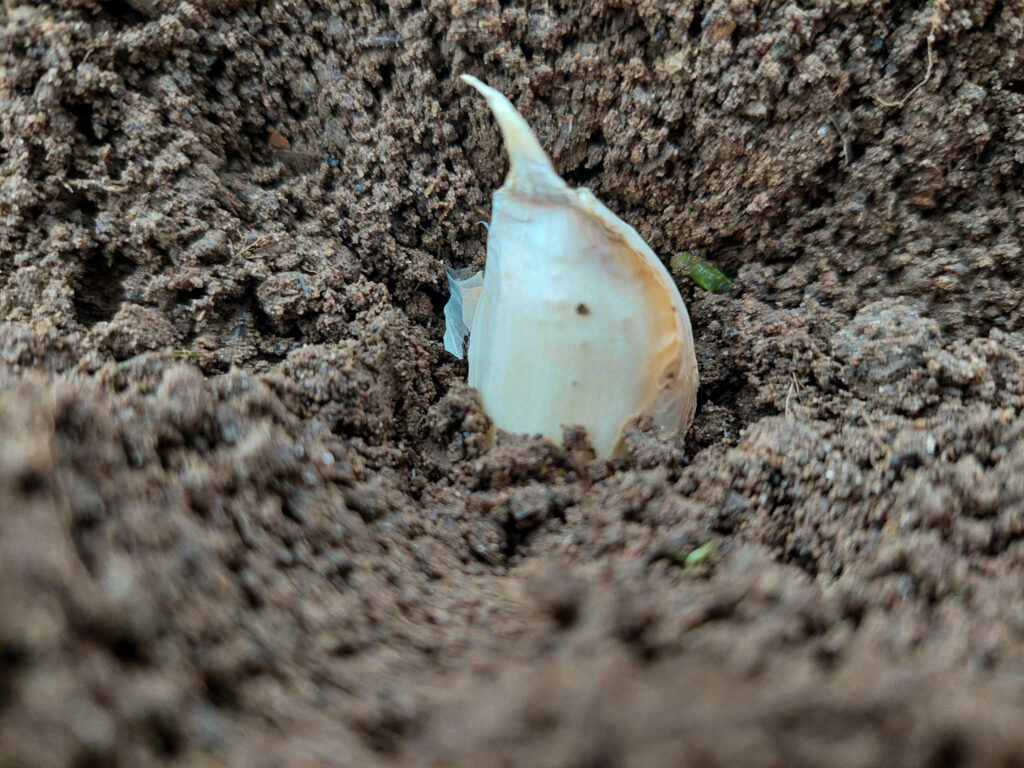
When you plant a clove, its pointed tip must face upwards. That’s where it’ll start sprouting, and we want it to be able to sprout upwards via the sunlight. The flat, rounded end will produce the roots and therefore point into the earth.
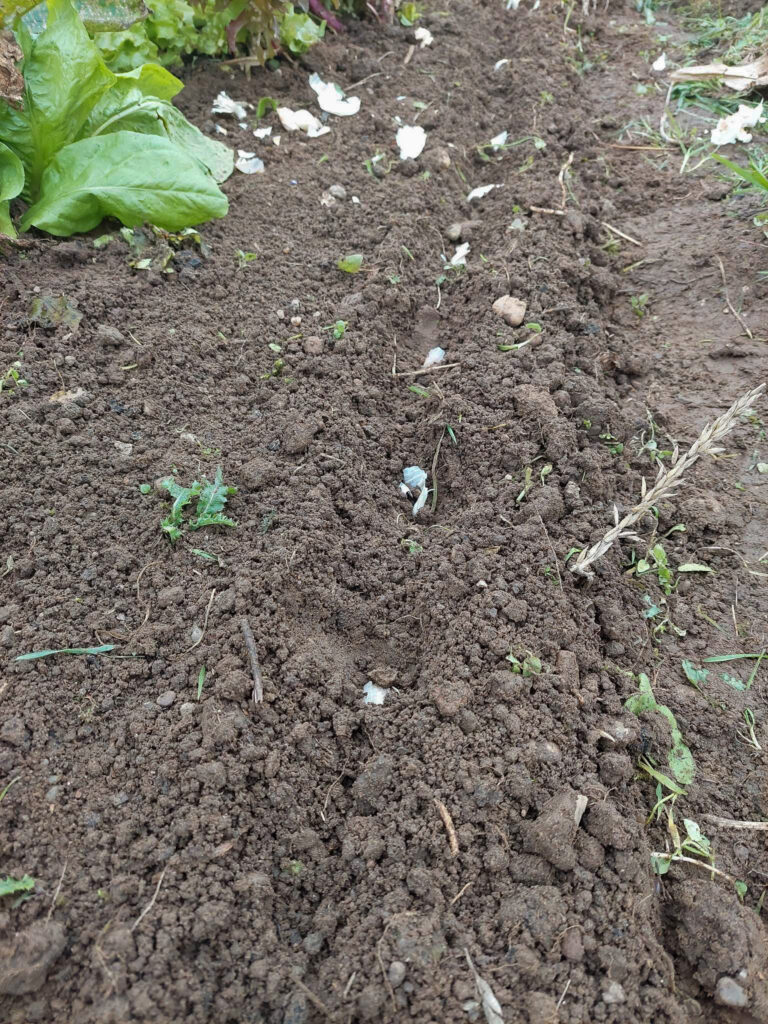
I recommend planting garlic in rows with 15 cm between cloves and 25 cm between rows. Within the rows, you make holes of about 4 – 6 cm (1,5 – 2,5 inches) deep for cloves and 1 – 2 cm (0.3 – 1 inch) deep for bulbils. A dibble can help here.
Put one garlic clove or bulbil per hole and cover it with soil; press the soil slightly around the clove so that it sits firmly in its spot.
Watering and mulching
A great advantage of planting garlic in autumn is that usually the soil is already sufficiently moist. That way, we don’t have to water the cloves. I don’t water my garlic after planting, but depending on your climate, it may be necessary to do so.
If you’ve followed me for some time, you know that I’m a huge fan of mulching. So, when I’ve planted my garlic, I put on a thin layer of mulch, either straw, dried leaves, well-rotted compost or grass clippings. When the sprouts show, and the weather tends toward freezing, I add more mulch to protect the cloves from extreme cold and keep the soil moist and weed-free.
If it’s mulched too thickly, though, garlic can develop fungal and viral diseases, so make sure that the mulch layer doesn’t exceed about 3 – 5 cm (1 – 2 inches).
How much to plant
As a rule of thumb, I calculate 8 – 10 cloves per person. For my family of three, that means about 30 cloves of garlic, which may sound like a lot but, thankfully, doesn’t take up much space.
If you’re a beginner to vegetable gardening, I recommend starting with 10 – 20 cloves to get a feel for it.
Stay on Track in the Garden
Wondering what else needs doing in the garden this month?
Join my seasonal newsletter and receive practical gardening advice, new growing guides and a free monthly garden checklist to help you keep track of the most important jobs—without feeling overwhelmed.
Garlic Care – Timeline
Autumn (if Autumn-planted)
2 -4 weeks after planting, green shoots will appear. When it gets too cold, the plants will stop growing and go dormant. Don’t worry, they’re fine, even though they have sprouted already.
Apart from removing weeds, you don’t have to do anything for your garlic now. If it’s very dry, water it, but that’s usually not necessary. Cover it with mulch, though, to protect it from cold temperatures and drying out.
Winter (December – February)
In winter, the plant is dormant, and although there’s no visible growth above ground, the roots develop further underground. As I described earlier, this cold period is essential for producing bulbs.
During this time of rest, you’ve got nothing to do. Don’t disturb your plants, not even to “just have a look if they’re fine” (which I admittedly did, but only once, so it doesn’t count).
After severe frost periods, you’re allowed to check that the cloves have not been heaved out of the ground. If so, just press them back in carefully.
Spring (March – May)
When the air grows warmer in spring, scrape the mulch away so that the soil can warm up.
If you haven’t planted garlic in autumn, early spring is the second-best time to do so. As soon as the soil is workable, plant the cloves as described above.
Weeding
Remove weeds as they will compete with the garlic for nutrients and water. It’s best to weed by hand as garlic has shallow roots that can easily be destroyed by hoeing.
The leaves will grow tall and lush now, even those of spring-planted garlic, and the plant builds up energy for bulb development.
If the soil is compacted, gently loosen it around the garlic plants to improve drainage.
Watering
Keep the garlic well-watered, especially as the weather gets warmer, but avoid overwatering it.
Inconsistent watering can cause bulb splitting. That’s why keeping the soil consistently moist is better than occasional soaking. Always water at ground level and not overhead to avoid diseases. The best time for watering is early morning.
To check your soil’s moisture, poke in about 2 – 5 cm (1-2 inches) with your finger: the soil should be moist but not soggy. If it’s dry at that depth, it’s time to water.
Fertilising
A healthy dose of a light nitrogen-emphasised fertiliser, for example, stinging nettle manure or blood meal, provides nutrients in spring. By mid-May, once the bulbs begin to swell, you should stop all feeding. Too much nitrogen will induce the leaves to grow when we want large bulbs instead.
Pest and disease control
Keep an eye out for pests and diseases like thrips or mould. Remove infected or infested plants immediately to keep pests and diseases at bay.
Scape removal (hardneck varieties only)
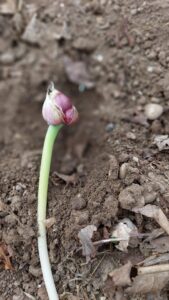
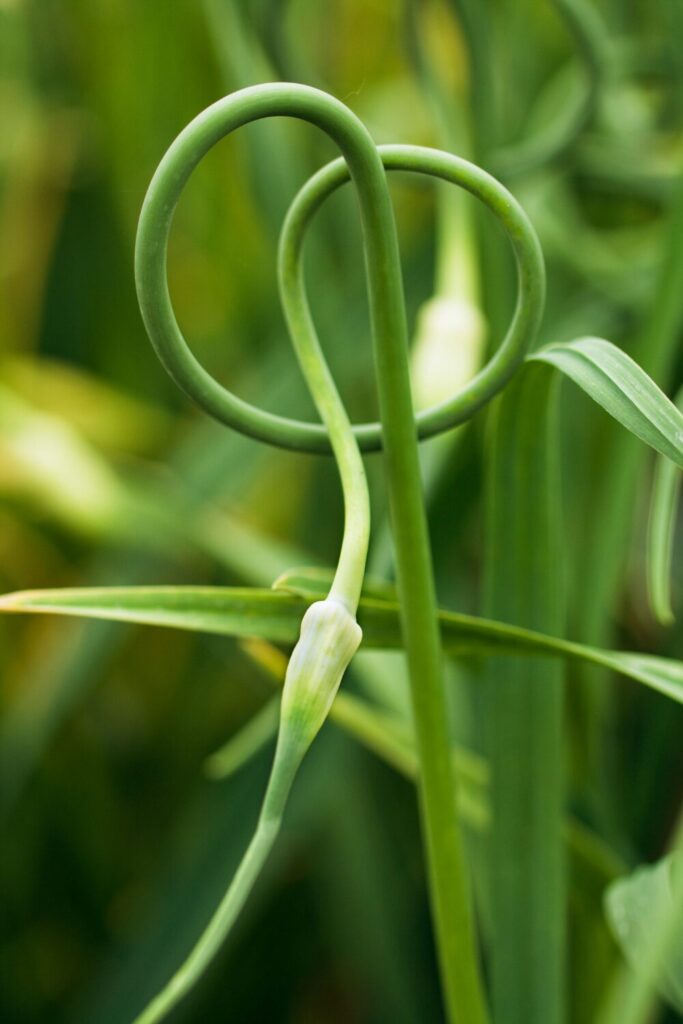
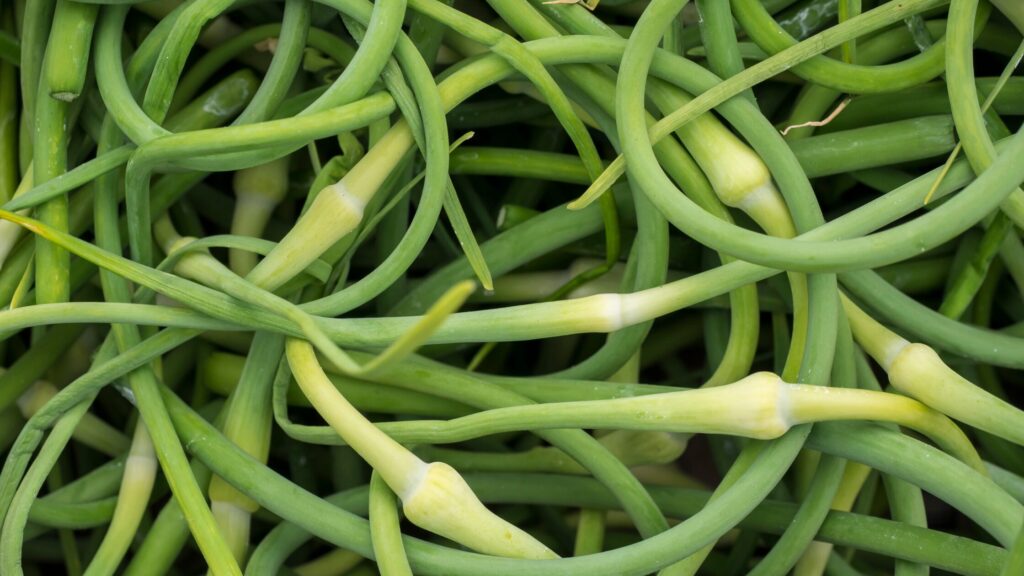
These beauties are the scapes. If you let them on the plant, they’ll burst into bloom, which is quite a pretty sight, and later on develop bulbils. If you want to get large garlic bulbs, however, you must cut off the scapes.
If you cultivate hardneck garlic, remove the scapes (i.e. flower stalks) before they bloom. Otherwise, the plants will use all their energy to form bulbils, instead of large bulbs.
The scapes are ready to harvest when they’ve made 1-2 complete curls and are still tender and flexible. You should be able to snap them off easily with your fingers. If you wait too long, they’ll straighten out, become woody and fibrous, and will be tough to eat.
The best test is to gently bend the scape – if it bends easily, it’s perfect. If it feels stiff or starts to crack rather than bend smoothly, you’ve waited a bit too long (though they’re still edible, just tougher).
The cool thing is that scapes are quite delicious! They have a mild garlic flavour, and you can use them like spring onions. Chop them into stir-fries, pasta or pesto, for example, or grill them whole as a side dish. Once cut off, they can be stored in the fridge for 2 – 3 weeks.
Common problems and solutions
We always hope that our crops go through the seasons without any problems and reward us with a large harvest. But although garlic is a very undemanding crop, some issues may occur. Let’s have a look and see how we can deal with them:
Yellow Leaves
If your garlic’s bottom leaves turn yellow in June/July, that’s perfectly normal: the bulbs are maturing.
If the problem occurs in spring, however, we’ve got a problem! Usually, the cause is overwatering or a nutrient deficiency.
What to do: Check if the soil is waterlogged. If it’s dry, feed the garlic with dissolved nettle manure or another liquid, fast-available fertiliser.
White Rot
White rot is a serious disease! The first sign is an early yellowing of the leaves and the formation of a white, fluffy mould on the bulb base. Eventually, the bulb becomes soft and decays, developing a strong odour.
What to do: Remove the affected plants immediately and throw them in the bin. Do NOT compost them!
White rot cannot be cured or treated, and it remains in the soil for 15 – 20 years. That means, if you get white rot in your garden, you can’t plant any alliums (garlic, onions, leeks) on that patch for at least 15 years.
To prevent white rot, you should only use certified seed garlic and practice crop rotation. Also, make sure your soil has good drainage.
Rust
When your garlic leaves show orange-brown spots or streaks, they have caught rust. It usually appears in damp conditions and is more common in softneck varieties.
What to do: Improve the air circulation by removing weeds and – in the first place – planting your cloves with enough space in between.
Rust usually doesn’t kill the plant, but you should remove all badly affected leaves. Do NOT compost them.
You’ll still get a usable harvest, but it may be slightly reduced.
No Bulbs Formed
The main cause for no bulbs forming is the wrong timing in planting. If you’ve planted too late and the garlic didn’t have a cold period, it didn’t get the trigger to form bulbs.
Another, less common cause is that you fertilised with too much nitrogen late in the growing season. Nitrogen enhances leaf growth but not fruit (or in this case: bulb) formation.
What to do: Stick to autumn planting for reliable results and stop fertilising once bulbs form.
Harvesting and storing garlic
When to harvest garlic
As a rule of thumb, garlic takes 8 – 10 months if it’s an autumn variety and 4 -5 months for spring varieties to become ready for harvesting.
In my zone, I can harvest garlic in June and July if it was planted in autumn and in July and August if it was planted in spring.
The exact timing, of course, depends on the variety and the weather.
How to know when garlic is ready to be harvested?
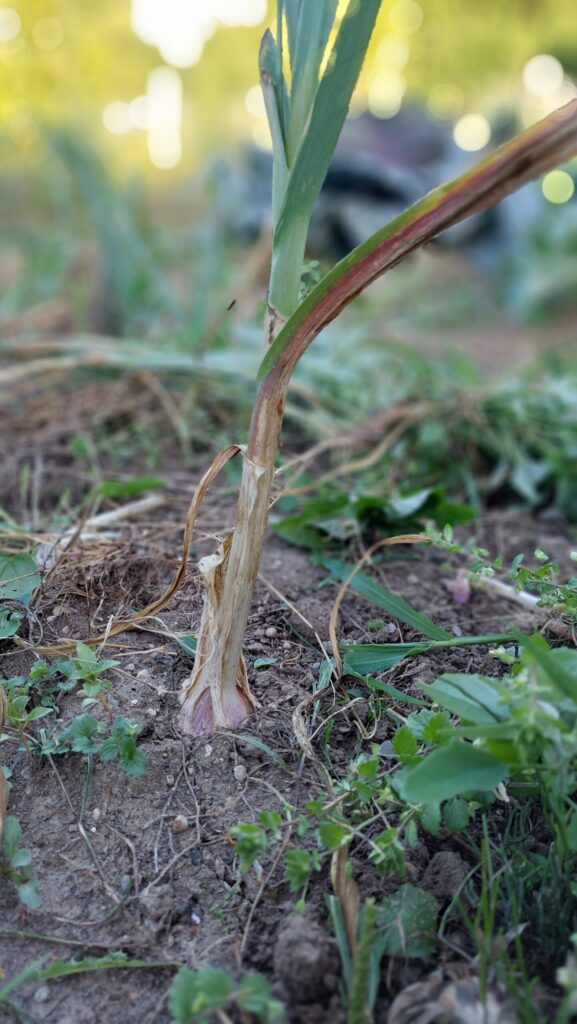
You know that the garlic is ready for harvesting when the bottom third to half of the leaves have turned yellow or brown, while the upper leaves are still green and start to flop over. Don’t wait until the leaves die back or collapse completely.
Also, the bulb wrapper must still be intact, and the bulbs should be closed.
If you wait too long, the bulbs may open up, which reduces their storage time.
If you’re unsure about whether your garlic is ready to harvest, carefully dig up one bulb to check its size and development. If the bulb is clearly defined and shows a tight skin, it’s ready.
Harvesting garlic
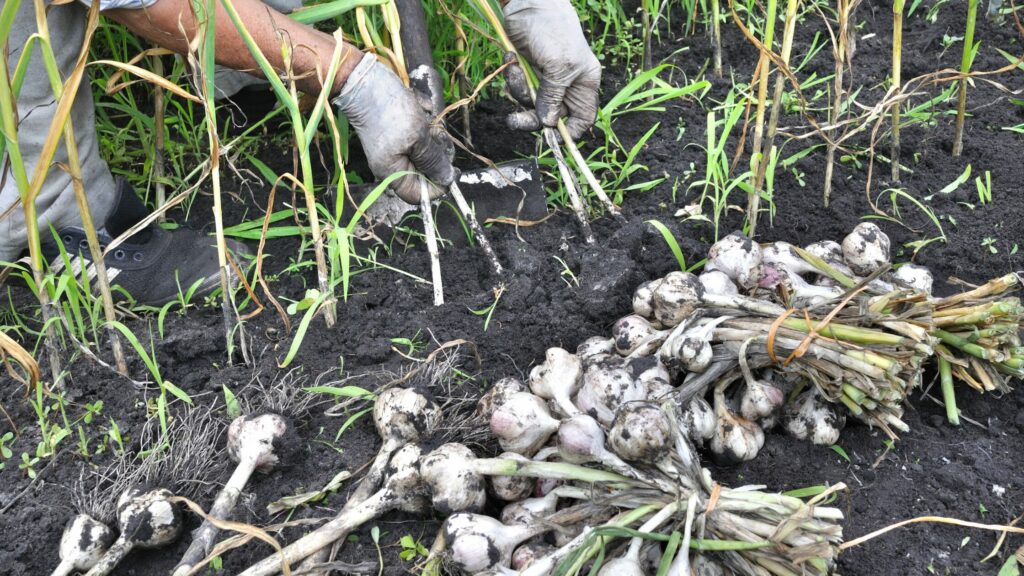
Choose a dry day for harvesting. Dry soil makes lifting the bulbs out easier and cleaner, and they can be stored for a longer time.
Loosen the soil around the garlic with a garden fork and pull out the bulbs. Clean up the garlic right on the bed by gently brushing off the soil. Now it’s ready to cure.
Curing Garlic After Harvest
Curing is an essential step after harvesting garlic. It dries the outer skins and seals the cloves, and by that dramatically extends the garlic’s storage life. If you skip this step, your garlic will rot within a few weeks!
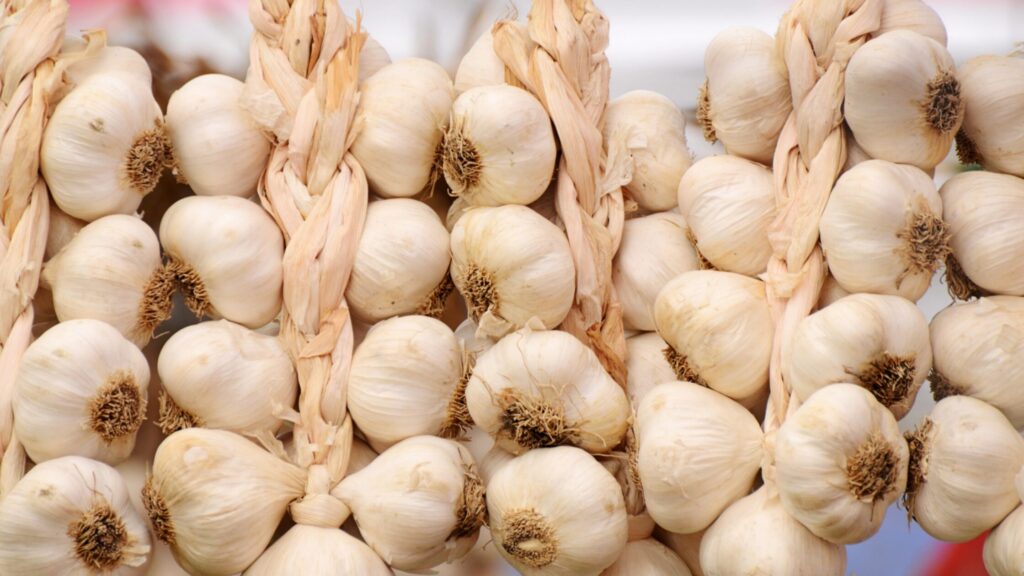
For curing, place the garlic into bundles and hang them in a dry, well-ventilated area for about two weeks. If you have a canopy at your house, a garage or even a balcony that’s protected from rain, that’s an ideal place. Just make sure that the garlic is out of direct sunlight, as that would cause bleaching and a degradation of the flavour.
If you, like me, don’t have a place to hang your garlic up to cure, however, you can always cure it lying flat on a rack or a slatted shelf. Keep the stems attached (they’ll dry down into the bulb) and don’t pile the bulbs on top of each other. Every few days, you should turn the bulbs to ensure that they’ll dry evenly. If you’ve got no place outdoors, cure your garlic indoors in a dry place (no moist basements!).
Depending on your curing location (and the weather, if it is outdoors), curing takes between 2 and 4 weeks. The garlic is ready for storage when the bulbs’ outer skins have become papery and dry, the stems are completely dry and brittle, and the roots have shrivelled.
Once your garlic is fully cured, brush off any remaining soil, but don’t wash the garlic! Then, either braid the stems if you have softnecks or bind the hardnecks together. Now it’s ready for storage.
How to store garlic
There are a few things we need to observe when storing garlic.
Optimal Storage Conditions
The perfect environment for storing garlic is a cool place with temperatures between 10 and 15 °C (50 – 60 °F). It should be dark or at least dim, because light causes sprouting. The place should have low humidity (about 50 – 60 %) and good air circulation.
These conditions are commonly found in a pantry, utility room, or spare room. I store my garlic in the basement, which is cool and dim, but thankfully not damp.
There, my garlic can be stored till the next harvest.
Storage methods
There are some ways to store garlic in such a way that it will last until the next harvest:
Mesh bags or nets
Putting garlic bulbs into mesh bags or nets is an easy method to store garlic, especially hardneck varieties, for the long term. The bags or nets provide excellent air circulation and make it easy to check on the bulbs. You can easily hang them from the ceiling or a shelf, and thus they won’t take up too much room.m
Braiding (softneck only)
Braid the stalks of softneck garlic while they’re still slightly flexible and hang them from the ceiling or a shelf in a cool and dry place. As with mesh bags, braids provide good air circulation and don’t take up much room.
Wooden crates or boxes
Put an old newspaper on the bottom of a crate or box and put garlic bulbs on it. The bulbs should not touch. Cover the bulbs with a second newspaper and continue layering the bulbs in the crate. Don’t stack them too deep, though. 3 – 4 layers is the maximum.
This is a good method of storage for large harvests, but you must check the bottom layers occasionally and discard any rotten bulbs as soon as possible.
Paper bags
This is a good method for small quantities: poke some ventilation holes in a paper bag and put the bulbs in. You can hang the bag from the ceiling or a shelf if it’s not too heavy, or just store it on the shelf.
No matter how you store your garlic, check it every few weeks and remove any bulbs that become soft or mouldy.
Preserving garlic
If the conditions for storing garlic are not optimal where you live, for example, if it’s too warm throughout your flat, preserving is a great way to store your garlic.
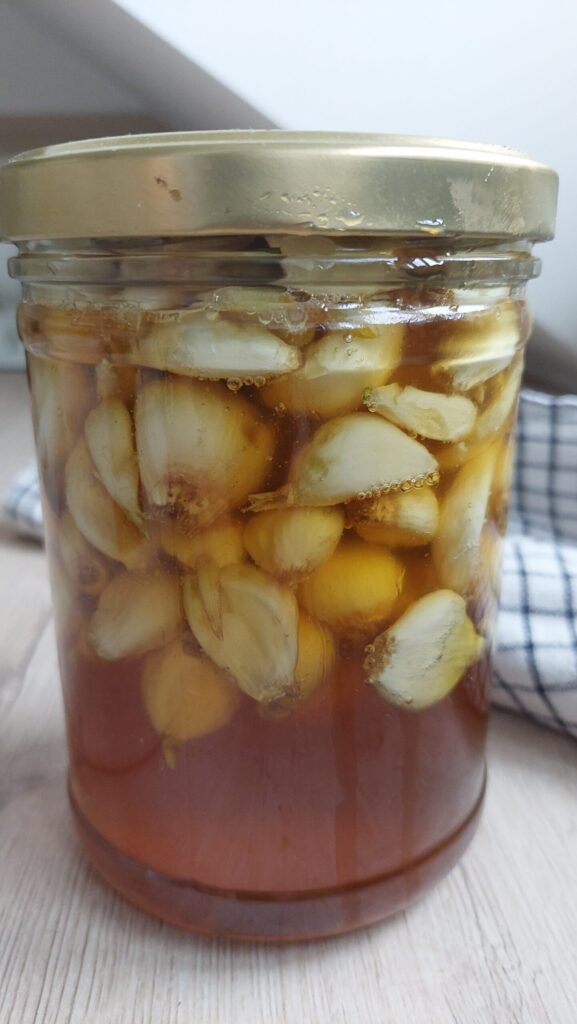
One of my favourite preservation methods for garlic is fermenting it in honey. In this recipe for fermented garlic in honey, I’ll show you how it’s done. It’s very easy and only requires two ingredients: garlic and honey.
How NOT to store garlic
There are some mistakes in storing garlic that you need to avoid.
In sealed plastic bags: they don’t allow for air circulation, trap moisture and the garlic will rot.
In the fridge, if you want to prevent premature sprouting.
In damp or poorly ventilated rooms
In direct light
Frequently Asked Questions
Can I grow garlic from supermarket cloves?
Technically, it’s possible, but I don’t recommend it for several reasons:
First of all, supermarket garlic is mostly imported and mostly from climates that are very different from yours.
And although it may look good and is safe to eat, the cloves may carry diseases that you’d spread in your garden when planting them.
Lastly, supermarket garlic is almost always treated with sprouting inhibitors to prevent the bulbs from sprouting in the market.
If you want to experiment, though, choose organic supermarket garlic, which is less likely to be treated. You must understand, however, that the results will be unpredictable.
My recommendation: Instead of using supermarket garlic, spend a few Euros, Dollars or Pounds (or whatever your currency is) on certified seed garlic for much better results.
Can I plant garlic cloves that have sprouted in storage?
Yes!
Sprouted garlic cloves from your pantry or storage can still be planted, and they’ll often grow just fine. The green sprout shows the clove is viable and ready to grow, and it’s actually a great way to use up garlic that’s past its prime for cooking!
However, sprouted cloves may have used some of their stored energy, so they might produce slightly smaller bulbs than unsprouted ones. Plant them as you would any other clove, with the sprout pointing upward. Just make sure the clove itself is still firm – if it’s soft, mushy, or mouldy, discard it.
Is it too late to plant garlic now?
That depends on the current month:
October-early November: Perfect timing! This is prime garlic planting season.
Late November-December: Still possible in mild winter areas if the soil isn’t frozen. Get the garlic in the ground ASAP.
January: It’s risky. I’d only attempt planting garlic now in very mild areas. The bulbs will be small, though.
February-March: When you’ve missed autumn planting, switch to spring planting. Plant your garlic cloves as early as the soil is workable.
April-September: Now it’s too late for spring planting. Use this time to prepare your bed and buy quality seed garlic for October planting.
How much garlic will I harvest from one clove?
One planted clove will result in one full bulb. Each bulb contains between 5 and 12 cloves, depending on the variety. So, one clove becomes 5 – 12 cloves at harvest.
Hardnecks typically produce larger but fewer cloves, usually around 6 – 8 large cloves.
Softneck varieties have smaller but more cloves, usually around 10 – 12 small cloves per bulb.
My garlic sprouted over winter – is that okay?
Yes, that’s completely normal for autumn-planted garlic!
2 – 4 weeks after planting in autumn, the cloves sprout, and the green shoots reach a height of 5 – 10 cm (2 – 4 inches) before winter. In winter, growth stops or slows down considerably, only to restart vigorously again in spring.
So, if your garlic sprouted over winter, this is exactly what should happen!
Can I leave garlic in the ground too long?
Yes and no. If you miss the right harvesting timing, the bulbs will split open, and the cloves will forfeit storability.
If you’ve completely overlooked a bulb in the soil, the cloves will sprout anew later and try growing new bulbs. Due to the minimum spacing, they won’t grow large, though.
Should I soak garlic before planting?
No. Soaking would enhance the risk of mould or rot.
Can I plant garlic in raised beds?
Yes, the steps are the same as with growing garlic directly in the soil. You may only have to water it more frequently.
Can I grow garlic from a single clove?
Yes, one clove of garlic will produce one bulb.
Why is my garlic flowering?
You’ve let the scape on the plant for too long, and it burst into bloom. You can still harvest the bulb, but it will stay smaller.
Garlic-growing mistakes to avoid
Planting unsuitable or unhealthy cloves
Planting too late for sufficient winter cold
Setting cloves upside down
Growing garlic in waterlogged soil
Applying too much nitrogen late in spring
Leaving mature bulbs in the ground too long
Make Seasonal Garden Planning Easier
Get my free monthly garden checklist, along with practical growing advice and new seasonal guides delivered to your inbox.
Why you should grow garlic
Garlic is one of those rare vegetables that asks for very little and gives back a great deal. Plant a handful of cloves in autumn, give them sunshine, well-drained soil and a little patience, and by next summer you’ll be harvesting beautifully aromatic bulbs you’ll be proud to use in your kitchen. Once you’ve grown your own garlic, it’s surprisingly difficult to go back to supermarket bulbs.
If you’re planning your vegetable garden, explore the rest of the Gardening Hub for more practical growing guides and seasonal advice.
If you grow your own vegetables, you can certainly relate: we carry the first zucchini of the season into the house like a trophy and celebrate cooking it with obsessive care. Zucchini No. 5 is watched with growing unease, and by the tenth, the family becomes mutinous, and we are torn between the urge to just let them grow out of control and the regret of letting them go to waste.
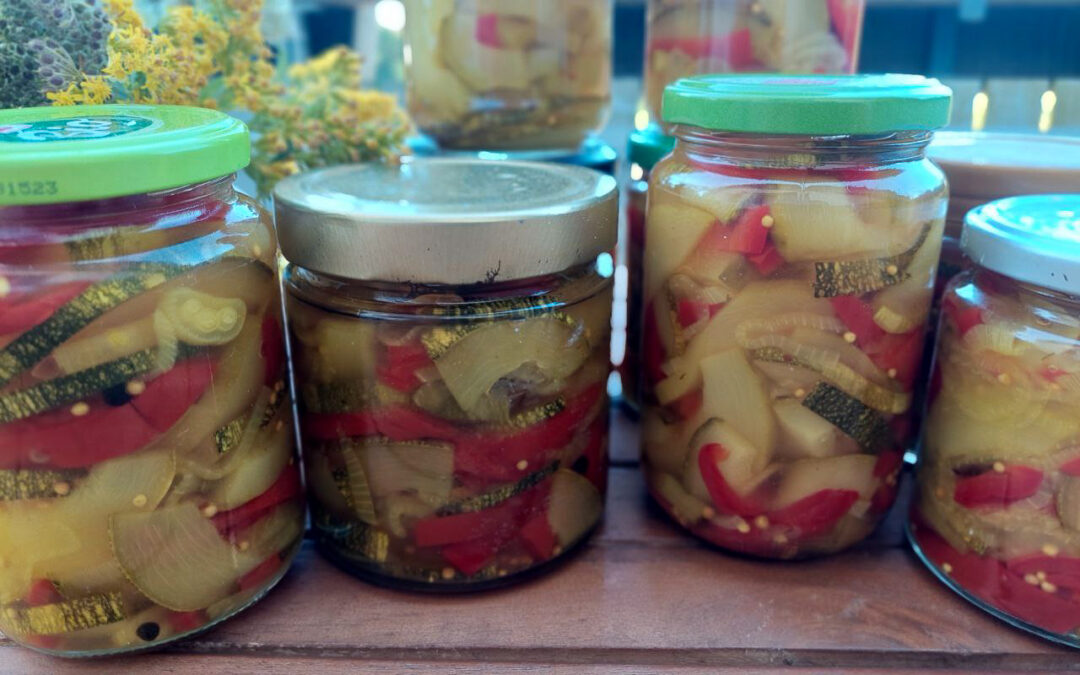
But here’s the solution, for I have the best recipe for pickled zucchini that will solve your zucchini overflow problem! With this recipe, you not only preserve an abundance of the green, yellow or striped varieties before they become baseball bats, but you’ll also create a flavour-packed treasure for the cold winter months.
Pickled zucchini
Yield: 6 jars of 1/4 l
Ingredients
2 kg zucchini of any size 1 kg bell peppers of any colour 0.5 kg onions, cut into rings 3/4 l apple cider vinegar (store-bought or homemade) 1 l of water 0.5 l apple juice 200 g sugar 4 tbsp salt 2 tbsp curry powder 1 tbsp dill 1 tbsp mustard seeds 1 tbsp peppercorns juice of one lemon
Instructions
One of the many great advantages of this recipe is that you can use zucchini of any size.
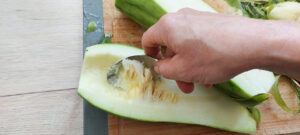
If they have really grown into baseball bats, you can peel them, cut them lengthwise into quarters and remove the mushy, seed-containing core with a spoon.
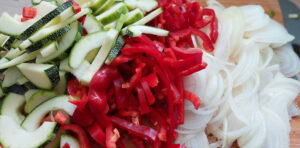
Cut the zucchini, bell peppers and onions into slices of 2 – 3 mm (1/10 inch). This recipe requires no salting before pickling.
Mix the vegetables in a bowl so that they are evenly distributed.
Put the vinegar, water and apple juice in a pot and bring it to a rolling boil.
Add the vegetables and spices, and let it boil for one minute. If your pot is too small to handle all the vegetables at once, you can boil them in portions and layer each batch in the jars after cooking.
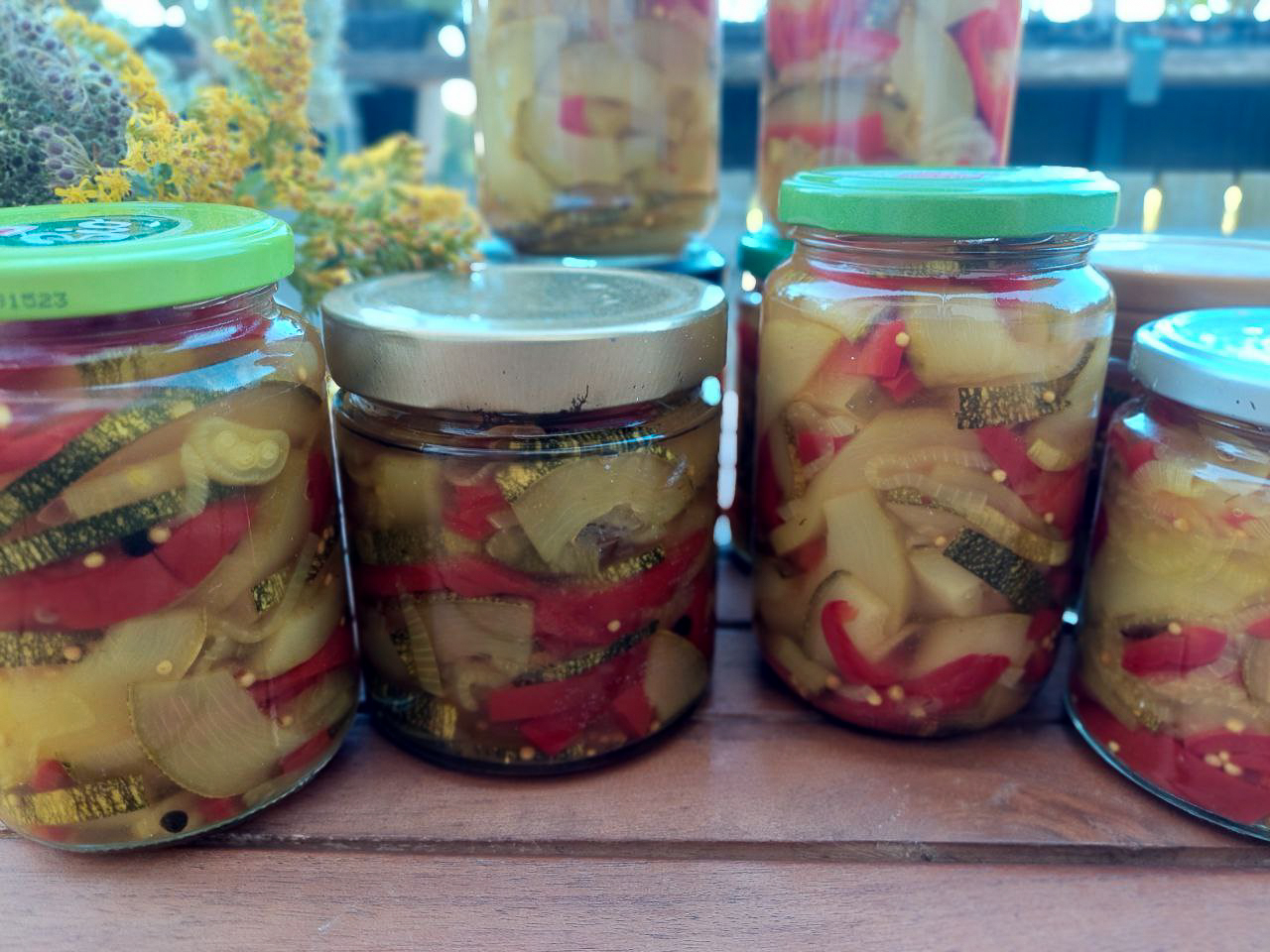
Fill everything in jars, fill up with brine, leaving a headspace of about an inch. Then close the lids tightly.
Once they’ve cooled down, you can eat the pickled zucchini right away. However, I like them best when they have had a resting time of 2 – 3 days.
After cooling down, you can store the pickled zucchini in a cool place (a cool basement works fine; alternatively, put them in the fridge) for up to one year.
Once a jar is open, you must store it in the fridge and consume it within 7 days.
How to use pickled zucchini
Pickled zucchini make a great side dish for a charcuterie or cheese assortment or as an ingredient in sandwiches and wraps. We also like it chopped up and mixed in potato mash to add a complex, salty and vinegary flavour. Or you mix it into an egg salad together with (pickled, fermented or raw) onions and mayonnaise.
Angela Braun
Pickled zucchini
A quick and easy recipe to deal with the surplus of zucchini from your garden!
One of the many great advantages of this recipe is that you can use zucchini of any size. If they have really grown into baseball bats, you can peel them, cut them lengthwise into quarters and remove the mushy, seed-containing core with a spoon.
Cut the zucchini, bell peppers and onions into slices of 2 - 3 mm (1/10 inch). This recipe requires no salting before pickling.
Put the vinegar, water and apple juice in a pot and bring it to a rolling boil.
Add the vegetables and spices and let it boil for one minute. If your pot is too small to handle all the vegetables at once, you can boil them in portions and layer each batch in the jars after cooking.
Fill everything in jars, fill up with brine, leaving a headspace of about an inch. Then close the lids tightly.
Once they've cooled down, you can eat the pickled zucchini right away. However, I like them best when they have had a resting time of 2 - 3 days.
After cooling down, you can store the pickled zucchini in a cool place (a cool basement works fine; alternatively, put them in the fridge) for up to one year.
Once a jar is open, you must store it in the fridge and consume it within 7 days.
Notes
Pickled zucchini make a great side dish for a charcuterie or cheese assortment or as an ingredient in sandwiches and wraps. We also like it chopped up and mixed in potato mash to add a complex salty and vinegary flavour. Or you mix it into an egg salad together with (pickled, fermented or raw) onions and mayonnaise.
Your zucchini problem? Solved!
This recipe transforms your “zucchini problem” from overwhelming to solved. It’s incredibly simple: no salting, and any zucchini size works.
Imagine those jars of pickled zucchini lined up in your pantry, waiting to be opened on a cold winter day when garden-fresh zucchini are only a dim memory. There’s hardly anything more rewarding!
So, harvest your zucchini now while they’re still abundant (and before they become baseball bats) and make these delicious pickles. Your future self will thank you.
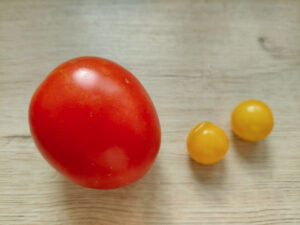
Tomatoes are one of the most popular vegetables in the whole wide world, not only among gourmets but also among us gardeners. And there are so many varieties out there: from teeny-tiny, pinhead-sized beads to enormous, almost melon-like specimens, in colours ranging from the classic red to orange, yellow, white, green and even black. There’s a tomato for everyone’s heart. There are so many varieties, I’d either need a much larger garden or at least three lives to try them all. When I’ve found a variety I love, however, I want to grow it every year. But why invest in seeds for tomatoes you’ve already successfully cultivated, when you can save them from your own fruits? It’s easier than you think, and it’s so satisfying to be part of the cycle of seed, becoming fruit, becoming seed again. I’ll show you which tomatoes you can harvest seeds from, what to look out for and how to make sure that they germinate well next season.
Why save tomato seeds?
Apart from the magic and fun, there are many more reasons to save your tomato seeds:
Cost
One seed package with 6 – 8 tomato seeds costs around 3 €. Now, I don’t know about you, but I’m not known for cultivating only one variety. More like 10 – 15. That would be 30 – 45 € just for tomato seeds every single year! Ehm…. no. Especially not, when I can get hundreds of seeds for free.
Adaptation
Plants adapt to their growing conditions. So, no matter what your garden’s conditions are, your tomatoes will, within one life cycle (!), adapt to them. Seeds from the plants in our garden, therefore, are better adjusted to your microclimate than any store-bought seeds ever will be.
Moreover, plants become increasingly resilient over generations. When you save seeds from your healthy tomato plants, you contribute to their future health.
Variety Preservation
Many heirloom tomatoes are bordering on extinction, and there are also quite a few rare or hard-to-find varieties. By saving their seeds, you take an active part in preserving those precious tomatoes and making sure that generations to come will still be able to cultivate and taste them.
Understanding Tomato Varieties for Seed Saving
Now, do we just go out and save tomato seeds? Not quite! First, you must understand that not all tomato varieties can be propagated by saving their seeds.
Open-pollinated tomatoes
Tomato blossoms have male and female parts. The male parts (anthers) contain the pollen, while the female parts (pistils) receive it and produce fruits and with them seeds. That way, tomatoes can be self-pollinating, seeing that male and female parts are so closely together, but they often get help in pollination from insects.
“Open-pollinated” means that those tomatoes are pollinated naturally, either by self-pollination or with the help of insects.
The cool thing about that is that open-pollinated tomatoes always produce the same kind of tomato (e.g. an ‘Indigo Rose’ plant produces only ‘Indigo Rose’ tomatoes) and all seeds harvested from an open-pollinated tomato will produce exactly the same variety next season. They breed “true to type”.
Which is great for us seed-collectors as we only have to, well, collect their seeds to make sure we can cultivate the same variety next year.
Heirloom tomatoes
We speak of heirloom tomatoes when the variety has been cultivated for at least 50 years or was commercially introduced before 1940.
All heirloom tomatoes are open-pollinated, but not all open-pollinated tomatoes are heirlooms.
Hybrid tomatoes
Hybrid tomatoes are a cross between different varieties. They have been created to enhance characteristics we want, like flavour, size, pest and disease resistance, colour and longevity. Unlike open-pollinated tomatoes, hybrids don’t produce seeds true to type; instead, they revert to their parents’ genes, either recreating one of them or creating a tomato with different characteristics. Hybrid tomatoes, therefore, are not suitable for seed-saving.
When you look at your seed package and F1 is printed behind the name, it’s a hybrid.
Open-pollinated vs cross-pollinated
Cross-pollination means that pollen from one variety has pollinated the blossom of another variety. It doesn’t alter the fruits, but the seeds are no longer true to type. In fact, cross-pollination creates hybrids and, as we’ve learned, hybrids are not suitable for seed-harvesting.
To avoid cross-pollination in our gardens, we should plant different varieties at a distance of about 3 m (10 feet) from each other. Another good method for guaranteeing that our varieties stay true type is to cover them with a finely-meshed cloth once they show buds. When the buds have opened, carefully shake the plant so that the pollen can reach its destination.
A good method to help pollination is to use an old electric toothbrush that you brush across the blossoms. The vibration of the toothbrush loosens the pollen from one blossom and lets it fall readily onto the next one, thus fertilising it.
When tomatoes form, you can remove the cloth.
The crucial step: Fermentation
Saving tomato seeds is easy, but it comes with a little catch: to make sure that the seeds germinate well next year and do not carry any diseases, we must ferment them.
Tomato seeds are enclosed in gel casings. These casings contain growth inhibitors that keep the seeds from starting to sprout inside the tomato. Fermentation breaks up the gel casings and removes the growth inhibitor. If we used the seeds without fermenting them, the gel casings and with them the growth inhibitors would still be intact and prevent most of the seeds from growing.
In our garden, when tomatoes fall to the ground, they decay and by that break up the gel casings. Fermentation copies that process.
By fermenting the seeds, we also make sure to kill any seed-borne pathogens and only cultivate inherently healthy plants.
How to save tomato seeds
Step 1: Choose the right fruits
Choose tomatoes that are ripe and healthy and show all the signs you like in a variety, that is, the appropriate (or even larger) size and flavour.
You can use overripe tomatoes, but make sure they aren’t damaged.
Always use tomatoes from more than one plant to maintain the genetic diversity. Also, if one tomato plant turns out to have a disease, e.g. the blight, you’ll still have healthy seeds from another plant.
It’s best to use tomatoes from mid to late season as they have adapted better to your specific garden conditions and climate.
Step 2: Get the seeds
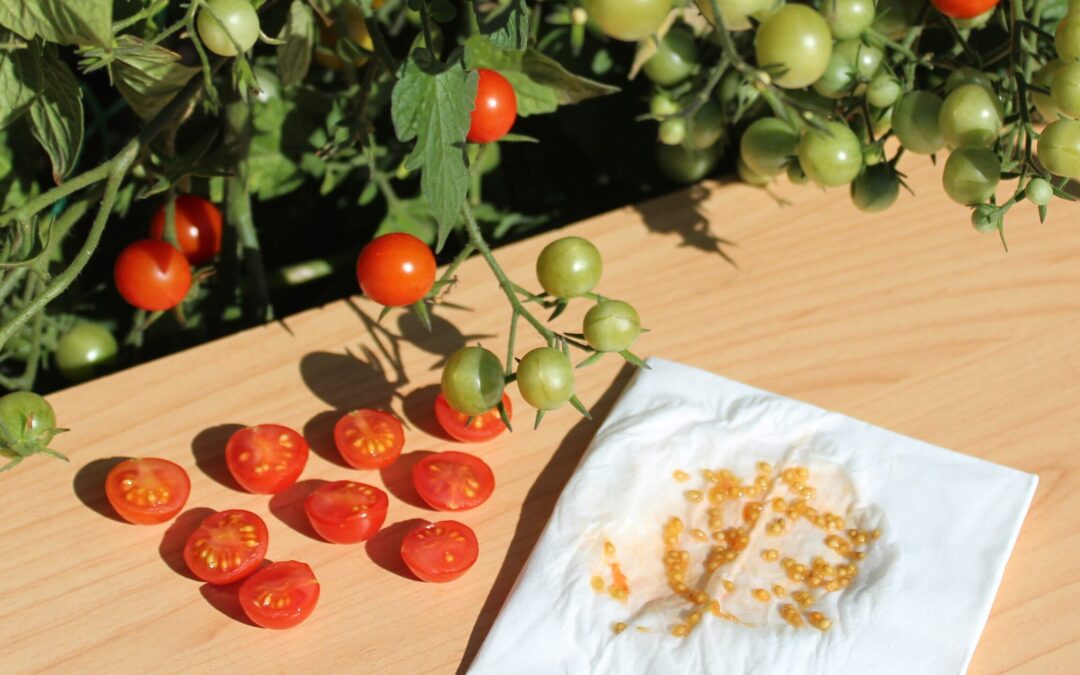
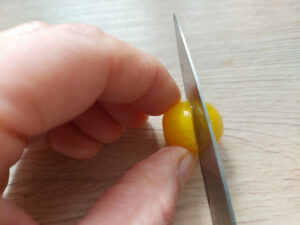
Wash them and cut them open around the middle.
With a finger or a spoon, scrape out the seeds and the jelly they’re in into a jar. Use the now seedless tomatoes for a salad or pasta sauce, or whatever you like to do with them.
Step 3: Water
Add water to the jar so that the seeds and the pulp can be stirred. I usually add about two fingers of water. Cover the mixture with a cloth; it needs air circulation.
Step 4: Labelling
Never trust your memory, but label the jar with the tomato variety you’ve got in there. You’ll thank yourself later.
Step 5: Fermentation
Put the jar in a warm place. I usually put it on the windowsill, but you should make sure that the temperature doesn’t change too much. Avoid any drafts. Temperatures between 20 and 25 °C (70 – 80 °F) are ideal for fermentation. If it’s colder, fermentation will still work, but it’ll take longer.
Stir your seeds every day. Usually after 3 – 5 days (depending on the temperature), they’ll sink to the ground. A little time later, an opaque film will form on the surface and – I’m sorry to say – the mixture will start to stink abominably. Take that into consideration when looking for a fermentation place. The kitchen may not be the best option.
The good news is: all these signs show that fermentation has started!
Step 6: Rinse
The good news is that once fermentation has started, you can remove the seeds from the jars. Pour them into a sieve and rinse them thoroughly. Take this process seriously. Rinsing not only removes the pulp and the now dissolved gel casings around the seeds, but it also stops the fermentation process.
Put the seeds back in the jar and fill it with water. Any seeds that float on the surface after this final rinse are bad and can be discarded.
Step 7: Dry the seeds
Rinse the rest again and put them on a tissue paper to dry. I either use the scrap of a kitchen towel or half a paper tissue, but you can also use waxed paper, parchment paper, coffee filters or a mesh screen over a plate. Remember to label whatever your seeds dry on. Stir the seeds so that they don’t clump.
Put the seeds in a warm place, away from direct sunlight. A good place in my house is the top of the fridge. Make sure temperatures are not too high, or else the seeds will sprout.
After one to two weeks, depending on your drying medium, the seeds will have dried.
Step 8: Storage
To check if your seeds are completely dry, try to break them. A dry seed breaks in half with a snap, while a still moist seed will bend or rip. Once the seeds are completely dry, you can store them in paper envelopes, brown glass jars or plastic bags. Make sure the seeds are really 100 % dry, especially when stored in plastic or glass containers. Otherwise, the moisture will make them mould and rot.
Remember to label the seed packages with the variety and harvest date.
Store the seeds in a cool, dry place. They are usually good for 4 – 6 years.
Final thoughts
As you can see, saving tomato seeds is easier than it sounds, and it’s so rewarding. One year from now, you’ll be making a tomato salad from fruits that only exist because of your seed-saving efforts. And imagine the satisfaction of telling your friends and family that the tomato salad they’re eating right now is not only from your garden but also grown from seeds you saved yourself! Admiring looks included.
Start now, choose some tomatoes you like, even if it’s only one variety, and save their seeds. You’ll be proud of yourself!
Wanna learn more about tomatoes? This article is for you then:
Every autumn, there comes a time when my kitchen fills with the sharp, tangy scent of fermenting cabbage. Even though it may still be warm and sunny outside, for me, the season for winter comfort food has officially begun. Call it genetic programming if you like. I don’t consider myself to be a typical German. I usually wear jeans and a shirt (I don’t even own a Dirndl), I’ve never been to the Oktoberfest, and I’ve got a fair sense of humour, if I may say so myself. When it comes to Sauerkraut, however, my German DNA takes over completely.
Whether I’m piling it alongside creamy mashed potatoes for the ultimate comfort meal, tucking it into a flaky strudel, or serving it as an elegant wine-braised side dish (yes, with sausages – some clichés exist for good reasons!), there’s simply no surviving a German winter without proper sauerkraut. And after years of mediocre store-bought versions, I discovered something wonderful: making your own is ridiculously simple.
You only need cabbage, salt, and a little patience to create sauerkraut that’s tangier, crunchier, and infinitely more satisfying than anything from a jar. Plus, there’s nothing more gratifying than watching this ancient preservation method work its magic right on your countertop. Ready to channel your inner German Oma and work some cabbage magic? Here’s everything you need to know.
What You Need For Homemade Sauerkraut
Once you see how simple it is to make sauerkraut and how little you need for it, you’re gonna ask yourself why you haven’t done that long before.
Equipment
I promise you’ll already have every equipment item in your kitchen!
Essential equipment for beginners
You need a wooden board and a sharp knife to slice the cabbage.
Once you’ve done so, you need a large bowl to put the cabbage slices in and mix them with salt.
For the fermentation process, take some jars with lids. Twist-off caps are fine, but even better are jars with rubber rings and a glass lid.
To keep all the kraut slices under the brine, you need weights. If you’re just starting, you can fill freezer bags with water (about a quarter full, depending on the bag size), close them and use them as weights.
Optional but helpful tools
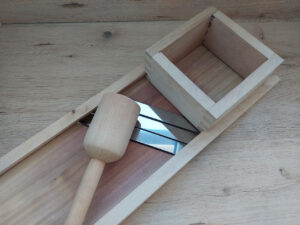
If you intend to make large batches of sauerkraut, you may want to think about buying a kraut slicer, which is a real game-changer when it comes to slicing cabbage heads.
Another great gadget for making sauerkraut is a kraut tamper, kind of a wooden club on a long stick. Optionally, you can use a (clean) bottle. You’ll find kraut slicers and tampers in every well-assorted German hardware store (which I highly recommend visiting when you are in Germany!) or on the internet.
For the fermentation process, you can use the aforementioned jars or a large sauerkraut pot.
Sauerkraut pots usually come with two halves of a clay weight; for jars, there are good glass weights you can buy.
Ingredients
For the classic version of homemade sauerkraut, you only need cabbage and salt. Make sure the salt doesn’t contain any additives like anti-caking agents, iodine or others. I like to use sea or rock salt.
Instructions For Homemade Sauerkraut
First of all, sterilise the sauerkraut pot or the jars and lids. You can read up here on how to do that properly.
Preparing the cabbage
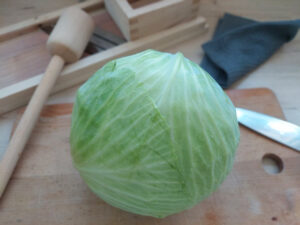
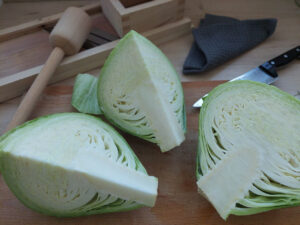
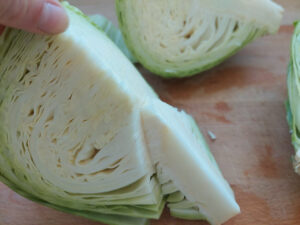
Cut the cabbage head lengthwise in half and quarter it. Remove the outer leaves and put them to the side; we’ll need them later.
Now you can generously cut off the stalk part, which is too hard (and bland) to make sauerkraut from.
Weigh the cabbage.
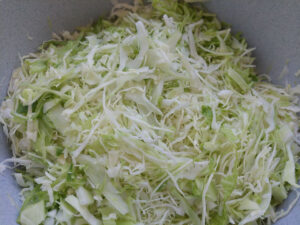
Finely slice the cabbage quarters, either with a knife, in the food processor or with your kraut slicer.
Put the cabbage slices in a large bowl.
Kneading and Packing
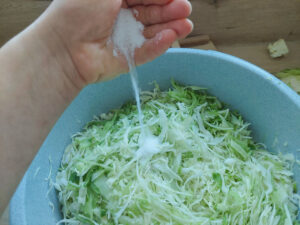
Now, add salt to the cabbage, about 1 tablespoon of salt per 1.5 kilograms of cabbage.
Roughly mix the salt into the slices and taste them. It should be salty but not oversalted.
Now, start kneading the cabbage slices thoroughly to break open the cell structure of the cabbage slices and knead the salt in. This takes some time; the larger the amount of cabbage, the longer. The slices will lose volume during this process, they’ll lose their usually opaque appearance and become glassy, and brine will form. If you can’t for the life of you squeeze out enough liquid from the cabbage – after a fair amount of wrestling with it, of course – cover the bowl, let it rest for 45 minutes and knead it again.
Put a handful of the cabbage into the kraut pot or a jar and press it thoroughly down with your fists, a clean bottle or the kraut tamper.
It’s important to apply sufficient pressure to get all the air bubbles out. Fermentation only works without oxygen, so if there’s air in the jars, the kraut will spoil. While pressing, you can see the brine welling up.
Alternately, add cabbage and press it in with the bottle or tamper until the pot or jar is full. Leave room to the edge of about 2 cm (1 inch). I know that some people recommend leaving more room in the jars, but I found that the risk of spoilage due to too much residual oxygen in the glass, even after fermentation, is higher.
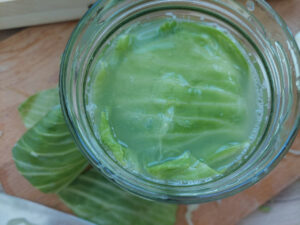
Now, take one of the outer cabbage leaves you put aside earlier, rinse it and cut it so that it can cover the cabbage in the jar.
Put a weight on top and thus fix the cabbage slices under the brine.
The Fermentation Process
Close the pot or jars with their lids and put them on a baking tray.
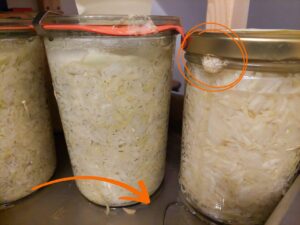
Put the jars in a place without direct sunlight and at temperatures between 15 and 22°C (60 – 70 °F). After a few days, the brine begins to bubble and foam, and it usually presses out of the jars. Now’s the time when you’re glad you put the jars on a baking tray.
Let the cabbage ferment for about 5 – 7 days (the colder the place, the longer the fermentation process takes, which can be up to 14 days). Check the jars daily and fill up with brine if necessary. For that purpose, mix 1/2 l of water with 15 g of salt and stir it until the salt has dissolved.
Storage
You can either taste the sauerkraut and – when it’s to your liking – store it in a cooler place of about 8 – 12 °C (45 – 55 °F) or you wait until the initial process of bubbling over is finished and put it in a cooler place then.
Closed jars can be stored at a cool and dark (but not necessarily pitch black) place for up to one year.
Once you’ve opened a jar, keep it in the fridge and consume the sauerkraut within 1 – 2 weeks.
Angela Braun
Traditional Sauerkraut
A simple, down-to-earth recipe for traditional sauerkraut.
1tbspsea saltwithout additives or anticaking agents
Equipment
Cutting board
Sharp knife or a food processor or kraut slicer
large bowl
Kraut tamper or a clean bottle or just your fist
Jars with lids or
Sauerkraut pot
Weights
Method
Sterilize the sauerkraut pot or the jars and lids. You can read up here, how to do that properly.
Cut the cabbage head lengthwise in half and quarter it. Remove the outer leaves and put them to the side; we'll need them later.
Now you can generously cut off the stalk part, which is too hard (and bland) to make sauerkraut from. Weigh the cabbage.
Finely slice the cabbage quarters, either with a knife, in the food processor or with your kraut slicer.
Put the cabbage slices in a large bowl.
Now, add salt to the cabbage, roughly 1 tablespoon of salt per 1.5 kilograms of cabbage.
Roughly mix the salt into the slices and taste them. It should be salty but not oversalted.
Start kneading the cabbage slices thoroughly to break open the cell structure and knead the salt in. This takes some time; the larger the amount of cabbage, the longer. The slices will lose volume during this process, lose their usually opaque appearance and become glassy, and brine will form. If you can't for the life of you squeeze out enough liquid from the cabbage - after a fair amount of wrestling with it, of course - cover the bowl, let it rest for 45 minutes and knead it again.
Put a handful of the cabbage into the kraut pot or a jar and press it thoroughly down with your fists, a clean bottle or the kraut tamper. It's important to apply sufficient pressure to get all the air bubbles out. Fermentation only works without oxygen, so if there's air in the jars, the kraut will spoil. While pressing you can see the brine welling up.
Alternately add cabbage and press it in with the bottle or tamper until the pot or jar is full. Leave room to the edge of about 2 cm (1 inch). I know that some people recommend leaving more room in the jars but I found that the risk of spoilage due to too much residual oxygen in the glass, even after fermentation, is higher.
Now, take one of the outer cabbage leaves you put aside earlier, rinse it and cut it so that it can cover the cabbage in the jar. Put a weight on top and thus fix the cabbage slices under the brine.
Close the jar with a lid but don't screw it too tightly. When the fermentation process starts, it's likely the brine bubbles out of the jar and that works best when the lid is still a bit loose.
Put the jars in a place without direct sunlight and at temperatures between 15 and 22°C (60 - 70 °F). After a few days, the brine begins to bubble and foam, and it usually presses out of the jars. Now's the time when you're glad you put the jars on a baking tray.
Let the cabbage ferment for about 5 - 7 days (the colder the place, the longer the fermentation process takes, which can be up to 14 days). Check the jars daily and fill up with brine if necessary.
You can either taste the kraut and - when it's to your liking - store it in a cooler place of about 8 - 12 °C (45 - 55 °F) or you wait until the initial process of bubbling over is finished and put it in a cooler place then.
Notes
Closed jars can be stored in a cool, dark (but not necessarily pitch-black) place for up to one year.Once you've opened a jar, put it in the fridge and consume it within 1 - 2 weeks.
I could imagine that you feel a bit amazed now that you see how easy it is to make sauerkraut at home, right? Just like a conjurer revealing his tricks, I hope I’ve shown you that there’s actually not much to it – it really is this simple: Slice some cabbage, mix it with salt, knead it until liquid starts coming out, fill it into jars and let nature do the rest. So, what are you waiting for? Grab your cabbage heads and some jars and start making sauerkraut. Your inner Oma will dance with joy.
Already hooked on fermenting? Then these recipes are for you!