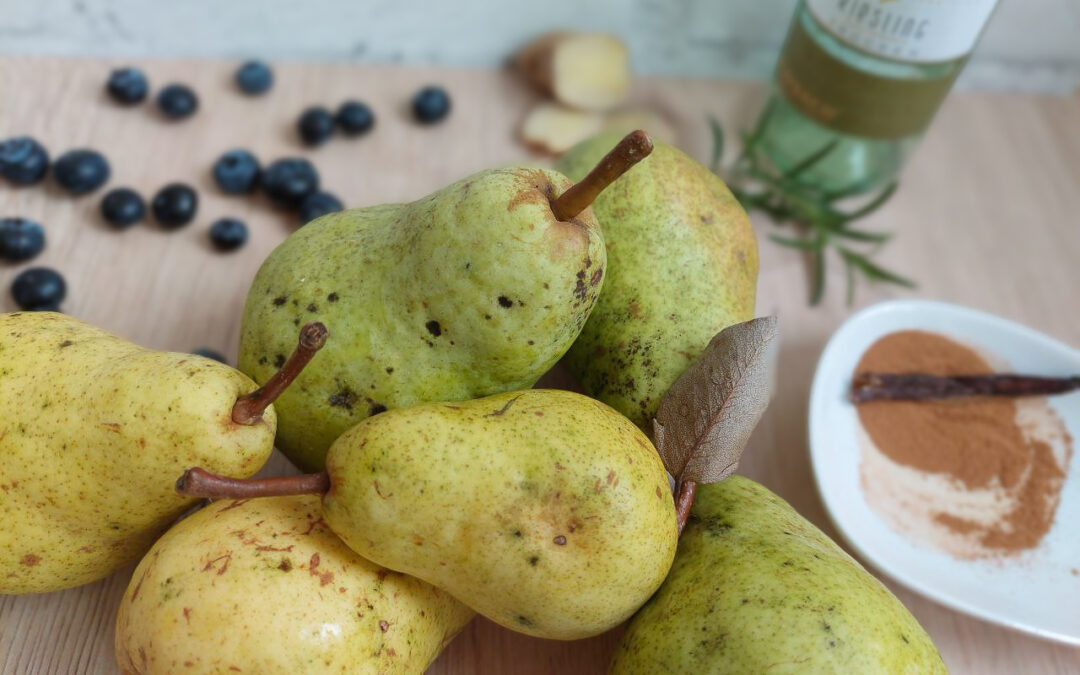
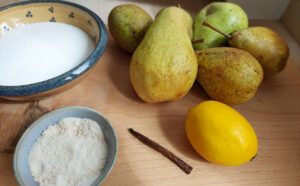
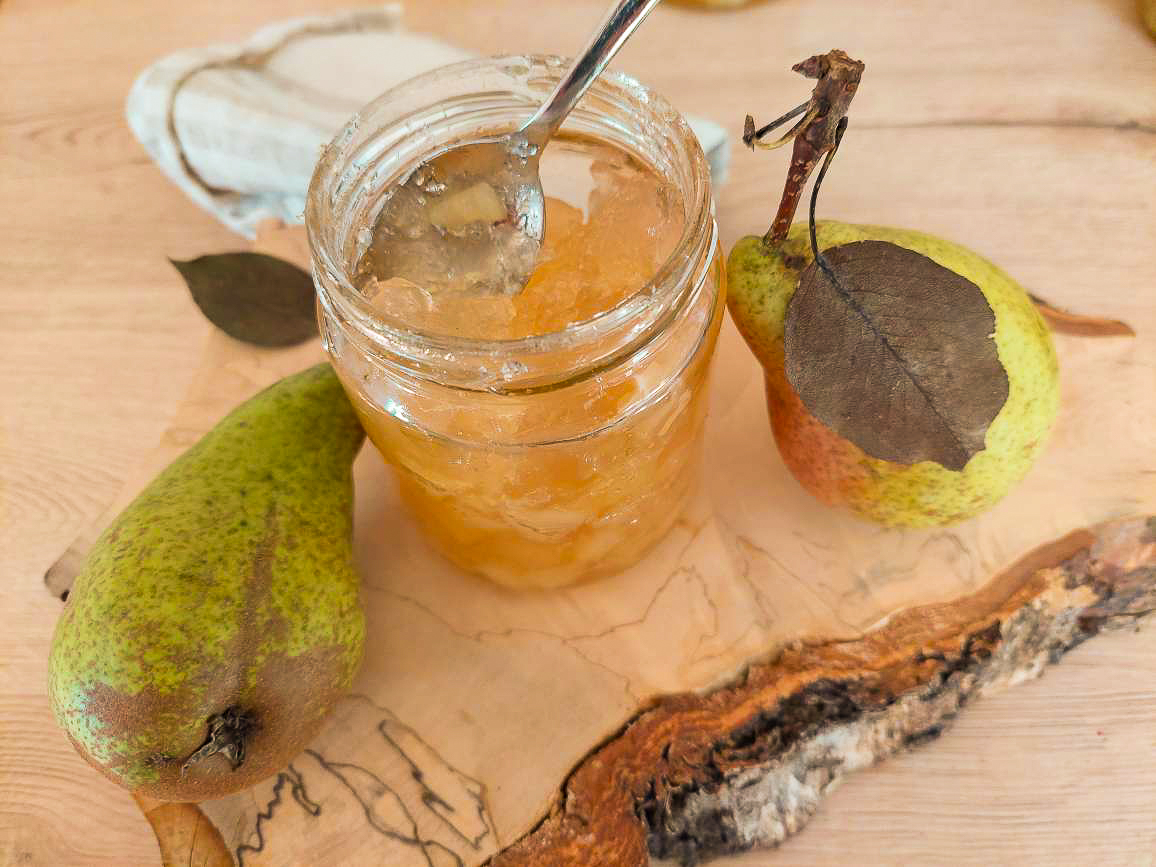
Although it’s still August – well, the end of August to be exact – we can already see the first signs of autumn around here: early morning mists, slightly shorter days and the first pears that are ready to be harvested! A few days ago, my dear colleague Bernadette came round and brought two buckets full of pears. Some of them were picked and unblemished – they will last a bit. But the others have fallen from the tree and have bruises. Those had to be processed as soon as possible. I chose to make jam from them, and although I love the classic pear jam, I didn’t want to make a large batch of just that one type. So, I got creative and paired the pears with different ingredients for warm and spicy as well as fresh and bright variations. They all turned out great!
But I don’t want to keep these heavenly recipes all to myself😊. Read on for my pear jam variations.
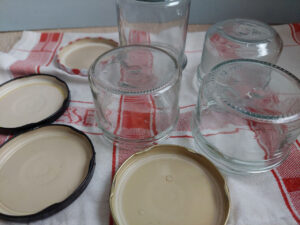
Note: Before you start, sterilise your jars and lids properly to prevent your jam from spoiling. In this guide, you can see how it’s done.
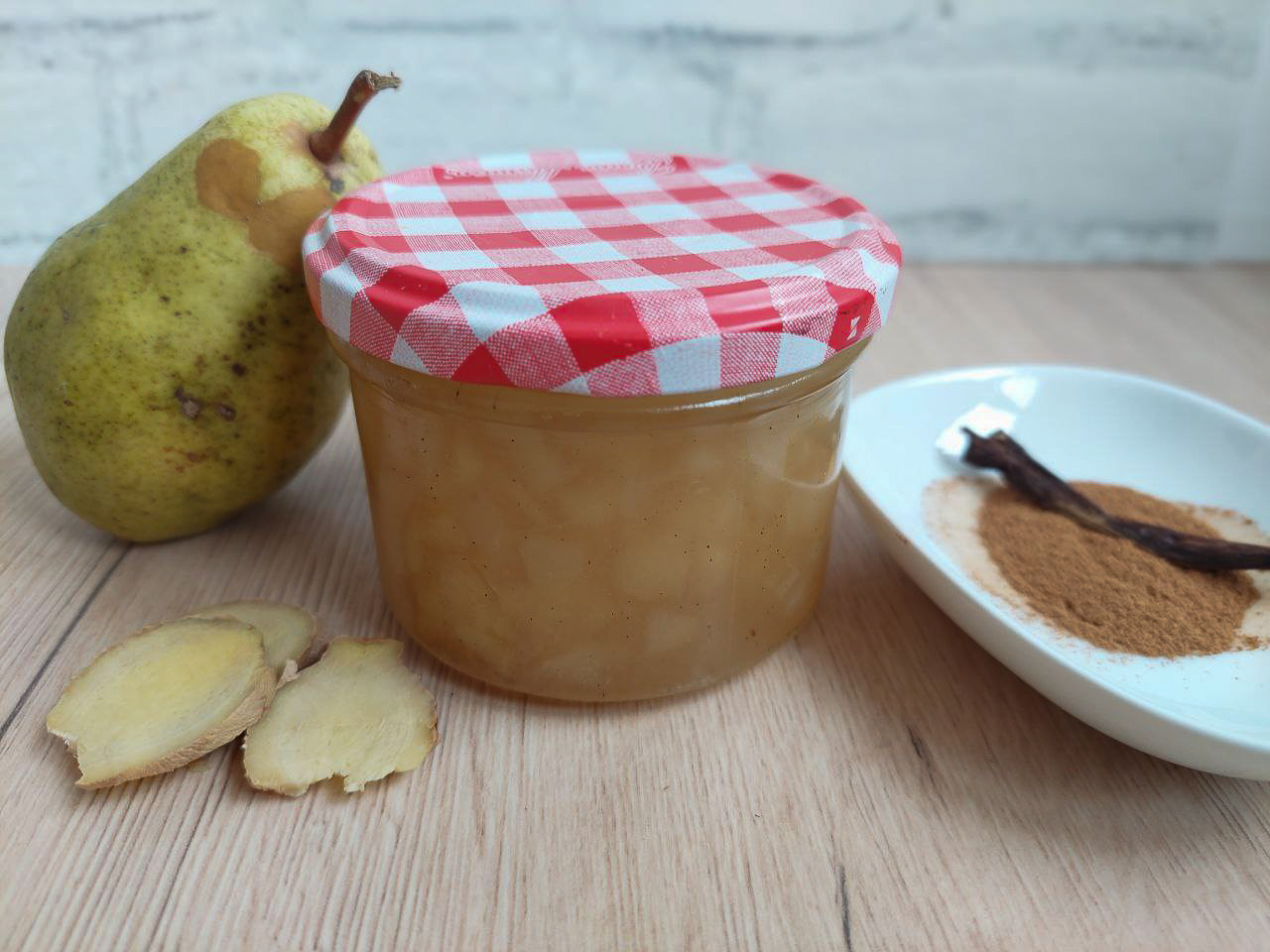
Pear Jam with Spices
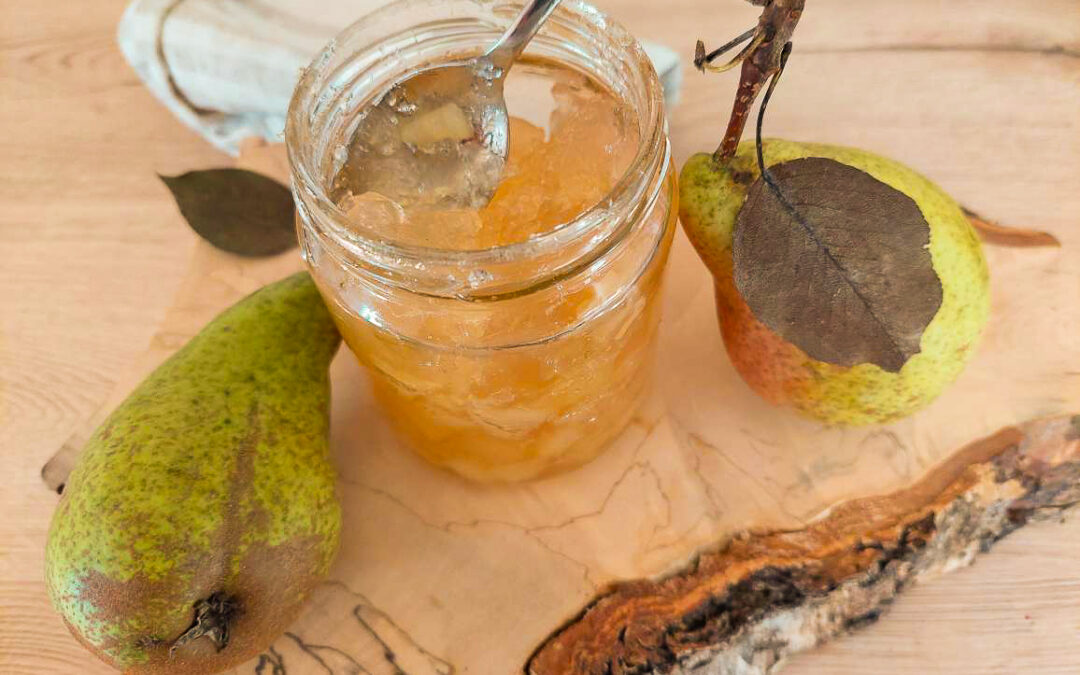
This recipe makes for a wonderfully soft and velvety pear jam. The combination of vanilla, ginger and cardamom adds a warm, yet zesty flavour. A great spread for an autumn breakfast.
1sachetpectinonly if you use normal sugar; leave out if you use jam sugar
2lemons
1/2vanilla pod
1/4tspground cardamom
1/2tspdried ground ginger
Method
Prepare your jars by washing them and the lids with hot water and let them cool on a towel or drying rack.
Wash the pears, peel them and cut them into quarters. Then weigh them.
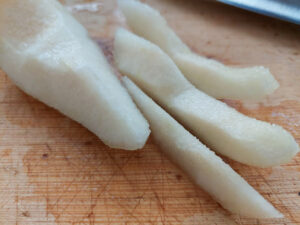
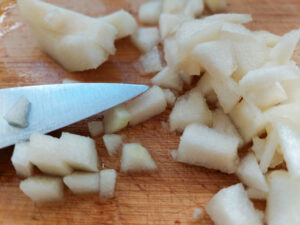
Cut the pear quarters lengthwise into 2 - 3 slices and chop them finely.
Put the chopped pears in a pot, mix them with sugar and add the cardamom and ginger.
Slice open the vanilla pod and scrape the seeds out. Put the seeds as well as the pod into the pot with the pears.
Squeeze the lemons.
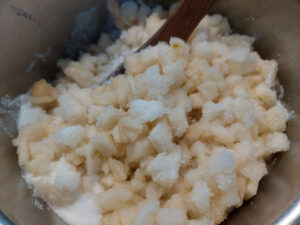
Mix the pears with the sugar, lemon juice and spices and let it all rest for at least 3 hours (you can also let it rest overnight). During that time, juice will form.
Heat the mixture while constantly stirring to prevent it from burning.
When the pears have come to a rolling boil, let it all cook rapidly for 4 minutes.
Pour the jam in jars and immediately close the lids tightly.
Once it's cool, the jam is ready for consumption.
Notes
This is a recipe for a soft pear jam with warm spices and can be stored for up to one year.
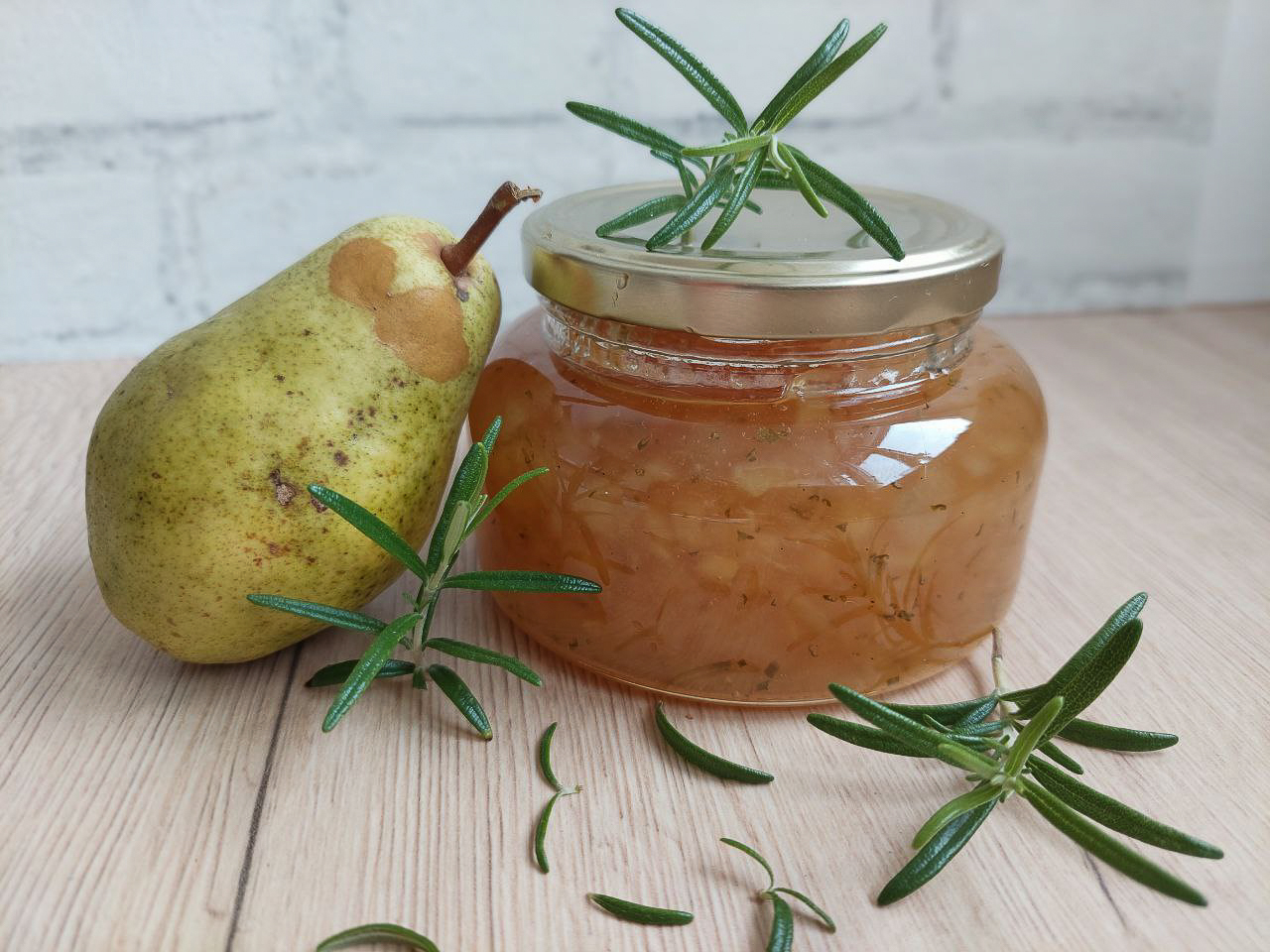
Pear Jam with Rosemary
If you like tarte flambée with goat cheese, pears and rosemary, you’ll love this recipe! The combination with pears and rosemary works wonderfully and doesn’t taste too “herbally”. It has a flavour that brings back summer, and as with the tarte flambée, pear jam with rosemary is a great addition to a cheese board.
Angela Braun
Pear Jam with Rosemary
A fresh pear jam variation that brings back summer with the unique rosemary pairing.
1sachetpectinonly if you use normal sugar; leave out if you use jam sugar
2lemons
3 tbspfinely cut rosemary
Method
Prepare your jars by washing them and the lids with hot water, let them cool on a towel or drying rack.
Wash the pears, peel and core them and cut them into quarters. Then weigh them.
Cut he pear quarters lengthwise into 2 - 3 slices and chop them finely.
Squeeze the lemons.
Finely chop the rosemary.
Put the chopped pears in a pot, mix them with sugar, lemon juice and rosemary and let the mixture rest for at least 3 hours (you can also let it rest overnight).
After resting, heat the mixture up and stir constantly to prevent it from burning.
When it all boils, let it cook rapidly for 4 minutes.
Pour the jam in jars and immediately close the lids tightly.
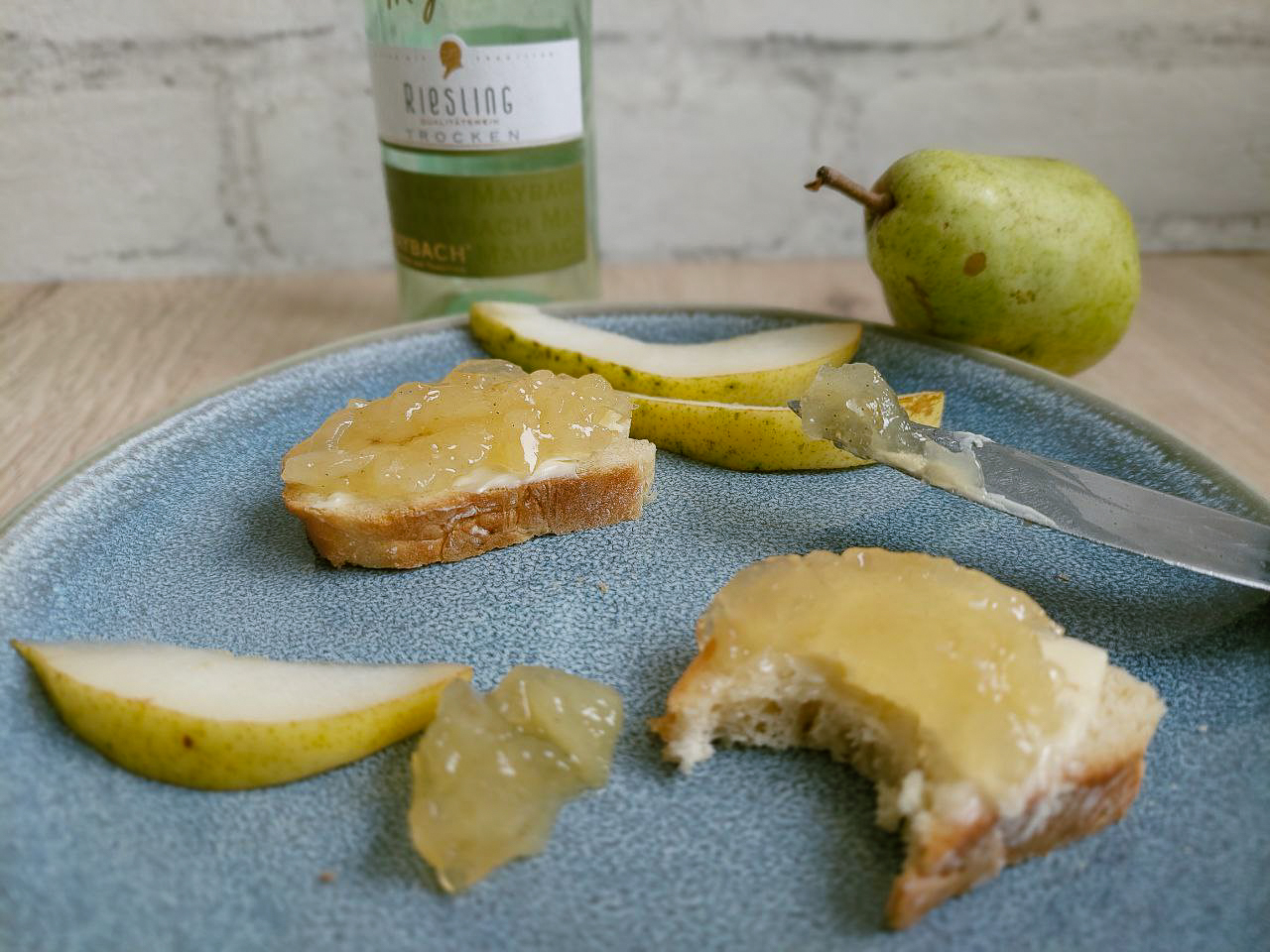
Pear Jam with Riesling
With this pear jam variation, you’ll certainly impress everyone! Pears go very well with white wine, which adds a subtle fruitiness and depth. For this recipe, I’ve chosen a dry Riesling. You can, of course, use any other white wine as long as it’s dry. It will alter the taste, though.
A word of warning: This is not for children! Part of the alcohol in this recipe will evaporate during cooking, but maybe not all.
Angela Braun
Pear Jam with Riesling
The Riesling adds a subtle fruitiness and depth to this pear jam.
1sachetpectinonly if you use normal sugar; if you use jam sugar leave the pectin off
Method
Prepare your jars by washing them and the lids with hot water and let them cool on a towel or drying rack.
Wash the pears, peel and core them and cut them into quarters. Then weigh them.
Cut the pear quarters lengthwise into 2 - 3 slices and chop them finely.
Put the chopped pears in a pot, mix them with the sugar, pectin (if needed) and the Riesling.
Mix it all and let it rest for at least 3 hours (you can also let it rest overnight).
Heat the mixture up while constantly stirring to prevent it from burning.
When the mixture has come to a rolling boil, set your timer and let it all cook rapidly for 4 minutes.
Pour the jam in jars and immediately close the lids tightly.
Once it's cool, the jam is ready for consumption.
Notes
This is not a recipe for children! Part of the alcohol in this recipe will evaporate during cooking, but maybe not all.
Pear-Blueberry Jam with Cinnamon
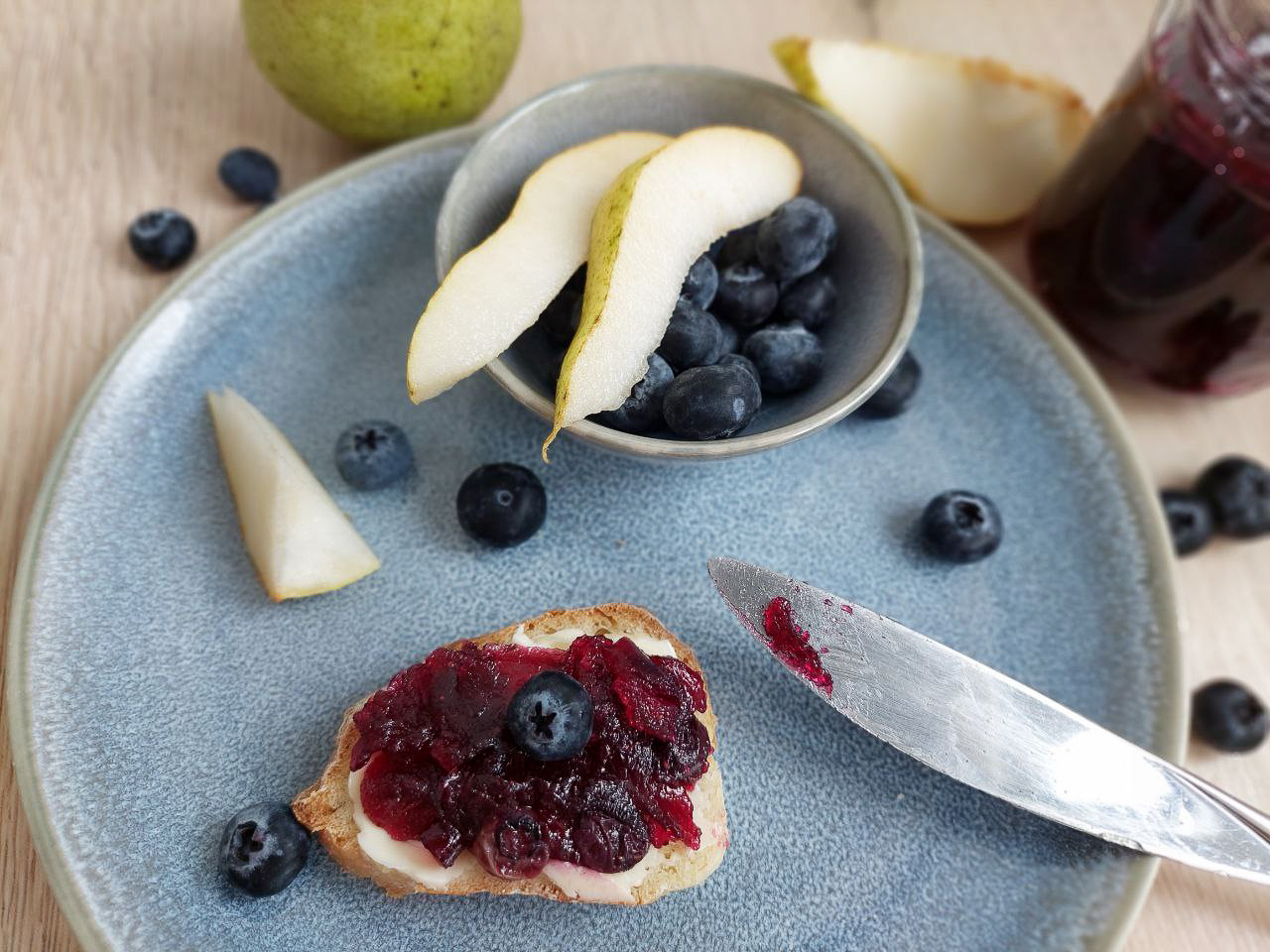
Now this pear jam variation is definitely (but not only) for children! If you had to keep your offspring away from the Riesling jam, offer them this pear-blueberry jam with cinnamon instead. They’ll love it. And with the (late) summer blueberries, the autumn pears and wintery cinnamon, we combine three seasons in one jar.
Angela Braun
Pear-Blueberry Jam with Cinnamon
Three seasons in a jar that will not only delight children!
1 sachetpectinonly if you use normal sugar; if you use jam sugar, leave the pectin off
1tbspground cinnamon
2lemons
Method
Prepare the jars by washing them and the lids with hot water and let them cool on a towel or drying rack.
Wash the pears, peel and core them, and cut them into quarters. Then weigh them.
Cut the pear quarters lengthwise into 2 - 3 slices and chop them finely.
Wash the blueberries.
Squeeze out the lemons.
Put the chopped pears and the blueberries in a pot and mix them with the sugar, pectin (if needed), lemon juice and cinnamon.
Let it all rest for at least 3 hours (you can also let it rest overnight).
Heat the mixture up and stir it all constantly to prevent it from burning.
When the fruits have come to a rolling boil, let it all cook rapidly for 4 minutes.
Pour the jam in jars and immediately close the lids tightly.
Once it's cool, the jam is ready for consumption.
Notes
This is not only a great addition to your breakfast table but also makes a good spread for a quick Victoria sponge roll.
All of the above recipes make 6 jars à 1/4 l and are shelf-stable for up to 1 year. If your family is anything like mine, however, none of these pear jam variations will last that long 😄.
Now it’s your turn! Which of these pear jam variations are you most excited to try? I’d love to know if you lean toward the warm spices of autumn, the sophisticated Riesling version, or the herbaceous rosemary combination. And if you create your own variation, please share—I’m always looking for new flavour inspiration!
Want more jam-making inspiration? Check out this post:
When the first pears are ready to be harvested, we know autumn has arrived – no matter how warm the weather still feels. The first pears are ready for picking in August, while late-season varieties can hang on the tree until the end of October. But here’s the dilemma: you can only eat so many fresh pears before they start to turn. That’s where the magic of pear jam comes in.
Unlike juicy berries, pears are comparatively dry fruits, which means making thick, spreadable jam requires a few key techniques. Today, I’ll walk you through my step-by-step method for creating a wonderfully velvety, sweet pear jam that captures all the golden abundance of autumn.
Choosing your pears
Varieties
You can use virtually any pear variety, except the small, sour cider pears. Excellent choices in my area include Williams Christ, Clapp’s Liebling, Gellert’s Butterbirne and Conférence. With over 1500 pear varieties worldwide, use whatever grows well in your area.
Ripeness is crucial
Test ripeness by gently pressing the fruit with your fingers. If the pear is rock hard, it needs more time on the tree to develop its full flavour. When the flesh feels soft to the touch, the pear is ready for jam-making. Process harvested pears within a few days – they quickly transition from perfect to overripe.
Essential Equipment and Ingredients
Equipment You’ll Need
To make pear jam, you will need a sharp knife and a cutting board to peel and chop the pears.
For “storing” them between quartering and chopping, you need a large bowl.
Then you need a heavy-bottomed pot for cooking the jam and a wooden spoon for stirring it to prevent it from burning.
Lastly, of course, you need suitable jam jars with lids. I prefer jars of 250 ml (0.4 pt / 9 oz), because they’re large enough to be practical, yet small enough to finish the jam before it spoils. You can choose smaller or larger jars, just as it suits you. I just wouldn’t recommend jars of more than 400 ml (0.7 pt / 14 oz).
Ingredients
Pears
Obviously, we need pears 😊! For 6 jars of 250 ml, we need 1 kg (2.2 lbs) of pears, net weight after peeling and coring.
You can upgrade or downgrade the amount, but I don’t attempt more than 2 kg of pears (plus sugar), because larger batches won’t set properly.
Sugar
Although pears are sweet already, we need sugar to preserve the jam. The classic choice is jam sugar, where the pectin is already included. Now, if you like your jam very sweet, use jam sugar 1:1, which means that you take the same amount of sugar as fruit. For 1 kg of pears, we need 1 kg of sugar.
As pears are very sweet already, however, jam sugar 2:1 is also a good choice. It means taking half the amount of sugar compared to fruit. For 1 kg of pears, now, we need 500 g of sugar.
I personally prefer using household sugar and adding pectin. There are sachets of pectin, which also come in ratios of 1:1 and 2:1 (even 3:1 for very sweet fruit). So, when I have 1 kg of pears, I use 500 g of household sugar and one sachet of pectin 2:1.
To sum it up, choose the type and the amount of sugar based on your sweetness preference:
Jam sugar 1:1 (that means equal weight of sugar and fruit) for a very sweet jam
Jam sugar 2:1 (half the amount of sugar compared to the amount of fruit) for moderately sweet jam
My preference: regular sugar (500 g per 1 kg pears) plus one sachet of pectin 2:1
Lemon juice
Raw pears have a wonderful aroma, but when they are made into jam, they can taste a bit one-dimensional. To balance the sweetness of the pears, we add the juice of one lemon. It doesn’t make the jam sour but adds a zesty nuance to the overall flavour.
Flavour enhancers (optional but highly recommended)
Strictly speaking, you don’t need to add anything to your pear jam, but some herbs and spices enhance the pears’ flavour even further:
Vanilla: Half a pod (or quarter if very fresh) transforms the jam
Warm spices: Cinnamon, cardamom, clove, or nutmeg
Fresh herbs: Rosemary, lemongrass, lemon balm, or thyme
Get creative with combinations! If you need some inspiration, look at this article where I have listed different pear jam variations.
Step-by-Step Instructions
Got everything you need? Wonderful! Let’s start then.
Sterilise Your Jars
We want our jam to be shelf-stable for as long as possible. In an anaerobic (that is, oxygen-free) environment, however, certain bacteria and germs can grow well, and thus we must sterilise our jars to make them germ-free. If you want to read up on how to sterilise your jars properly, have a look here.
Prepare the Pears (Without Browning)
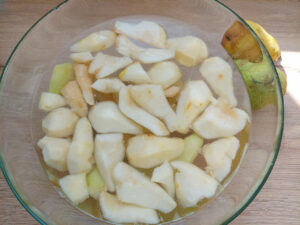
Pears turn brown quickly once they’re peeled. Although this change of colour doesn’t alter the taste, we want our jam to be the typical beautiful cream colour. To prevent the pears from browning, we must ensure that they’re not exposed to air for too long. Additionally, we must use acid, either in the form of lemon juice or vinegar, for preventing colour change.
For that purpose, fill a large bowl with water and add either the juice of one lemon or a splash of vinegar.
Now, peel, quarter, and core the pears, and immediately put them into the bowl.
When all pears are prepared that way, we can remove the single quarters and slice them lengthwise into 3-4 pieces.
Now chop them finely crosswise. If necessary, cut the chops further. Be careful, though: we don’t want pear pulp but small, yet distinct pieces.
The Crucial Resting Period
If we cooked jam from pears immediately after chopping them, the jam would become relatively dry and compact. So, we must induce the pears to remove some of their juice, and that’s best done by mixing them with sugar and letting them rest for a few hours. This step makes all the difference between dry, compact jam and a perfectly textured preserve:
Put the pear chops in a pot and add the sugar, pectin (if necessary), lemon juice and spices.
Mix it all thoroughly and let it rest for at least 3 hours, or overnight if possible.
During that resting period, the pears release their juices while absorbing the sugar, thus creating the perfect base for jam.
Cook to Perfection
Now it’s time to cook the jam!
Bring the pear mixture to a rolling boil over medium-high heat.
Set your timer for 4 minutes and let it all boil for that time. Stir the mixture regularly to prevent it from burning.
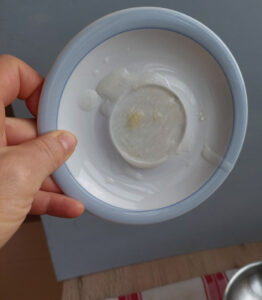
Test if the jam is done by dropping a spoonful of hot jam onto a cold plate. Now, tilt the plate and watch the jam: if it runs like water, it must be cooked for another minute. If it flows like thick honey, it’s ready!
Fill and Seal
Ladle hot jam into the sterilised jars. To make sure you don’t spill jam on the rims, a funnel comes in handy.
Clean the jar rims if necessary, and immediately seal the jars with tight lids.
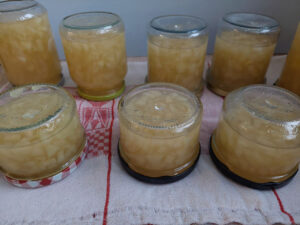
Flip the jars upside down onto a clean kitchen towel and leave them like that for about 10 minutes to create a vacuum seal.
Turn the jars right-side up and let them cool completely.
Listen for the satisfying “pop” as vacuum seals form. When the jars are completely cooled off, press the centre of each lid: is it firm? Wonderful, everything’s fine! If it moves, the lid’s not properly sealed. Put that jar in the fridge and eat it within 1 – 2 weeks.
1sachetpectinonly if you use household sugar; if you use jam sugar you don't need pectin
1lemonjuice
1/4 - 1/2podvanilla(optional)
Equipment
Sharp knife
Cutting board
large bowl for prepped pears
Heavy-bottomed pot
Wooden spoon for stirring
Jam jars with lids (I prefer 250 ml /9 oz jars - large enough to be practical, small enough to finish before spoiling).
Method
Sterilise your jars
Fill a large bowl with water and add either the juice of one lemon or a splash of vinegar.
Peel, quarter, and core the pears and immediately put them into the bowl.
Remove the quarters one at a time and slice them lengthwise into 3 - 4 pieces.
Now chop them finely crosswise. If necessary, cut the chops further, but be careful: we don't want pulp but small, yet distinct pieces.
Put the pear chops in a pot and add the sugar, pectin (if necessary), lemon juice and spices.
Mix it all thoroughly and let it rest for at least 3 hours, or overnight if possible.
Bring the pear mixture to a rolling boil over medium-high heat
Set a timer for 4 minutes and maintain the boil. Stir regularly to prevent the mixture from burning.
Test for doneness by dropping a spoonful of hot jam onto a cold plate. Tilt the plate- if the jam flows like thick honey, it's ready
Ladle hot jam into sterilized jars (a funnel prevents messy rims)
Clean jar rims if needed and immediately seal with tight lids.
Flip jars upside down on a clean towel for 10 minutes to create a vacuum seal.
Turn the jars right-side up to cool completely.
Notes
Store sealed jars in a dark place at room temperature for up to 2 years. Once opened, refrigerate and enjoy within several weeks.
Storage
Like all jams, pear jam is best stored in a dark place at room temperature. Here, it is shelf-stable for up to 2 years. Once a jar is opened, keep it in the fridge and enjoy it within several weeks.
Your Gateway to Creative Jam-Making
Making pear jam is satisfying beyond words. Once you’ve mastered the basic technique, I guarantee you’ll soon find yourself experimenting with exciting flavour combinations.
But the best of all is that you’ll have a wonderful preserve for your pantry that brings the golden abundance of an autumn orchard onto your breakfast roll.
If you liked this jam, these posts may also interest you:
Home canning has become increasingly popular in recent years, and it’s obvious why: it’s cheaper to make preserves by yourself instead of buying them, and you have full control over what’s in your jars – or rather, what’s NOT in them! Also, what’s more sustainable than (ideally) growing your food on your doorstep and processing it freshly out of the garden?
There is, however, one crucial point we must observe to guarantee that our homemade preserves are safe to eat for a prolonged time: hygiene. It goes without saying that you wash your hands before processing any food, but there are also the jars to consider, in which we put our preserves. The jars and lids must be clean, too. Yet, just washing them out will not do the trick. Some germs and bacteria thrive in anaerobic (that is, oxygen-free) environments, like in closed jars, and they’re not beneficial for us! In fact, they can cause severe illness like botulism, especially in low-acid food.
That’s why we must sterilise jars and lids and thus kill all harmful bacteria before we use them for canning and preserving. Now, don’t shy away! You don’t need any fancy equipment for sterilising your jars at home. In fact, I guarantee you already have all you need.
Stick with me and I’ll describe four simple yet effective methods of how to sterilise jars at home.
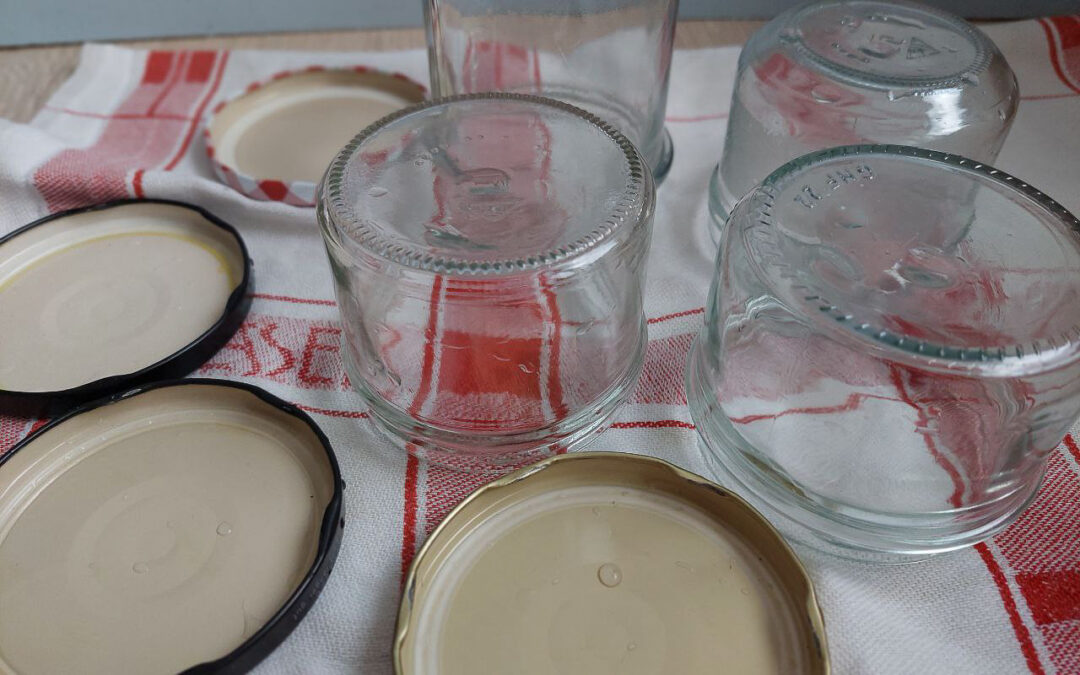
The easiest method to sterilise jars is with boiling water. Put the open jars and the lids into a large pot and fill the jars and the pot with cold water. Jars and lids must be under water! Slowly heat the pot until the water boils. Let it all boil for 10 minutes. Remove the jars and lids with tongs and put them on a clean kitchen towel to dry off and cool down.
Make sure the jars are completely submerged!
Sterilisation in the oven
You can also use your oven to make your jars germ-free. This method is especially suitable when you have lots of jars to sterilise. Don’t sterilise the lids in the oven! They must be boiled in water. Pre-rinse your jars with hot water. Put the jars without lids on a baking tray and put them in the oven. Heat the oven to 140 °C / 285 °F top/bottom heat. Once the oven has reached that temperature, set your timer for 15 minutes.
Afterwards, take the jars out of the oven, either with tongs or oven mitts. Don’t touch the rim or the inside of the jars! Put the jars on a clean kitchen towel and let them cool down.
Dishwasher
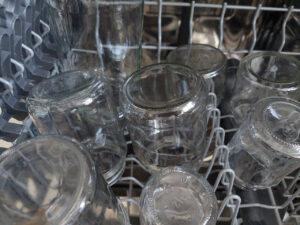
The easiest but also the longest method to sterilise jars is in the dishwasher. It’s especially suitable when you have many or large jars of one litre (1.8 pt / 35 oz) or more. Put all the jars upside down, as well as the lids (separately), into the dishwasher.
Do not add detergent! Also, do not add dirty dishes. Only the jars and the lids are allowed in that wash cycle! Choose the hottest programme and start it. Once the programme is finished, let the jars and lids cool off inside the dishwasher.
Microwave
The fastest method to sterilise jars is in the microwave. Do not sterilise lids that way! They must be boiled in water for 10 minutes. Fill the jars with water up to one-third. Put them in the microwave at 600 Watt and wait till the water is boiling. Leave them in the microwave for one further minute. Carefully remove them with tongs or oven mitts, or let them cool off in the microwave.
To prevent spoilage of our precious preserves, we must sterilise the jars. Here are different methods of sterilisation.
Author: Angela Braun
Instructions
Water-bath sterilisation
Put the open jars and the lids into a large pot and fill the jars and the pot with cold water. Jars and lids must be submerged!
Slowly heat the pot, bring to a boil and boil for 10 minutes.
Remove the jars and lids with tongs and put them on a clean kitchen towel to dry off and cool down.
Oven method
Rinse the jars with hot water.
Place them on a baking tray (not the lids!) and put it in the oven.
Heat up the oven to 140 °C / 285 °F top/bottom heat.
Once the oven has reached that temperature, set your timer for 15 minutes.
Take the jars out of the oven, either with tongs or oven mitts. Don't touch the rim or the inside of the jars! Put the jars on a clean kitchen towel and let them cool down.
Dishwasher
The easiest but also the longest method to sterilise jars is in the dishwasher. It's especially suitable when you have many or large jars of one litre (1.8 pt / 35 oz) or more.
Put all the jars upside down, as well as the lids (separately), into the dishwasher.
Do not add detergent! Also, do not add dirty dishes. Only the jars and the lids are allowed in that wash cycle!
Choose the hottest programme and start it.
Once the programme is finished, let the jars and lids cool off inside the dishwasher.
Microwave
The fastest method to sterilise jars is in the microwave. Do not sterilise lids that way! They must be boiled in water for 10 minutes.
Fill the jars with water up to one-third.
Put them in the microwave at 600 Watt and wait till the water is boiling.
Leave them in the microwave for one further minute.
Carefully remove them with tongs or oven mitts, or let them cool off in the microwave.
Whatever method you choose to sterilise your jars and lids, the most important thing is that you don’t skip this crucial step! When you ladle your homemade jam into freshly sterilised and still warm jars, close them with a lid and listen for that satisfying “pop”, you know that only good things are in that jar. That jam will stay fresh and safe for a year or more, thanks to your sterilisation, and so all the time and effort you put in making that jam was absolutely worthwhile. And not only did you make a yummy preserve, but you’ll have the absolute certainty that it will benefit your family whenever you eat it. Enjoy your delicious, safe homemade preserves with complete peace of mind!
Wanna dive right into jam making? Here are a few inspirations:
I love it when I can harvest cucumbers and gherkins because it means that it’s summer! And summer, for me as a school secretary, means holiday season, one of my favourite times of the year. While I could – and often do – eat cucumbers all summer long, gherkins are best preserved. Fermented gherkins (or salt gherkins) are a classic ferment. Crisp, tangy and naturally fermented, they have very little in common with the vinegar pickles you’ll find in most supermarkets.
In this guide, I’ll show you how to master fermented gherkins. Let’s dive in.
Quick overview
Fermentation time: 4–7 days
Salt concentration: 3.5%
Temperature: 15–18 °C (60–65 °F)
Difficulty: Easy
Ready after:
➡️ Half-sour: 4–5 days
➡️ Full-sour: 6–7 days
Storage: up to 1 year refrigerated
Before You Start: 4 Things That Make Fermented Gherkins Successful
As I said before, fermented gherkins are a classic example of lacto-acid fermentation, but there are a few aspects to consider.
Salt content
Fermented gherkins need a brine with a higher salt content. While a brine with 2% salt is usually enough, we use a concentration of 3.5% in this recipe. This is due to the relatively high water content of gherkins. The salt draws water from them and allows them to partly replace it with the salty brine. That way, they stay crunchy for a long time.
Tannic leaves
Additionally, I like to add leaves that contain tannin, which also help the gherkins stay crisp and crunchy. The tannins help strengthen the vegetable’s cell walls, which keeps the gherkins crisp. You can use the leaves of oak, wine, cherry, raspberry, blackberry, currant, bay and horseradish. If you can’t get any of those, you could also put a bag of black tea in the jar, but be prepared that it changes the gherkins’ colour.
Temperature
While I usually prefer fermenting other vegetables at temperatures around 20°C (68°F), I like to ferment gherkins at a lower temperature range between 15 and 18°C (60 – 65°F). That way, fermentation occurs a bit slower and won’t become too sour too soon. If you are up for a full-sour version, however, feel free to ferment at 20 °C / 68 °F.
Water
I use our tap water for fermenting, and it works just fine. However, if you live in a region where your tap water is highly chlorinated, or the house you live in has old (rusty) pipes that could leak iron, it’s best to run it through an activated carbon filter before using it for fermentation (or drinking or cooking, for that matter).
If in doubt, taste your tap water. Smelling and tasting good? Then go on and use it for fermentation. If it’s got a metallic or chlorine taste, filter it first.
Distilled water is NOT a good alternative, as – due to the lack of minerals – it tastes very bland and lets the gherkins go mushy.
Mastering fermented gherkins – Step by step
Probably the most difficult part of making fermented gherkins is getting the gherkins, unless you cultivate them in your garden. While all cucumber varieties can be fermented, gherkins are the best choice. They are uniformly small, usually up to 10 cm (4 inches). They have a thick skin that is thicker than cucumbers.
If you don’t grow your own gherkins, you can sometimes find them in the supermarket, but you need to check them carefully for freshness. Gherkins become flabby a few days after being harvested. If the ones you found show dull, wrinkled skin, they were picked too long ago. Yellow gherkins are also not suitable. They’ve been harvested overripe.
If you have a local farmers’ market in the vicinity, that’s a good place to buy freshly picked gherkins (or any fresh vegetables for that matter).
A word on bitterness
Sometimes, cucumbers and gherkins can get bitter, especially when the plant gets stressed by too much heat, too little water or great differences in temperature. Unfortunately, fermentation won’t remove existing bitterness. If you want to ensure that your gherkins are good to use, try one or two to check that everything’s all right.
Want to ferment with confidence? Download my free Fermentation Starter Checklist and get practical preserving tips, seasonal recipes and new fermentation guides delivered straight to your inbox.
Equipment
Good news: you’ll only need a few jars with lids and fermentation weights for each jar. If you’re not quite sure whether your jars are ok and what weights you can use, check out my fermentation equipment list.
Ingredients
Yield: one jar of 4 l or 6 jars of 3/4 l
about 20 gherkins 12 – 15 garlic cloves 2 fresh dill flowers (alternatively: 2 tbsp dill seeds) 2 tbsp peppercorns 2 tbsp mustard seeds 5 bay leaves 3 l water 105 g salt 5 – 10 tannic leaves (for example, from oak, wine, raspberry, currant or blackberry)
Instructions
Sterilise the jars and lids. In this guide, you’ll learn four simple methods to do so.
Thoroughly wash the gherkins and remove the vines and blossom ends. The blossom end contains enzymes that soften the gherkins during fermentation.
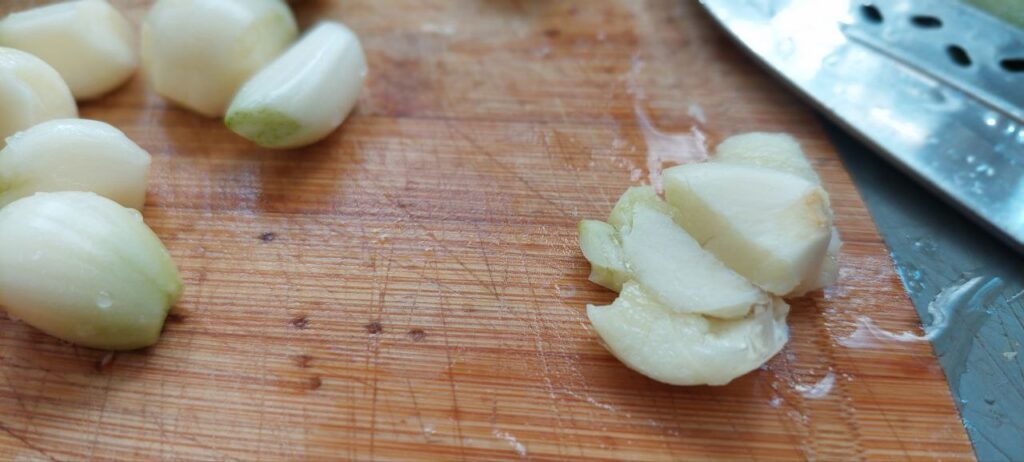
Peel the garlic cloves and either press them slightly with the blade of a knife or cut them in half.
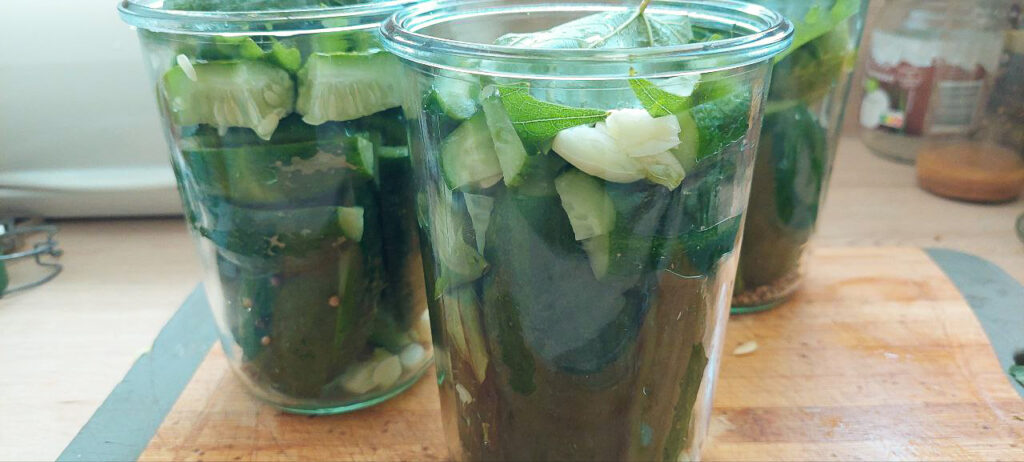
Now, layer the gherkins, the garlic cloves, bay leaves and spices in one large or several small jars. If the gherkins are too large for your jars, cut them into slices or sticks.
Prepare the brine by dissolving the salt in the water. Stir the mixture until the salt has completely dissolved.
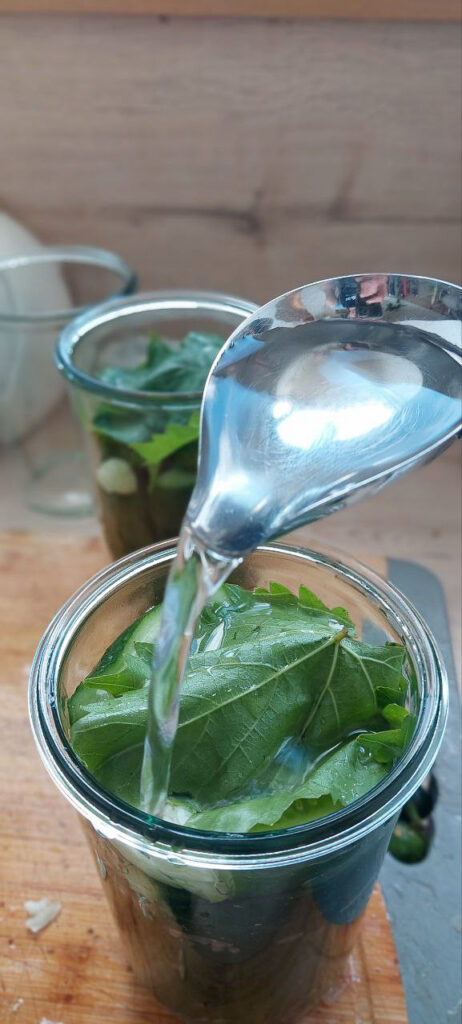
Pour as much brine over the gherkins so that they are covered by it. Store the residual brine in the fridge.
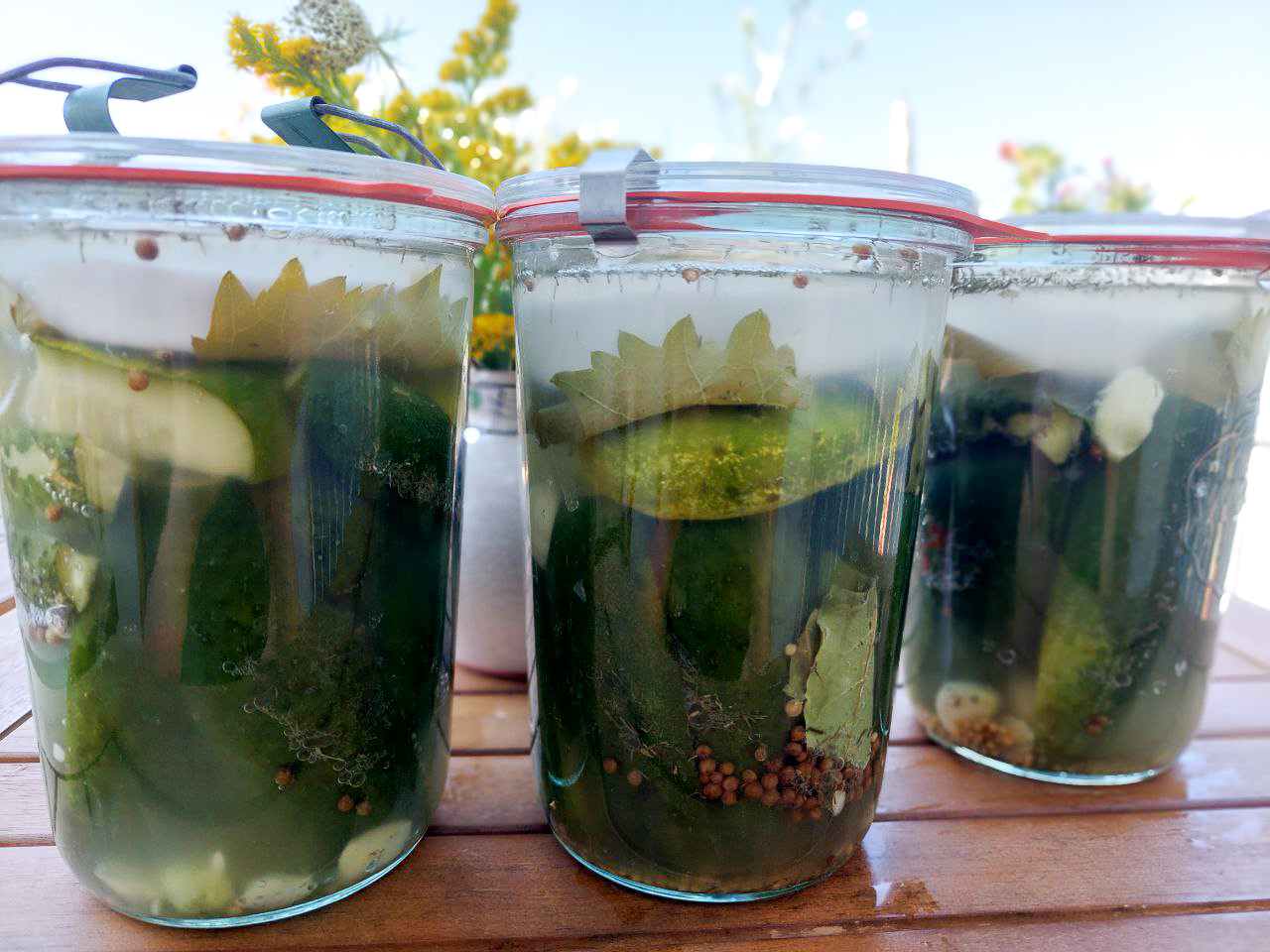
Cover the brine surface with the tannic leaves and put a weight on them to make sure that everything stays under the brine.
Put the jar or jars on a baking tray or something similar and let everything ferment at 15 – 18 °C (60 – 65°F) in a place without direct sunlight for 4 – 7 days.
You’ll usually notice bubbles within the first day or two, and the brine may become cloudy. Both are perfectly normal signs of active fermentation.
Keep an eye on the jars and pour in some of the brine from the fridge if, during fermentation, too much brine flows out of the jar.
After 4 – 5 days, the gherkins are half-sour; after 6 – 7 days, they’re full-sour. Taste them to test the flavour and either eat them right away or put them in a cool place (at best the fridge) to stop, or rather slow down, fermentation.
You can store the jars in the aforementioned cool place for up to 1 year. The flavour continues to develop slowly during storage, becoming more sour over time.
Angela Braun
Fermented gherkins
Small as they are, gherkins burst with flavour when fermented! Make this wonderful preserve with gherkins, a salt brine and a few herbs and spices.
5 - 10tannic leavesfor example from oak, wine, raspberry, currant or blackberry
Method
Thoroughly wash the gherkins and remove the vines and blossom ends.
Peel the garlic cloves and either press them slightly with the blade of a knife or cut them in half.
Now, layer the gherkins, the garlic cloves, bay leaves and spices in one large or several small jars. If the gherkins are too large for your jars, cut them into slices or sticks.
Prepare the brine by dissolving the salt in the water. Stir the mixture until the salt has completely dissolved.
Pour as much brine over the gherkins so that they are covered by it. Store the residual brine in the fridge.
Cover the brine surface with the tannic leaves and put a weight on them to make sure that everything stays under the brine.
Put the jar or jars on a baking tray or something similar and let everything ferment at 15 - 18 °C (60 - 65°F) in a place without direct sunlight for 4 - 7 days. Keep an eye on the jars and pour in some of the brine from the fridge if, during fermentation, too much brine flows out of the jar.
After 4 - 5 days, the gherkins are half-sour, after 6 - 7 days they're full-sour. Taste them to test the flavour and either eat them right away or put them in a cool place (at best the fridge) to stop or rather slow down fermentation.
You can store the jars in the aforementioned cool place for up to 1 year
Notes
As long as you stick to the salt ratio of 3.5 %, you can get creative with herbs and spices. Add, for example, coriander or dried chilli flakes or cut down the amount of garlic. You can also add onion rings.
Recipe alterations
If you want a less “garlicy” taste, cut down the amount of garlic cloves. Instead, add some onion rings. You can also get creative with the spices, for example by adding dried chillies or coriander.
Ready for your next ferment?
If you enjoyed making these fermented gherkins, you’ll probably love experimenting with other vegetables too.
Download my free Fermentation Starter Checklist and receive seasonal fermentation recipes, troubleshooting tips and preserving ideas throughout the year.
Troubleshooting
Although you think you’ve done everything right, some problems may occur:
Shrivelled gherkins
Either the gherkins were not fresh enough (that is, they were harvested longer than two days before you processed them) or your brine was too salty. Either way, they’ve lost too much water in the brine and have become shrivelled. Nevertheless, you can still eat them.
Hollow gherkins
Here again, the gherkins may not have been freshly harvested. Another reason for hollow gherkins is that the gherkins were too large. But like shrivelled gherkins, hollow ones are still edible.
Discolouration
During the fermentation process, it’s normal that the gherkins’ colour changes from a fresh, bright green to a dull olive green. However, if they get a different colour, there are several reasons for that.
Either the water you used for the brine was too hard or, more often, colouring spices like curcuma or vegetables like red onions caused the colour change. Discolourations, however, are harmless, and you can eat the gherkins.
Slimy gherkins
That’s a more serious problem that could have been caused by several mistakes:
either you used too little salt in your brine (i.e. a ratio below 3.5 %) or
fermentation temperatures were too high (15 – 18 °C / 60 – 65 °F are ideal) or
you didn’t cut off the blossom ends or
The gherkins were not fully covered with brine.
Unfortunately, slimy gherkins are not edible, and you must discard them.
White film on top
If the layer is thin, white and smooth, it’s usually kahm yeast rather than mould.
Kahm yeast is a layer of wild yeasts that forms on lacto-fermented goods. It always appears on the surface; that is exactly where the ferment has contact with oxygen.
In most cases, kahm yeast is harmless. But it can affect the ferment’s taste and make it slightly musty. Most importantly, it’s a sign that there’s oxygen in the ferment and that’s where mould can grow.
When you detect kahm yeast on your ferment, carefully remove it from the surface with a spoon, then wipe the jar and the fermentation weight clean.
Afterwards, smell the ferment: when it smells fresh and slightly sour, everything’s ok. If the smell is unpleasant or “weird”, discard it.
You either haven’t cut off the blossom ends, or they’ve fermented at a high temperature for too long. Another reason could be that the ferment is older than a year.
How salty should the brine be?
It’s difficult to go by taste, which is why you should always take the exact amount of salt and water indicated in the recipe.
Can I ferment whole cucumbers instead?
Yes. Use small, firm pickling cucumbers if possible. Larger slicing cucumbers contain more water and usually don’t stay as crisp during fermentation.
Why are my gherkins hollow?
Either they were not quite fresh when fermented, or they were too large. They’re still edible, though.
Can I reduce the salt?
No. The salt ratio is crucial for a safe ferment.
How long do fermented gherkins last?
Properly stored in a cool, dark place, they last for at least a year. You can store them longer, but notice that the flavour will gradually get more sour and the gherkins will eventually turn mushy.
Small pickles, big flavour
Every summer has its flavours. For me, fermented gherkins are one of them.
They’re easy to make, don’t require many ingredients and taste so good, you’ll never want to have a pantry without them! Once you’ve made a batch yourself, you’ll discover just how different naturally fermented gherkins are from the vinegar pickles most of us grew up with—and chances are they’ll become a permanent resident of your fridge, too.
If you want to get creative, try out different herbs and spices or cut down on the garlic. As long as you stick to the salt ratio and make sure that everything’s under the brine, you’ll be fine!
Can’t get enough of fermenting? Try these recipes:
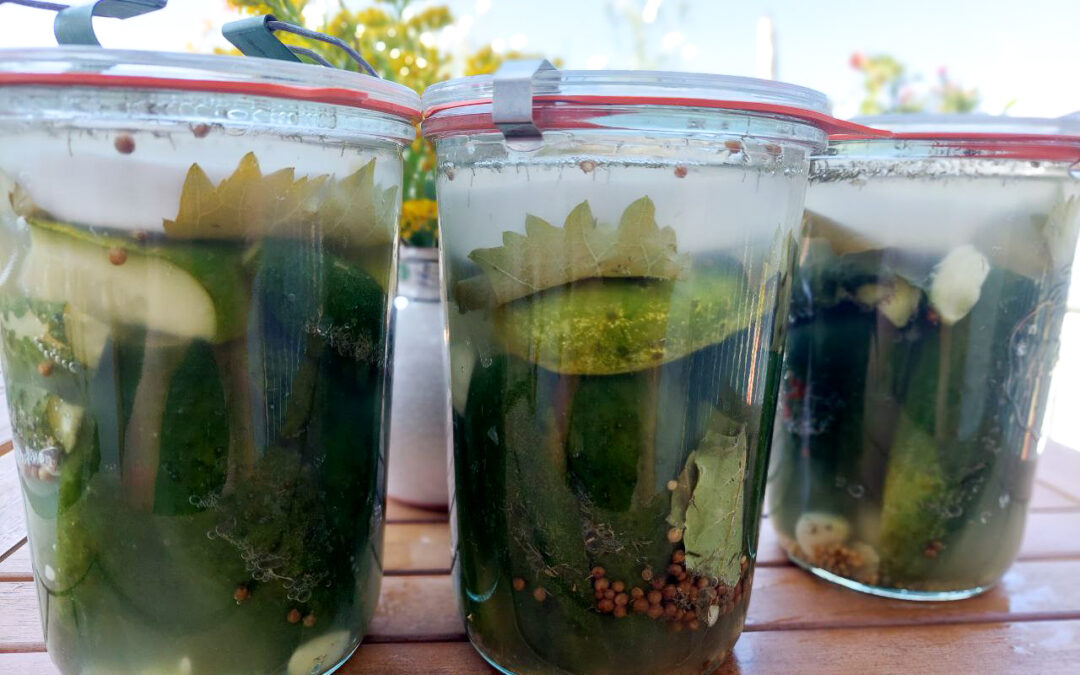
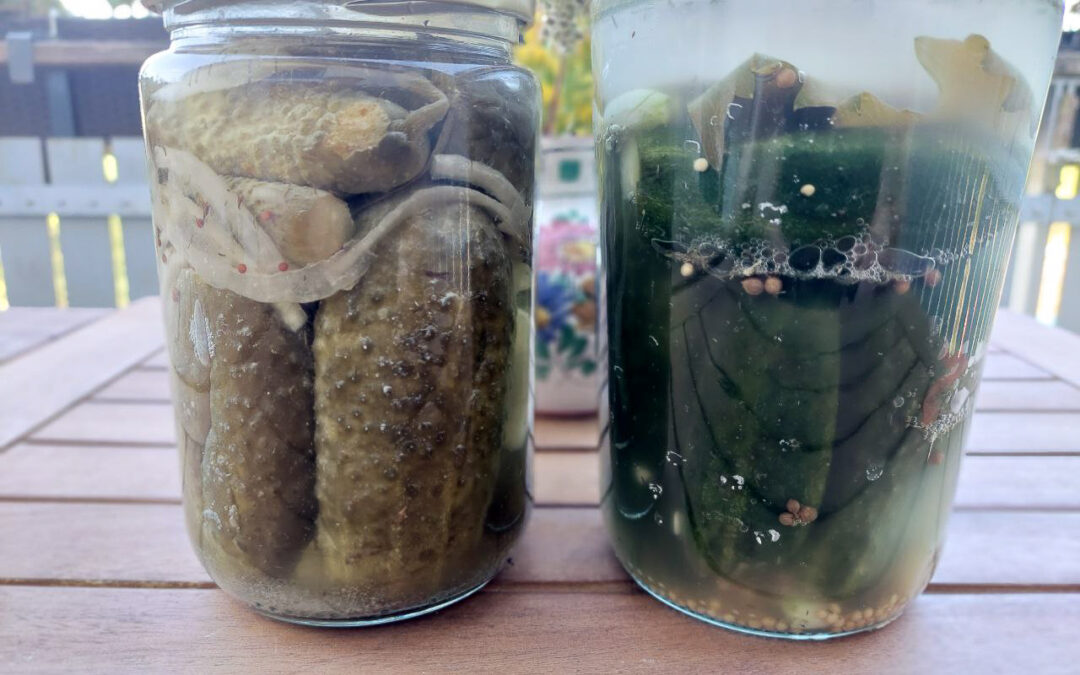
Look at the title picture of the two jars of preserved gherkins. Apart from the herbs, can you see any difference? I dare say no. Same green cucumbers, same briny liquid—so what gives? The answer is that the gherkins in the left jar are preserved with vinegar, and the ones in the jar on the right are fermented. While they appear to be alike – and are often generally referred to as “pickles” – there is a difference between fermentation and pickling.
First of all, they differ in taste. The pickled gherkins taste bright and acidic, while the fermented ones have a tangy and more complex flavour. Additionally, they contain numerous beneficial probiotics, which have a positive impact on health.
Let’s have a closer look at pickling and fermentation and compare them.
Quick Overview
Fermentation
Pickling
Process
Living, biological process
Chemical method
Timeline
1 – 4 (+) weeks
0 – 5 days
Nutrition
Probiotics, enhanced nutrients
Almost no nutritional changes
Flavour
Complex, tangy
Bright, acidic
Storage
Cool (fridge) after the initial fermentation
Shelf-stable when properly canned
Fermentation
Fermentation is a biological process where beneficial bacteria convert sugar and starch in the food into lactic acid. This happens naturally when vegetables are submerged in salt water or when salt is added directly to them.
To start fermentation, we make a salt brine or add salt to the goods we want to ferment. The salt creates an environment where the good bacteria (for example, lactobacilli) thrive while harmful ones can’t survive.
After a few days, we can watch little bubbles in the jar. The lactobacilli have started converting carbs (sugar and starch) into lactic acid and carbon dioxide (CO2). The latter displaces oxygen from the jar by pressing it out of the jar (sometimes even together with some brine). That’s great because lacto-fermentation needs an anaerobic environment (that is, an environment without oxygen) to work properly.
The fermentation process needs temperatures between 18 and 22 °C (64 – 72 °F). Not only does it form lactic acid and thus preserve the food, but it also increases the content of vitamins and micronutrients and creates probiotics, which have a positive effect on gut health.
After 1 – 4 weeks, depending on the food and the taste we like to acquire, we transfer the ferment to a cool place, for example, the fridge to stop – or rather, slow down – fermentation.
Fermented vegetables have a salty-fresh, complex, tangy flavour.
Examples of fermented goods are sauerkraut and kimchi, sourdough, kombucha and yoghurt.
Pickling, on the other hand, is a chemical process where food is preserved in an acidic solution, usually vinegar. The acid (here: acetic acid) creates an environment that’s too harsh for harmful bacteria to survive.
To pickle vegetables, we make a brine from water, vinegar, salt (and sometimes sugar), heat it and pour it over the vegetables in a jar. During cooling, the jar forms a vacuum, which is an environment with low oxygen. That and the acid from the vinegar and the salt kill any harmful bacteria.
Unlike fermentation, pickling doesn’t affect vitamin levels or create probiotics.
Pickles are ready to eat within a very short time, usually a few hours to a few days. They are usually kept in a cool, dry place (usually the fridge), unless you preserve them additionally in a water bath canner. The canning makes the low-oxygen environment in the jar into a no-oxygen (that is, anaerobic) environment. That way, you can store it at room temperature for up to 2 years.
Pickled vegetables have a bright, sharp, fresh flavour.
Understanding these basic differences leads us to a crucial component in both processes: salt.
Salt plays multiple crucial roles in fermentation, but also in pickling, working through several different mechanisms:
Preservation Through Osmosis
Salt not only draws water out of the vegetables, but also any pathogens that may be present. This dehydration effect concentrates the remaining liquid into a high-sodium environment where most spoilage bacteria cannot survive. The salt essentially “pickles” the gherkins at a cellular level, creating an inhospitable environment for decomposition.
Selective Bacterial Environment
While salt kills bad bacteria, it also encourages beneficial bacteria, which are more salt-tolerant than pathogens. The right salt ratio (typically 2 – 5 % by weight) is therefore essential to create a selective environment where only the bacteria we want can thrive and produce lactic acid.
Texture Preservation Through Cell Structure
Apart from its preserving benefits, salt also firms the vegetable texture by drawing moisture from cell walls and then allowing them to reabsorb the salty brine. This process replaces the vegetable’s natural water content with salt water, which helps maintain the crispy texture of the cell walls. The salt also breaks down pectin enzymes that would otherwise soften the vegetables over time.
During fermentation, this happens automatically when the vegetables are covered with brine, but we also use this effect to keep gherkins crisp when pickled. This is why many pickle recipes call for pre-salting (brining) the vegetables for several hours before the final pickling – it jump-starts this firming process and results in crunchier final pickles.
Concentration Matters
Too little salt won’t provide adequate preservation or firming, while too much can make pickles inedibly salty and overly firm. The optimal range depends on your method – quick pickles typically use less salt since vinegar provides the primary preservation, while fermented pickles rely more heavily on salt concentration for both safety and texture.
This dual action of preservation and texture enhancement makes salt the cornerstone ingredient that separates successful pickles from mushy, spoiled failures.
Acidity levels and food safety
Acidity levels are absolutely critical for safe pickle making – they’re the primary defence against dangerous pathogens, particularly botulism:
The pH Safety Zone
For safe home pickling, your final product must have a pH of 4.6 or lower. This acidic environment prevents Clostridium botulinum (the bacteria that cause botulism) from growing and producing toxins. Botulism is especially dangerous because it can be fatal, and the bacteria can survive in low-oxygen environments like sealed jars.
Understanding Acetic Acid Percentages
What we can do, now, to ensure the right pH of the finished product is to use a vinegar with the right amount of acid. Most pickling recipes call for vinegar with at least 5% acetic acid. This isn’t arbitrary – it’s the minimum concentration you need to reliably acidify your brine so that it’s safe when combined with water and vegetables. Using weaker vinegar can create unsafe conditions.
When you want to modify recipes, use different vinegar types or work with vegetables with varying natural acidity levels, you may want to test the pH level of your pickles. Testing strips or digital meters can give you a definitive confirmation of the pH.
Proper Brine Ratios
The standard safe ratio for vinegar and water is typically 1:1, which means one part of vinegar to one part of water. This can vary, however, based on other ingredients like salt and sugar. Never reduce the vinegar content in tested recipes without understanding the pH implications. Adding too much water, vegetables with high pH, or alkaline ingredients can push your pickle into the danger zone above pH 4.6.
Summary
While both are preserving methods, fermentation and pickling differ in the way they approach preservation: fermentation is a biological process that uses salt to create an environment ideal for beneficial bacteria, usually lactobacilli that convert carbs into lactic acid.
Pickling, on the other hand, is a purely chemical process that uses acidity, typically from vinegar, to also create an environment where harmful bacteria can’t survive.
Fermentation takes longer (usually several weeks) and enhances vitamins and creates probiotics, while pickles can be eaten almost immediately but have no altered nutritional content.
Also, the flavours differ: ferments have a more complex and tangy flavour while pickles taste more bright and acidic.
Neither is better than the other, though, both methods produce delicious results! They are just two different ways to preserve food. I happily use both, fermentation and pickling, to make our food last through winter, and I recommend the same for you!