
.
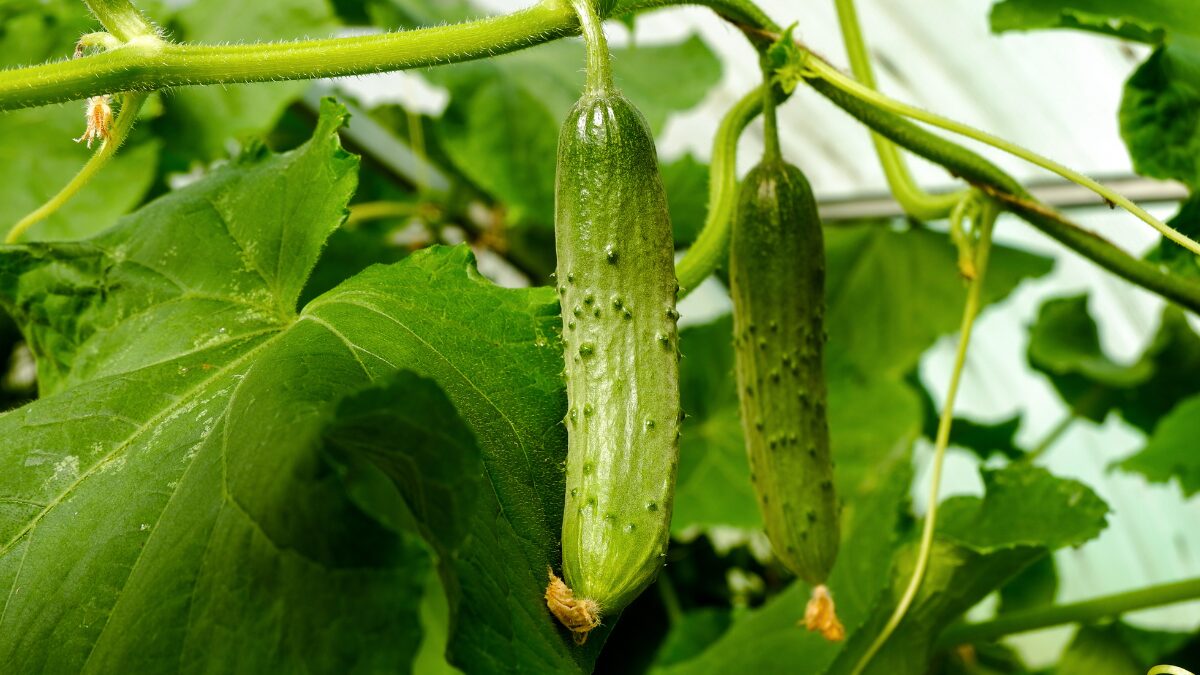
Cucumbers are a great vegetable to grow in your garden – and it’s easier than you might think. Even if you’re a beginner gardener, I promise you that you can harvest an abundance of cucumbers that will taste so much better than the store-bought stuff. In this complete guide on how to grow cucumbers, you’ll find everything from seed-starting to harvest.
Imagine going out into your garden or greenhouse in the summer, picking a large, ripe cucumber in passing, and biting into it right away. The crunchy sound it makes, the burst of fresh flavour on your tongue, and its juice dripping from the corner of your mouth… You can have all that.
In this guide, I’ll show you everything I know about growing cucumbers — from starting seeds and creating the right growing conditions to harvesting an abundant, flavourful crop.
Quick overview
| Stage | Key Requirements | Timing |
|---|---|---|
| Seed-starting | 22 - 29 °C / 72 - 84 °F soil temperature | Beginning to mid-April |
| Germination time | 5 - 10 days | |
| Transplanting | After the last frosts | Mid to end of May |
| Sunlight | 6 - 8 hours per day | All season |
| Nutrients | Nitrogen and potassium; phosphorus when blossoms form | Every 3 - 4 weeks |
| Harvest | Regular picking | 8 - 10 weeks after sowing |
Beginner Success Checklist
❄️ Plant cucumbers only after frost danger has passed
🌞 Choose a warm, sunny location
🌱Grow plants vertically on a trellis
💦 Keep soil consistently moist
🥒 Harvest fruits regularly to encourage new growth
What are Cucumbers?
Many people are astonished when they learn that cucumbers belong to the same plant family as melons and pumpkins. This family is called Cucurbits or, in Latin, Cucurbitaceae.
Cucumbers (Cucumis sativus), like pumpkins, melons and zucchini, are botanically speaking berries, a so-called “pepo”. A pepo is defined by a relatively thick peel, juicy flesh and seeds within.
Choosing the Right Cucumber Variety
Some cucumbers are just larger and longer than others, and that’s it, right? Wrong. There’s much more to cucumbers than meets the eye…
Variety
If you believe cucumbers are just those long, slender, green fruits you can find neatly aligned in supermarket shelves, you don’t know cucumbers yet. Stay with me, and I’ll show you.
Common cucumber types
The main distinction between cucumber types is by their intended use.
Salad cucumbers or snake cucumbers
Salad or snake cucumbers are probably the best-known cucumber type in the mid-latitudes. Their fruit is cylindrical, straight with a slight bend, and with both edges a bit thinner. They have smooth skin and are mostly eaten fresh – in salads, on sandwiches or as sticks with a dip.
Snake cucumbers are said to be sensitive and thus are often cultivated in a greenhouse. Fortunately, there are many more robust snake cucumber varieties that grow excellently outdoors.
Did you know that it’s quite easy to build a greenhouse without breaking the bank? In my guide on how to build a greenhouse, I show you how you can do it from scratch.
Salad cucumbers are mostly cultivated on trellises, where they produce straight fruits. You can also grow them without a trellis, lying on the ground, where their fruits will become bent. That said, if you want to get straight cucumbers, grow them on a trellis.
My favourite snake cucumber varieties are “Telegraph Improved” (greenhouse), “Delicius” (outdoors), “Tanja” (outdoors) and “Straight Eight” (greenhouse).
Pickling cucumbers or gherkins

Pickling cucumbers are commonly cultivated outdoors because they’re more robust and require less warmth. As the name indicates, pickling cucumbers (or gherkins) are mostly used for pickles, either by preserving them in a vinegar brine or by fermenting. You can, however, eat them fresh as well.
By preserving cucumbers, we make sure that we can eat cucumbers all year round.
My favourite pickling cucumber varieties are “Boston Pickling”, “Vorgebirgstraube” (a German variety), and “Homemade Pickles”.
Stewing cucumbers
As the name suggests, stewing cucumbers are mostly used for steaming and stewing. They grow well outdoors and produce large, thick fruits that turn yellow as they mature. They’re often used in Asian cuisine for curries and chutneys.
Colour and shape varieties
Cucumbers are not only green – they can be white, yellow, orange, brown and sometimes even blue.
The same goes for their form: we mostly know cucumbers as longish fruits, but there are also bent, curved, short and even round varieties with wrinkled, reticulated, warty or even spiky peels.
Even the taste differs. Salad cucumbers are crunchy, fresh and juicy, but rather neutral in taste; there are varieties with fruity, sweet or slightly sour flavours.
How to select the right cucumber varieties for your garden
Space
A greenhouse is nice to grow cucumbers in, but not absolutely necessary. In fact, you can cultivate cucumbers even in a pot on the patio or balcony, IF you live in at least zone 5 and the pot is at least 50 cm / 1.5 feet in diameter.
In the patch, cucumbers need about 50 cm / 1.5 feet of space between each other and are best grown on a trellis.
Quantity
In general, outdoor cucumber plants typically produce 6–12 fruits per season in temperate climates.
For salad cucumbers, calculate about 2 plants per person in your household, more if the plant produces small cucumbers. Depending on the variety and growing conditions, one cucumber plant typically produces between 5 and 20 fruits over the season. Smaller pickling varieties often yield more fruits than large slicing cucumbers.
If you want to make your own pickles, you need at least 4 pickling cucumber plants per person.
As a beginner, I’d recommend choosing resistant cucumber varieties like “Tanja” and “Telegraph Improved” as salad cucumbers and “Vorgebirgstraube” and “Boston Pickling” as pickling cucumbers.
Growing Conditions for Cucumbers
Temperatures
Cucumbers grow best in warm temperatures between 20–30°C (68–86°F). As they like it warm, they must not be planted out until after the last frosts. In my zone 7b, that’s around mid-May. If you’re not sure what your hardiness zone is, head over to this site, where you can look it up. But temperature isn’t the only requirement.
Light
Cucumbers need at least 6 hours of sunlight per day, better 8 or more. Choose a spot in your vegetable garden that lies in full sun and is protected from harsh winds.
My garden, for example, is facing southwards and has no houses or trees on the east and west sides that could cast a shadow on the vegetable patches.
Normally, that would expose the garden to the west winds that usually blow here, but it lies in a slight hollow, which creates a microclimate that’s slightly warmer than the surroundings.
Water
Cucumbers need regular, thorough watering, or else their fruits become bitter.
Outside in the garden, I usually water them twice a week or, when it’s really hot and dry, every other day. To check if they need water, I poke a hole of about 2 -3 cm (1 inch) in the soil with my finger. If it’s still moist under the surface, I don’t do anything, but if it’s dry, I get the watering can.
In the greenhouse, where temperatures are usually higher, I water them every day or at least every other day.
In pots, watering daily is a must, especially when it’s hot outside.
Water your cucumbers in the morning rather than in the evenings and avoid splashing water onto their leaves.
Garden vs Containers
You can cultivate cucumbers outside in a garden patch, indoors in a greenhouse or even in containers on a balcony or patio.
I’ve tried all three methods and learned the following:
Growing Cucumbers Outdoors
Cucumbers can grow well outside in a patch in your vegetable garden, but only if you use outdoor varieties. They grow quite well outside, even if the summer is not all hot and dry. Last year, for example, was quite rainy here in Bavaria, but the salad and pickling cucumbers I grew outdoors still produced fruit. Admittedly, the harvest has been larger in warm summers, but with the cucumbers from the greenhouse, it was enough.
Growing Cucumbers in a Greenhouse
To have a more stable harvest, I love cultivating cucumbers additionally in the greenhouse. There, I’m in control of watering, and temperatures are always a bit higher than outside. It’s important, however, to keep the greenhouse properly ventilated so that temperatures don’t climb too high.
Growing cucumbers in containers
Lastly, I also grew a cucumber in a container on my balcony. I chose a pot with about 40 L volume, which turned out to be ok. Ensure the seedlings get enough light while being protected from rain. When it gets too cold or moist outside, you can easily carry them in and pamper them there until the weather’s right again.
Cucumbers in containers need more water than those in a patch or greenhouse. Make sure to water them thoroughly at least once a day, better twice.
Soil
Cucumbers need nutritious, well-draining soil that can hold water but without waterlogging. To prepare your garden or greenhouse before planting, distribute compost on the patch and rake it roughly in.
It’s great to have your own compost, and it’s not as complicated as you might think. Here’s my beginner’s guide to composting that will tell you how to do it.
Before you plant cucumber seedlings, make sure the soil is warm, between 15 – 18 °C (60 – 65 °F). Otherwise, they’ll stop growing for quite some time.
If you grow cucumbers in containers, fill them with mature compost, mixed with rock flour, nettles and well-rotted manure or sheep wool. The nutrients in these components will slowly release into the soil, where they can be absorbed by the plants.
Spacing
As cucumbers grow, they become broader. It’s important, therefore, that we plant them with enough space between them and also between the rows so that they have enough space.
If we plant them too closely, they’ll not only produce less fruit but will also be prone to diseases and pests.
In the patch, the right spacing between cucumber plants is 50 – 60 cm (20 – 25 inches) and 80 – 100 cm between rows (2 – 3 feet).
The row spacing for pickling cucumbers is smaller. I usually install a trellis at the north side of a patch and plant the cucumbers on both sides with about 40 cm (20 inches) between rows.
In containers, logically, we put only one cucumber plant. When they grow, we can easily pull the pots apart, creating enough space for our plant babies.
The perfect companions for cucumbers
Proper vegetable companions strengthen and protect our cucumbers while at the same time making the most of the (usually too small) space in the patch. The best-known companion plant for cucumbers is dill, but there are many other options:
- Basil: Repels pests, attracts pollinators and promotes growth
- Dill: Attracts pollinators
- Nasturtium: Attracts aphids
- Peppers/Chillies: Similar light and water requirements
- Beans: Enrich the soil with nitrogen
- Garlic: Protects from fungal diseases and aphids
- Onions: Repel pests like white fly
- Corn: Works as a windbreaker and natural trellis
- Lettuce: Keeps the soil moist
- Spinach: Keeps the soil moist
- Radishes: Repel pests like cucumber beetle
Avoid planting cucumbers near these crops, as they compete for nutrients or share diseases:
- Tomatoes: Heavy feeder
- Zucchini: Same plant family
- Pumpkin: Same plant family
If you want to learn more about great partners in the patches, have a look at this guide about companion planting.
Now that we know the growing conditions for cucumbers, let’s start growing them!
How to Start Cucumber Seeds Indoors vs. Direct Sowing
You can either seed-start cucumbers indoors or sow them directly into the garden patch.
The best way is to combine both methods.
Start your first cucumber seedlings indoors, plant them out after the last frost and at the same time sow further cucumbers directly into the patch. When the pre-started plants get a disease, like for example mildew, or stop producing fruit, you can rip them out and still have a harvest from the directly sown cucumbers.
Let me show you how to start cucumbers from seeds
Seed-starting cucumbers – The What, When and How
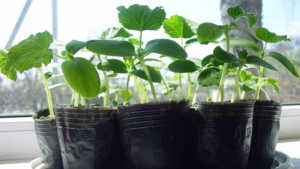
When to start cucumbers indoors
In Bavaria, the last frost is expected in mid-May, so that would allow me to sow cucumbers as early as mid-April.
I’ve tried it several times, and it never worked. That’s why I always start all of my cucumber varieties indoors.
Cucumbers grow relatively fast, and if we seed-start them too early, they can easily become thin and spindly and thus would be weak and prone to pests and diseases.
The best time to seed-start cucumbers, therefore, is about 4 – 6 weeks before the last expected frost date. In my hardiness zone 7b, that’s beginning to mid-April.
Equipment
For seed-starting, you need a container, planting soil, your seeds and water.
Container
There are many pre-made seed-starting containers to buy at the store, for example, mini greenhouses and special seed-starting trays. They usually have a transparent lid that creates a warm, protected environment. I got some and use them every year.
Cucumbers, however, like all the members of the Cucurbit family, don’t like their roots disturbed. For that reason, it’s better to sow them into single pots, one seed per pot. That way, we don’t have to thin them out and dig up their roots when transplanting them from the large seed-starting container to a pot or even outdoors.
Soil mix
The best soil for seed-starting cucumbers is either store-bought cultivation soil or well-rotted compost. Seeds have all the nutrients they need for germination in themselves. A rich, nutrient-dense soil would only lead to spindly and weak seedlings.
Put the soil in the containers you want to use and make sure to distribute it well to the edges. Press it slightly flat and fill up more soil if necessary. There should be a gap of about 1 cm (0.4 inches) from the soil to the edge of the container.
Seed-starting process
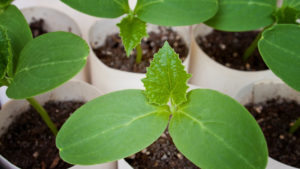
Put the cultivation soil into the pots and press it slightly in. When applying a bit of pressure with your hand, it should be firm but not brick-hard.
Poke a hole in the middle of each pot and put one seed in.
Label the pots. Honestly, that’s crucial to identify the plants later. No, you won’t remember where you put which variety and yes, it’s absolutely necessary to take the (short) time and stick labels into each pot.
Carefully water the pots and cover them either with a transparent lid (if part of a kit) or just wrap them with cling film. That way, we create a greenhouse-like atmosphere that holds the warmth and moisture at a constant level.
It’s important to open the covering daily to allow airflow and prevent fungal diseases.
Put the pots in a warm place with temperatures between 22 and 29 °C (72 – 84 °F) until they germinate, which is usually after 5 – 14 days. When the seedlings show, move the pots to a slightly colder (20 – 22 °C / 68 – 72 °F) room with enough light.
In this article, I describe in detail how to get healthy cucumber seedlings.
What to Expect After Sowing
- Germination: 5–14 days
- First flowers: 4–5 weeks
- First harvest: 8–10 weeks
- Productive period: 6–8 weeks
Hardening Off
Before we can release the seedlings into the wild outdoors, we have to harden them off. Start about a week before transplanting and put the seedlings outside for a couple of hours.
It’s important to monitor the temperature, as cucumbers are sensitive. Make sure it’s a warm day and put the seedling tray or pots in the shade so they don’t get too hot or even sunburnt.
Each day, prolong the time the plants stay outdoors, and after 3 days, you can start placing them in the sunlight (not around noon, that would be too much).
To make them accustomed to the wind, gently brush them with your hand, simulating wind movement.
After one week of hardening off, the cucumbers are ready for transplanting.
Transplanting Cucumbers to the Garden or Containers
When the nights finally stay warm, it’s time to get our cucumbers outside.
I always transplant my seedlings on a cloudy day or in the late hours of the afternoon to reduce the risk of plant shock.
First, I lay the pots or carefully uprooted plants out on the patch so that I can adjust the distance between them. Remember: it’s 50 – 60 cm (20 – 25 inches) between plants and 80 – 100 cm between rows (2 – 3 feet). If you plant in large pots, you can skip that step, of course, as it’s only one plant per pot.
In each planting hole, I put a small shovel full of moistened, well-rotted manure and half a handful of rock flour as a long-term fertiliser. This provides my cucumbers with some quickly available nutrients (manure) and a long-term fertiliser (rock flour). More on fertilising in “Daily Care and Maintenance”.
Then I put the plants as deep as the first real leaves. They’ll build further roots on the stem that’ll help them take up more water and nutrients.
I cover the hole with the soil I removed earlier and carefully press it down around the roots.
I water the seedlings properly after planting so that the soil settles around the roots, leaving no air holes.
When all my cucumbers are in the ground, I cover the soil between them with mulch. This could be hay, straw, pulled weeds, leaves, sheep wool, or wood shavings. If you plant in pots, mulch as well. Mulch helps reduce water evaporation, so you don’t have to water too often. It also reduces the growth of weeds, which I appreciate because weeding is not my favourite task.
If you live in a cooler climate and don’t have a greenhouse, you may want to consider foil tunnels around the plant rows. I wouldn’t use covers as they are too heavy and could eventually break the plants off.
Daily Care and Maintenance for Cucumbers
We’ve got our cucumber babies safely in the earth; now we’ve got to make sure that they thrive.

Watering Routines
Cucumbers consist mostly of water, and that’s why they need lots of it. Water cucumbers thoroughly every two days, daily when it’s hot. If they get too little water, cucumbers produce bitter fruits that are also slightly poisonous.
To check if my cucumbers need watering, I test the soil by touching the surface and even poking my finger into the ground. If it feels dry, it’s time to water.
I water the plants thoroughly, but ensure I don’t overwater them. With good drainage, either in the patch or the pot, that’s no problem.
Fertilising
Once your plants are thriving, the next step is to support them with the right nutrients.
Cucumbers are heavy feeders, which means they need a lot of nutrients. I prepare the patches in spring by adding compost and raking it in.
After the first fertilisation during transplanting (see above), I don’t feed the plants until the first buds show. Now they need phosphorus and potassium, and we can feed them with a tomato fertiliser.
Every 3 – 4 weeks, I add some nettle manure to the water and water my cucumbers with it.
Temperature control
We can’t control the temperature outside, of course, but we can monitor it in a greenhouse. I also had times when I forgot to open the windows of my greenhouse and only got there around noon or even later. Especially on sunny summer days, temperatures get high very fast in a greenhouse, and although cucumbers need it to be warm, hot is too hot, and temperatures above 35 °C (95 °F) can stress plants and cause blossoms to drop.
The same goes for colder temperatures. Below 10 °C (50 °F), cucumbers will stop growing. When low temperatures are forecast, we just protect our babies with a foil tunnel or by closing the greenhouse windows.
If you cultivate cucumbers in pots, put them indoors when it’s too cold outside. If it gets warmer, you can always put them back out.
How to build a cucumber trellis
The easiest method to build a trellis for your cucumbers is by binding three long rods together at their upper end and installing them like a tipi. The cucumbers will climb upwards, and the fruits will stay clean.
This trick also allows you to plant more cucumbers in the same space.
Protecting Cucumbers from Pests and Diseases
Sooner or later, all cucumbers will get infected with powdery or false mildew. To keep the damage as low as possible, you can either plant resistant cucumber varieties and/or use succession planting. That way, you’ll have fresh cucumbers all season long. I’ve written a comprehensive guide that describes the most common cucumber diseases, their prevention and how to treat them organically.
The most common pests on cucumbers are aphids, thrips and spider mites.
Companions like nasturtium attract aphids away from cucumbers. (Wanna know how to get rid of aphids? Here’s the deal.)
To protect cucumbers from thrips and spider mites, I usually use beneficial insects like lacewing larvae and predatory mites. This method works best in the greenhouse; outdoors, it’s a bit trickier.
The best prevention against pests and diseases, though are healthy plants! Follow the care guidelines in this article—consistent watering, proper spacing, good air circulation, and companion planting—and you’ll avoid most problems.
Pollination and Fruit Development
Cucumbers develop male and female blossoms, which can be easily distinguished. Understanding the “who’s who” of cucumber blossoms improves pollination chances and makes it easier for you to pollinate by hand if necessary.
Understanding male and female flowers
Cucumber plants produce male and female flowers on the same plant. Both flowers are yellow and have five petals that grow thinner towards the end and slightly bend outwards.
The petals build a corolla, which is surrounded by green sepals.

Male flowers
The male blossoms have a tube at the base of the corolla from which the stamens develop, which produce pollen. Male blossoms grow in bundles on thin stems in the leaf axils.

Female cucumber flowers
Female blossoms develop pistils instead of stamens. They grow separately on the plant and show a slight fruit setting.
Some cucumber varieties, the so-called parthenocarpic varieties, only produce female flowers. They don’t need pollination and are especially suitable for greenhouses. Outdoor cucumbers, however, need male flowers for pollination, so they should generally not be removed.
Should you remove male cucumber flowers?
It’s not necessary to remove the male flowers, but in some cases it can help to enhance the number of fruits and their quality.
Male flowers lack fruit set at the base. Their main task is pollination.
When you see that your cucumber plants have too many male flowers compared to female ones, you can remove some of the male flowers to concentrate the plants’ energy on female flowers and thus fruit formation.
Don’t overdo it, though. There should always be enough male flowers on the plants to guarantee pollination.
How to remove male flowers the right way
Identify the male flowers: they have a slim stem with no small cucumber at the flower base.
Choose the right time: The best time to remove male flowers is in the early mornings when the plant is not stressed (yet), and the flowers are still closed.
Clean tools: Use a clean and sharp knife or garden scissors to remove male flowers to prevent infecting the plants with diseases.
Cut off the flower: Cut the male flower stem about 2 – 3 cm (3/4 – 1 1/4 inches) below the flower, without damaging the nearby leaves or stems.
Training and Pruning Cucumbers
It’s common knowledge that we need to prune tomatoes, but what about cucumbers? Well, let’s say there’s no common consensus on whether pruning cucumbers is necessary.
Let me explain to you the reasons behind that and how it’s done. After that, you can decide for yourself if you want to prune your cucumbers or not.
Why prune cucumbers?

Limited space
In general, we only prune cucumbers that climb up a trellis and have limited space to grow. Cucumber plants can claim lots of space – if we let them. To prevent them from proliferating, especially in a greenhouse, we guide one or two shoots upwards. All other side shoots are pruned.
Prevent diseases
Cucumber diseases like mildew especially appear in a humid and warm climate. The danger of infection is enhanced when there are too many leaves on the plants that keep the humidity inside. Pruning removes side shoots and their leaves and ensures improved aeration.
Enhance fruit formation
One shoot can only care for a limited number of fruits. When the main shoot has many fruits, the side shoots should be pruned. After all, we don’t want more leaves but more fruits.
Additionally, by the end of August, it’s not sensible to let the cucumber plant produce flowers. It’s too late for fruits that develop then to mature before cold temperatures strike.
When you have enough space – usually outdoors instead of in the greenhouse – you can just let the cucumbers grow as they like, as long as they don’t get in the way of other plants.
How to prune cucumbers
Pruning cucumbers in itself is quite easy. Simply cut off suckers that develop in the axis between the main and side shoot, either with your fingers or with a knife or garden scissors.
Also, remove side shoots and leaves from the two feet at the bottom. That way, you can water more easily without wetting the leaves.
When your cucumber plants have reached the top of the trellis, cut off the shoot tips. That way, they won’t grow any higher.
Make sure your hands and tools are clean when pruning so that you can’t spread diseases.
Hand pollination techniques
Usually, pollination is done by flying insects like bees, bumble bees and others. However, due to unfavourable climatic conditions like cool soil temperature and high humidity, pollinators may not be able to do their job properly. In that case, we may have to pollinate our cucumbers ourselves:
The best time for hand pollination is mid-morning when the flowers start to open. Make sure you have both male and female flowers at the same time.
Pick a fresh male flower and carefully remove the petals to expose the stamens.
Rub the male stamens directly on the stigma of the female flower. Alternatively, you can use a small, clean brush to take the pollen and transfer it to the stigma of the female blossom.
If successfully pollinated, female cucumber blossoms will soon develop little cucumber fruits below the flower.
But how do we know when cucumbers are ready to harvest? And how to harvest them properly? I’ll show you.
Harvesting Cucumbers – When and How
Finally! Our cucumbers are ready to be harvested. Depending on the variety, that can be as early as 8 weeks after seed-starting.
It’s best to harvest middle-large cucumbers. Very young cucumbers don’t taste good, yet very large fruit have a thick skin and contain many seeds.
To harvest cucumbers, cut them off with a sharp knife or garden scissors. If you try to rip the fruit off the branch, you usually end up ripping off the branch or part of the fruit. Yep, speaking from experience here.
The fruit stem, or at least part of it, should always remain at the fruit so that it stays closed. This is especially important when you want to store the fruit.
How to Store Cucumbers
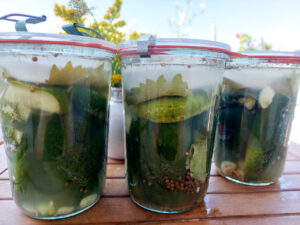
Fermented gherkins
Fresh cucumbers should always be stored in a dry and cool place, optimally at 10 – 13°C (50-55°F). They shouldn’t lie next to apples or tomatoes, as these fruits emit the gas ethylene, which makes cucumbers spoil faster.
Cucumbers don’t store equally well in the fridge, as the temperatures are too cold for them.
For long-term storage, preserve your cucumbers. Pickled gherkins are a classic, as are fermented gherkins.
If you want to try them out, here you’ll find a recipe for brine-pickled gherkins, and here’s a recipe for fermented salt cucumbers.
And if you have more cucumbers than you and your family could ever eat, give them to friends and neighbours. I’m sure they’ll love it!
Troubleshooting
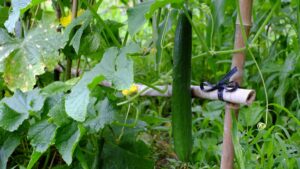
1. Why do my cucumber plants have flowers but no fruit?
Common Causes & Solutions:
- Immature plants: It takes about 4 weeks from pollination to harvest. Stay patient!
- Temperature stress: Temps are either too high or change a lot between high and low.
Provide shade in extreme heat and protect your plants from cold nights with fleece or bring the pots indoors. - Pollination problems (especially in the greenhouse).
Open the windows and door, and plant insect-friendly flowers and herbs to attract pollinators.
2. Why are my cucumbers bitter?
Common Causes & Solutions:
- Irregular watering: Water cucumbers thoroughly at least every other day, if in containers, at least once a day.
- Heat stress: Temps are either too high or change a lot between high and low.
Provide shade in extreme heat and protect your plants from cold nights with fleece or bring the pots indoors.
3. Why are my cucumber leaves turning yellow?
Common Causes & Solutions:
- Overwatering: Poke a hole near the cucumber roots and check the soil. If it’s dry, water thoroughly
- Nutrient deficiency: Cucumbers are heavy feeders and need a lot of nutrients. Add nettle manure or tomato fertiliser
- Natural ageing: With age, cucumber leaves turn yellow and die
4. Why do cucumber plants suddenly wilt?
Common Causes & Solutions
- Heat stress: Temps are either too high or change a lot between high and low.
Provide shade in extreme heat and protect your plants from cold nights with fleece or bring the pots indoors. - Underwatering: Water cucumbers thoroughly at least every other day, if in containers, at least once a day.
- Root damage: If the damage is small, the plant could recover
- Fungal disease: Remove the infected leaves immediately and discard them in the garbage (not the compost). The plant may recover.
5. Why do my cucumbers grow small or misshapen?
Common Causes & Solutions
- Poor pollination: Attract more pollinators by planting flowers and flowering herbs; open the windows and doors of your greenhouse to let the insects in.
- Inconsistent watering: Water cucumbers thoroughly at least every other day, if in containers, at least once a day.
- Nutrient deficiency: Cucumbers are heavy feeders and need a lot of nutrients. Add nettle manure or tomato fertiliser
6. What is the white powder on my cucumber leaves?
The Cause: This is powdery mildew, a fungal disease prone to cucumbers.
The solution: If just a few leaves are infected, remove them immediately and discard them in the garbage (not the compost). Also, make sure that air gets to the plant and, if necessary, prune it.
If the disease has spread too far, remove the whole plant.
7. Why did my cucumber plants stop producing fruit?
Common Causes & Solutions
- Natural ageing: With age, cucumber plants stop producing fruit
- Nutrient deficiency: Cucumbers are heavy feeders and need a lot of nutrients. Add nettle manure or tomato fertiliser
- Diseases: Diseases weaken the plant
- Lack of harvesting: The more you harvest, the more fresh fruits the plants produce
FAQs – Questions and Quick Answers
✔️ How long does it take to grow cucumbers?
Depending on the variety, between 50 and 75 days from seed-starting to harvest.
✔️ Do cucumbers need a trellis?
It’s advisable, especially when your space is limited. It’s optional, though.
✔️ How many cucumber plants do I need per person?
About 2 plants of salad cucumbers and 4 plants of pickling cucumbers per person.
✔️ Can cucumbers grow in pots or containers?
Absolutely. Just make sure they are large enough (diameter about 40 cm / 16 inches)
✔️ How often should I water cucumbers?
Check the soil and water when it feels dry. Outdoors, water regularly and deeply every 1 – 2 days, in a container, water daily or – if very hot – twice a day.
✔️ When is the best time to plant cucumbers?
After the last night frost, in zone 7b, that’s mid-May. In the greenhouse, you may plant two weeks earlier.
✔️ Can cucumbers grow in partial shade?
Yes, but only if the space is protected from wind, the soil has good drainage, and the plants are properly fertilised.
Time to Get Growing
Remember when I told you earlier how wonderful it would be to just go into the garden, pick a cucumber and bite into it right away? You’re just a few steps away from cultivating your own cucumbers this season.
I hope I’ve shown you that it’s not rocket science and that you definitely have it in you to grow cucumbers this year!
Just keep in mind to start them from seeds about 4 – 6 weeks before transplanting, leaving them enough space and at best, grow them on a trellis.
If you then water and fertilise them regularly during the summer and make sure that they stay healthy, there’s nothing between you and a delicious bowl of cucumber salad!
Ready to get started? Your cucumber-growing adventure begins now! 🥒
If you want to grow more delicious vegetables in your garden, you can read on here:
How to plant, grow and harvest tomatoes in 14 steps
The Complete Pumpkin Grower’s Guide: From Seed Selection to Harvest
How to Grow Peppers & Chillies from Seed: The Ultimate Step-by-Step Guide
0 Comments