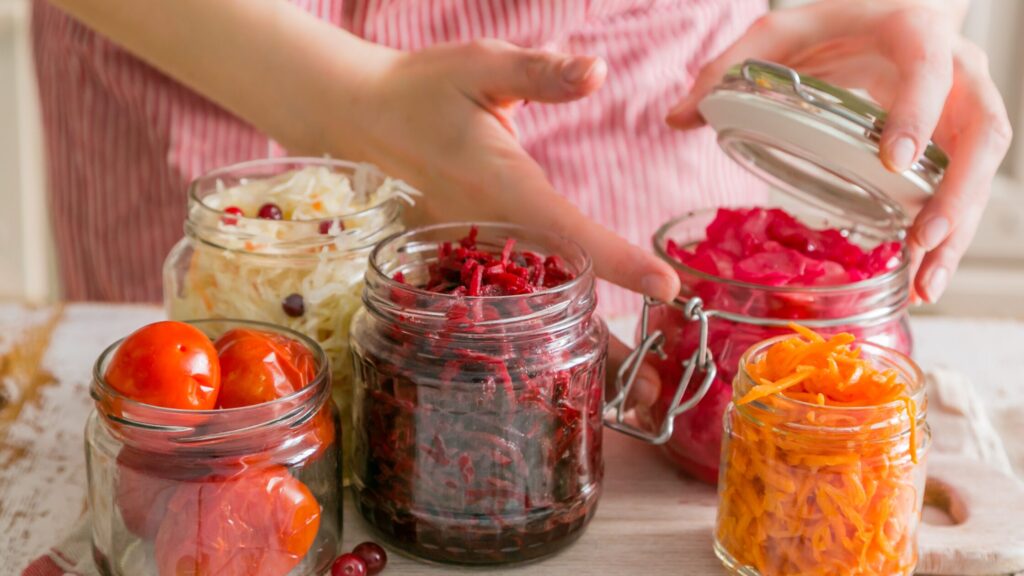
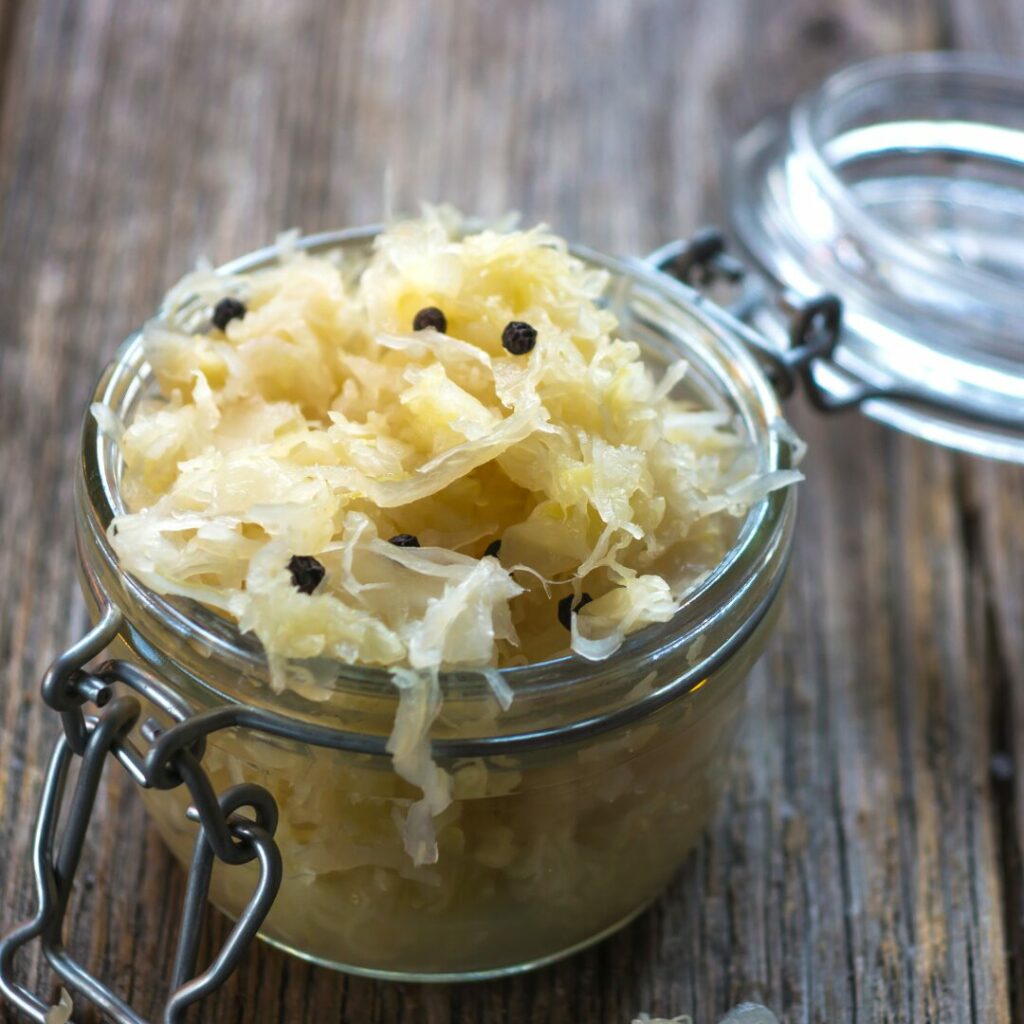
Let’s address the elephant in the room, shall we? Whenever I talk about fermentation, someone eventually asks the same question: “That sounds great—but is homemade fermentation safe?”
Few topics create as much anxiety among beginner fermenters as food safety. Some people say fermentation is perfectly safe, others warn about deadly bacteria, and somewhere online you’ll inevitably stumble across frightening stories about botulism.
The good news is that traditional vegetable fermentation is one of the oldest and safest methods of food preservation—provided you follow a few simple principles. So yes, homemade vegetable fermentation is remarkably safe when you use the correct amount of salt, keep your vegetables submerged beneath the brine, and practise good hygiene.
In this guide, I’ll explain what actually keeps fermented foods safe, what can go wrong, and when you should throw a batch away.
To answer the question if fermentation is safe quickly: Yes, as long as you observe certain rules.
Can fermented vegetables be dangerous?
✔ Usually not.
Traditional lacto-fermentation naturally creates an acidic environment that prevents harmful bacteria from growing. As long as you:
use clean equipment
keep vegetables submerged
use enough salt
discard obviously spoiled batches
home fermentation is remarkably safe.
What Makes Fermentation Safe?
To determine that fermentation is a safe process, we must first understand how fermentation works. Please note that I’m talking mainly about lactic acid fermentation in this article.
The (originally Latin) word „fermentation“ means „transformation of a substance“. When food is fermented, the transformation is carried out by the smallest creatures, called microorganisms or microbes, such as bacteria and yeasts.
In simple terms, fermentation is a preservation method that uses beneficial microorganisms to transform and protect food.
Microorganisms which are naturally present on vegetables, fruits and other food break down the natural sugars and transform them into alcohol, acids or other by-products.
Depending on the type of fermentation, the microorganisms involved in the process vary. When we ferment sauerkraut, for example, we apply lactic acid fermentation and the most common bacteria responsible for that process are the Lactobacillus species.
Now, there aren’t only beneficial bacteria on our food, but also some that could do us harm. To keep them at bay and even kill them off, we use salt in lactic acid fermentation.
These three factors work together to make lactic acid fermentation remarkably safe.
Salt
If you have ever made sauerkraut, you know that we just need two ingredients: cabbage and salt.
The amount of salt is determined by the net weight of the cabbage. After slicing the cabbage, we weigh it and add 3 % of its weight in salt.
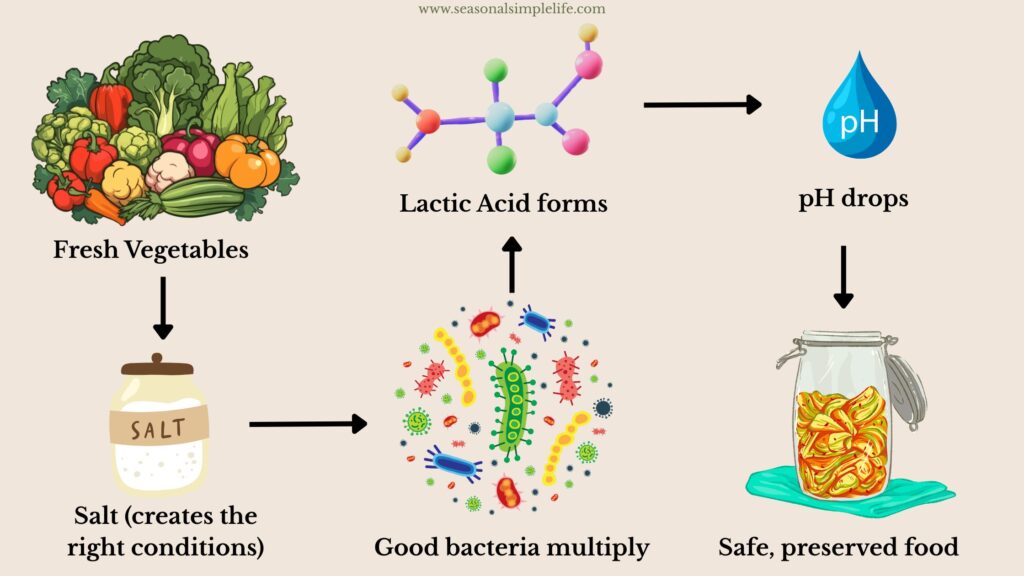
This step is essential for the safety of the fermented food later. Salt slows down undesirable microbes while at the same time giving lactic acid bacteria an advantage. The latter can handle the salty environment much better, allowing them to multiply faster and displacing unbeneficial microbes.
Oxygen removal
Another crucial point in lactic acid fermentation is the removal of oxygen in the jars or crock.
Let’s take sauerkraut again as an example: when we’ve sliced the cabbage and added the salt, we knead the cabbage with our hands until a brine forms. Then we pack the cabbage tightly into jars or a crock, pounding it down so that any air pockets get removed. The brine will eventually cover the cabbage.
When we’ve packed enough cabbage in the jar, we cover the surface with a weight, keeping everything under the brine, that is, without oxygen.
Why is this important? Well, certain harmful microorganisms need oxygen to survive and grow. Mould, for example, usually forms on the surface of the brine when it’s been exposed to air. Kahm yeast, though not toxic, is another example.
I can hear you ask now: “But although the cabbage may be under the brine, there’s always oxygen between the brine surface and the jar lid. Wouldn’t mould form as a consequence?”
The short answer is: No. You see, during fermentation, gases will be built up. We can witness this process by the bubbles that form and the occasional “burp”. The gases develop so much pressure that they’re gradually pressed out from under the lid. That way, they also displace the oxygen that has been in the jar in the first place.
Lactic acid
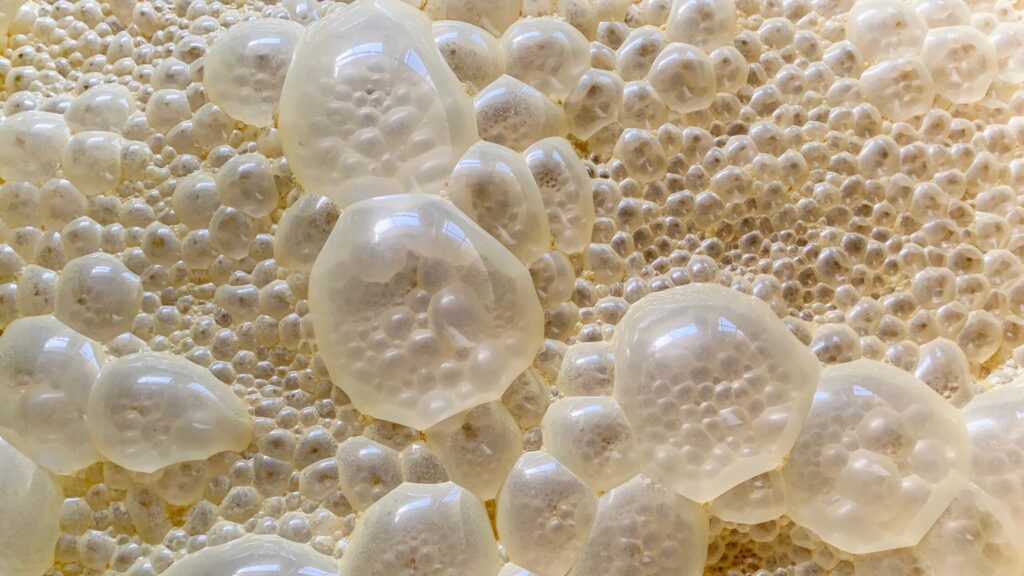
After a few days, the fermentation process will start. As I mentioned before, we can see bubbles and the gases that form not only take oxygen with them, but sometimes also a bit of brine. These are the visual clues for a successful fermentation process.
What we can’t see – but could measure – is that the brine’s pH level continually drops. After all, it’s called lactic acid fermentation for a reason: the Lactobacilli transform the sugars in the vegetables into acid, which naturally lowers the pH to between 3.8 and 4.2.
Although properly fermented vegetables usually reach a pH below 4.6, most home fermenters don’t need to measure it. If you follow the basic rules—adequate salt, submerged vegetables, and sufficient fermentation time—the acidity develops naturally.
In this acid environment, harmful microorganisms like putrid bacteria or alcohol-producing yeasts can’t exist.
Pretty cool, right?
Together, these three factors—salt, oxygen removal and acid production—create an environment in which beneficial bacteria thrive while harmful microorganisms struggle to survive. That’s the foundation of safe vegetable fermentation.
Even with all these natural safety mechanisms in place, many people still confuse fermentation with food spoilage. When talking about fermentation, one woman once said to me that to her fermentation is just rotted food. Let me show you why fermentation is something entirely different:
Why Fermentation Isn’t “Rotting”
Rotting is always an uncontrolled (and uncontrollable) process where many different microorganisms are involved. The results are always several unpleasant compounds. Thankfully, we can detect them in multiple ways, either by their abhorrent smell, alarming colours (black, violet, orange, etc.) or their repugnant appearance.
Humans are naturally repelled by rotten food. We have an inherent toxicity detector that alerts us when food is off.
Fermentation, on the other hand, is a controlled process that is dominated by beneficial microbes. In the case of lactic acid fermentation, these microbes produce acid, which not only gives our food a sour taste but also protects it from any harmful microorganisms.
Fermented vegetables smell slightly sour but not repugnant, and they look perfectly well.
Can You Get Botulism from Fermented Vegetables?
It’s important to distinguish vegetable fermentation from low-acid home canning. Although both preserve food, they rely on completely different principles and carry different risks.
Botulism is a rare but life-threatening poisoning that is caused by the bacterium Clostridium botulinum. This poison usually results from rotten meat or insufficiently canned food.
If someone were to eat food contaminated with Clostridium botulinum, they’d develop severe symptoms that could even be lethal. Although botulism is extremely rare, isolated cases do occur, which is why people are understandably concerned.
But: Properly fermented vegetables are a very poor environment for Clostridium botulinum. The ferments become too acidic for botulism bacteria to grow or produce toxin.
When we apply the right amount of salt to our vegetables when fermenting them and see that everything remains submerged, we have done everything to make sure our ferments will be safe to eat.
But how will we know that?
Signs Your Ferment Is Healthy
The best way to check whether our ferment is healthy is by using our senses:
✔ The content of the jar has a sour smell.
✔ When fermentation starts, bubbles form.
✔ The brine eventually becomes cloudy.
✔ We can even detect a slight yeast aroma.
✔ When you eat a forkful, you’ll notice that the vegetables have been softened.
✔ The vegetables change their colour during the fermentation process and usually become duller.
Now that we know what a good ferment looks and smells like, what about one that’s gone south?
Signs Something Went Wrong
This table will show you at a glance whether your ferment is good-to-eat or must be thrown away:
Normal 👍🏻
Discard ⚠️
Cloudy brine
Fuzzy mould
White kahm yeast
Pink mould
Bubbles
Black mould
Sour smell
Rotten, putrid smell
Sediment
Slimy, foul ferment
Let me show you the difference between kahm yeast and mould:
Kahm Yeast vs Mould
Kahm yeast is a layer of wild yeasts that forms on lacto-fermented goods. It always appears on the surface; that is exactly where the ferment has contact with oxygen.
It may develop an unpleasant flavour, but overall it’s harmless.
Its typical appearance is flat and sometimes slightly wrinkled, but it never shows a furry structure. And that’s the great difference between Kahm yeast and mould.
Important: Kahm yeast is not mould. It occurs when oxygen comes into contact with the ferment.
Mould: While Kahm yeast is flat, even and like a white film on the surface, mould grows in sections. It’s often coloured – either green, black, blue, or even pink – and, most importantly, it has a fuzzy, hairy appearance that’s growing upward.
Contrary to Kahm yeast, mouldy ferments must always be discarded.
If in doubt, throw it out!
If you’re ever genuinely unsure whether a ferment is safe, don’t taste it.
Fermentation should build confidence—not anxiety. When a batch shows obvious mould, smells rotten or makes you uneasy, discard it and start again.
There are some common mistakes to avoid when fermenting vegetables:
Using too little salt
Initially, it seems like a large amount of salt we have to use when fermenting vegetables, and we may be tempted to cut it down. Unfortunately, that’s a sure way to produce something rotten.
As we’ve learned, the salt kills harmful microorganisms and promotes beneficial ones, which will thrive and multiply happily in the salt brine. Eventually, they will create an acidic environment that helps keep the ferment safe for a long time.
Vegetables floating above the brine
Fermentation is an anaerobic process, which means without oxygen. When vegetables are not constantly submerged but stick out of the brine, they’ll get in touch with the little oxygen that’s left in the jar and eventually will start to mould.
Dirty utensils
Hygiene is important in any preserving process, and also in fermentation. The jars and lids we use needn’t be sterile (see below) but clean. The same goes for knives, cutting boards, the tamper and fermentation weights. Clean them in hot soap water and let them dry before you use them.
While you should close the lid on fermentation jars, it’s sufficient to only screw them slightly. That way, gases that form during fermentation as well as the occasional drop of brine can get out from under the lid. If you seal the jars too tightly, the gases have no way of escaping and pressure will build up, which could even lead to the jar exploding.
Opening constantly
When I first fermented in jars, I opened them once a day because I feared they might explode otherwise.
And to have a peek inside. Not that I’m curious. I just wanted to check that everything’s alright.
Unfortunately, this non-curiosity allowed the oxygen to flow back, and from the five jars I had initially used for fermentation, I had to throw out three because they got mouldy.
By now you know how to recognise a healthy ferment and avoid the most common mistakes. If you’d like a printable reminder while making your first batch, I’ve put together a free checklist you can keep beside your jar.
Common Questions During Fermentation
A healthy ferment can still surprise you. Here are a few common questions that often come up during the fermentation process.
Should You Sterilise Jars?
It’s a great myth that still circles around in fermentation groups that the jars and lids you use must be sterilised.
While that’s perfectly true and necessary for canning or preserving jam, sterilising isn’t necessary for vegetable fermentation.
After all, we make use of microorganisms that occur naturally on vegetables and fruits – and also our clean hands with which we have touched the jars.
Clean is enough when it comes to fermentation equipment. Just wash it all in hot soap water and let it dry before use.
Is White Sediment Dangerous?
Often, there’s a white sediment forming at the bottom of the jar, especially some time after the initial fermentation process has ended. This sediment is completely normal.
During fermentation, dead lactic acid bacteria and vegetable particles can settle at the bottom of the jar. It’s harmless and a normal sign of fermentation.
Does Fermentation Continue in the Fridge?
To start the fermentation process, we need temperatures between 20 – 24 °C ideally. After the initial fermentation is finished, we put our jars in a cool place, usually the fridge. There, the process doesn’t stop entirely, but slows down considerably so that the ferment can be stored longer without becoming too sour.
Can You Eat Fermented Food If It Smells Strong?
Especially beginners get hit in the face when they open their first jar of home-fermented vegetables, because the smell is unfamiliar and they wonder whether what they produce is safe to eat.
Look, fermented food doesn’t smell in the least like fresh vegetables. Freshly sliced cabbage, for example, has a slightly stale smell, but nothing strong. Sauerkraut, on the other hand, smells sour, tangy and even a bit sulphuric, and that’s perfectly fine.
Depending on what you fermented, the smells may differ.
Garlic, for example, develops a very sharp, pronounced smell once it’s fermented. I’ve put my small jar of fermented garlic paste into another jar, because the smell was so pronounced that the whole fridge reeked of it.
Even a slightly yeasty smell is perfectly normal in a ferment. After all, there are also yeasts involved in lactic acid fermentation.
There are, however, smells that tell us that this jar has to be thrown out.
When a ferment smells truly repugnant, rotten and like garbage or rotten meat, the only way is to discard it. A bad smell usually goes with mould, pink or orange slime on the surface, and maybe even a lid that explodes in your face when you open the jar.
Frequently Asked Questions
Can harmful bacteria survive fermentation?
Not when you use the right amount of salt, have observed hygiene and made sure that everything is submerged.
How much salt makes fermentation safe?
Depending on the vegetables you use, a salt ratio between 2 and 5 % is safe.
Should I remove kahm yeast?
Yes, I’d recommend carefully removing it. Otherwise, mould could form.
Can I scrape mould off and keep the ferment?
Mould develops long “roots” that penetrate the whole ferment, but is invisible to the naked eye. Mouldy ferments should always be discarded.
Is cloudy brine normal?
Yes. Microorganisms and yeasts make the brine cloudy.
Can I use tap water?
Yes, but only if it’s not chlorinated. Chlorine will harm the fermentation process.
Is fermentation safe for children?
Yes, children benefit as much from fermentation as adults.
Can pregnant women eat fermented vegetables?
Yes, it won’t harm them or the baby.
Can I eat fermented vegetables if they taste very sour?
Yes. A stronger sour taste simply means fermentation has progressed further. The vegetables are still perfectly safe, although you may prefer storing them in the refrigerator sooner next time if you enjoy a milder flavour.
Why does my ferment smell like cheese?
During fermentation, many different aromatic compounds are produced. Depending on the vegetables and the microorganisms involved, some ferments can briefly develop a smell reminiscent of cheese or feet. As long as the smell isn’t rotten, putrid or accompanied by mould, this is usually a normal stage of fermentation.
Does vinegar make fermentation safer?
No, it would, on the contrary, inhibit the process. Vinegar is used in pickling, which is different from fermentation.
Common Fermentation Safety Myths
Somehow there are still some fermentation myths out there that refuse to die, no matter how often someone has proven them wrong. Let me show them to you, so that next time one of them comes up in conversation, you can confidently clear it up.
Myth 1: If there’s no mould, it’s always safe
I wish this were true, but as we’ve learned, there are several factors that matter when it comes to food safety in ferments.
The first, of course, is smell. If there’s no mould but your nose tells you it’s dying from the smell, discard the ferment.
Other factors are acidity and a properly performed fermentation process.
Myth 2: Every white film is mould
More often than not, a white film on the brine surface is just kahm yeast, which is harmless.
Myth 3: Fermentation needs special bacteria
Fresh vegetables and fruits naturally carry all the microbes needed for fermentation.
Myth 4: Sterilising everything makes fermentation safer
While clean equipment is important, sterile conditions are neither necessary nor desirable for vegetable fermentation.
Myth 5: Fermentation is unpredictable
On the contrary: once you understand the basic principles, fermentation is remarkably consistent.
Final Thoughts
For thousands of years, our ancestors have preserved food through fermentation.
While no method of food preparation is entirely without risk, vegetable fermentation is surprisingly forgiving. By understanding the basic principles—salt, submersion, cleanliness, and patience—you’ll soon learn to recognise the difference between a healthy ferment and one that should be discarded.
Confidence comes with experience, and after a few successful batches, you’ll likely find fermentation far less mysterious than it first appeared.
Something doesn’t look quite right? Learn how to diagnose soft vegetables, white film, strange smells and other common fermentation issues in my complete troubleshooting guide.
Continue Your Fermentation Journey
Just getting started? These guides will help you take the next step:
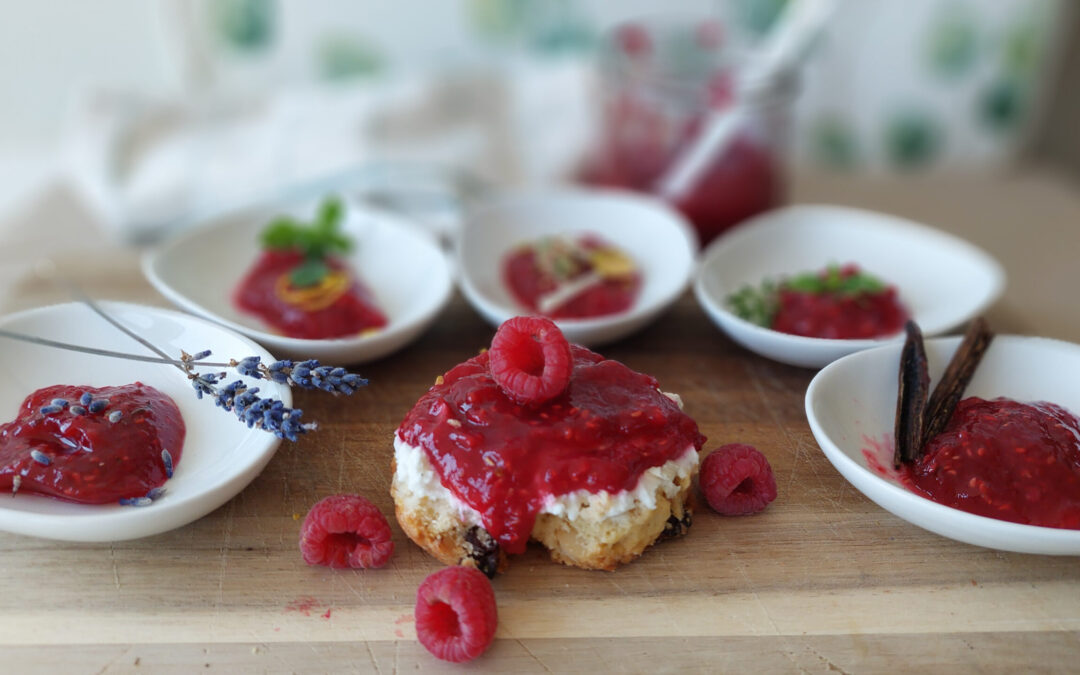
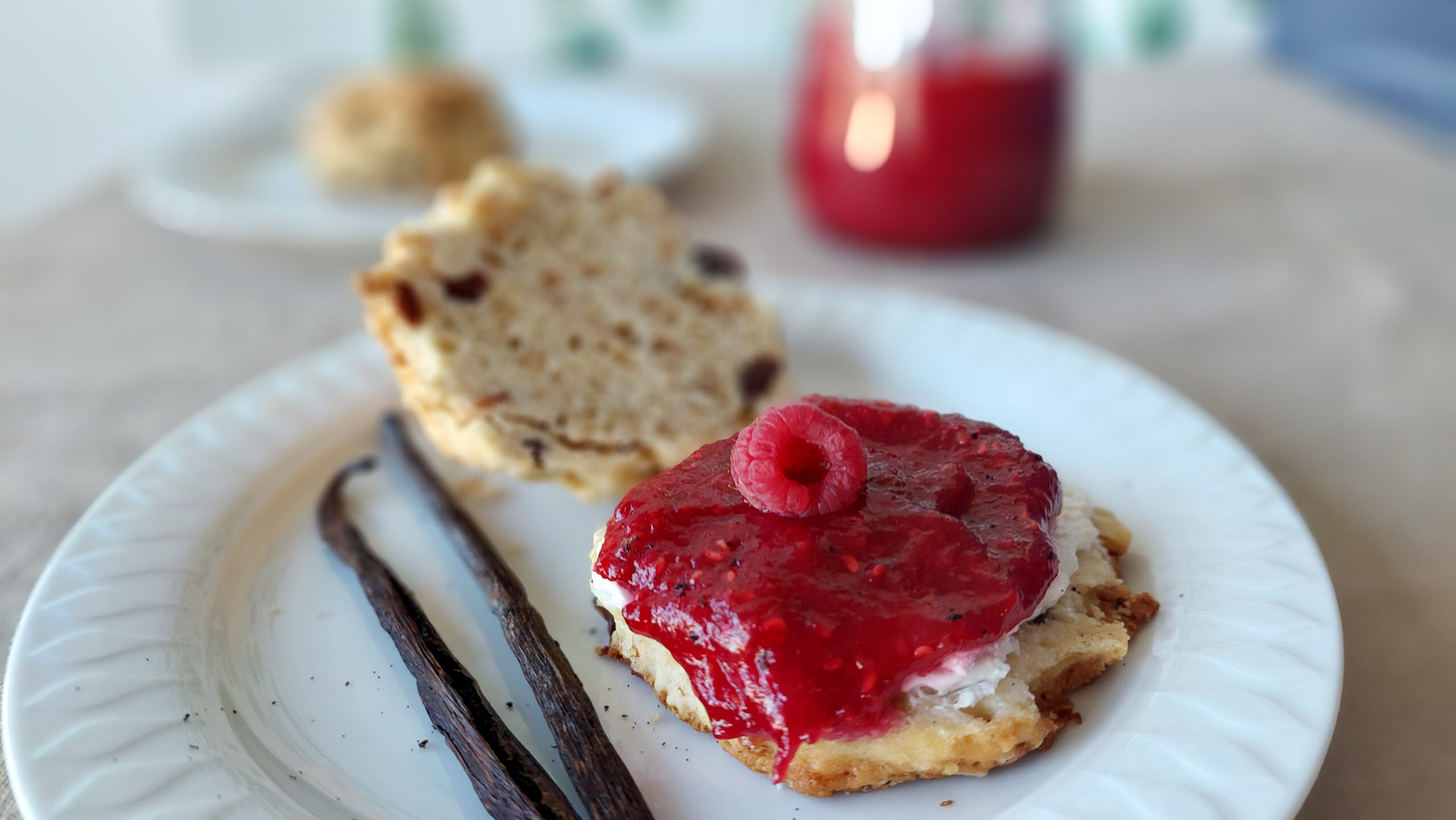
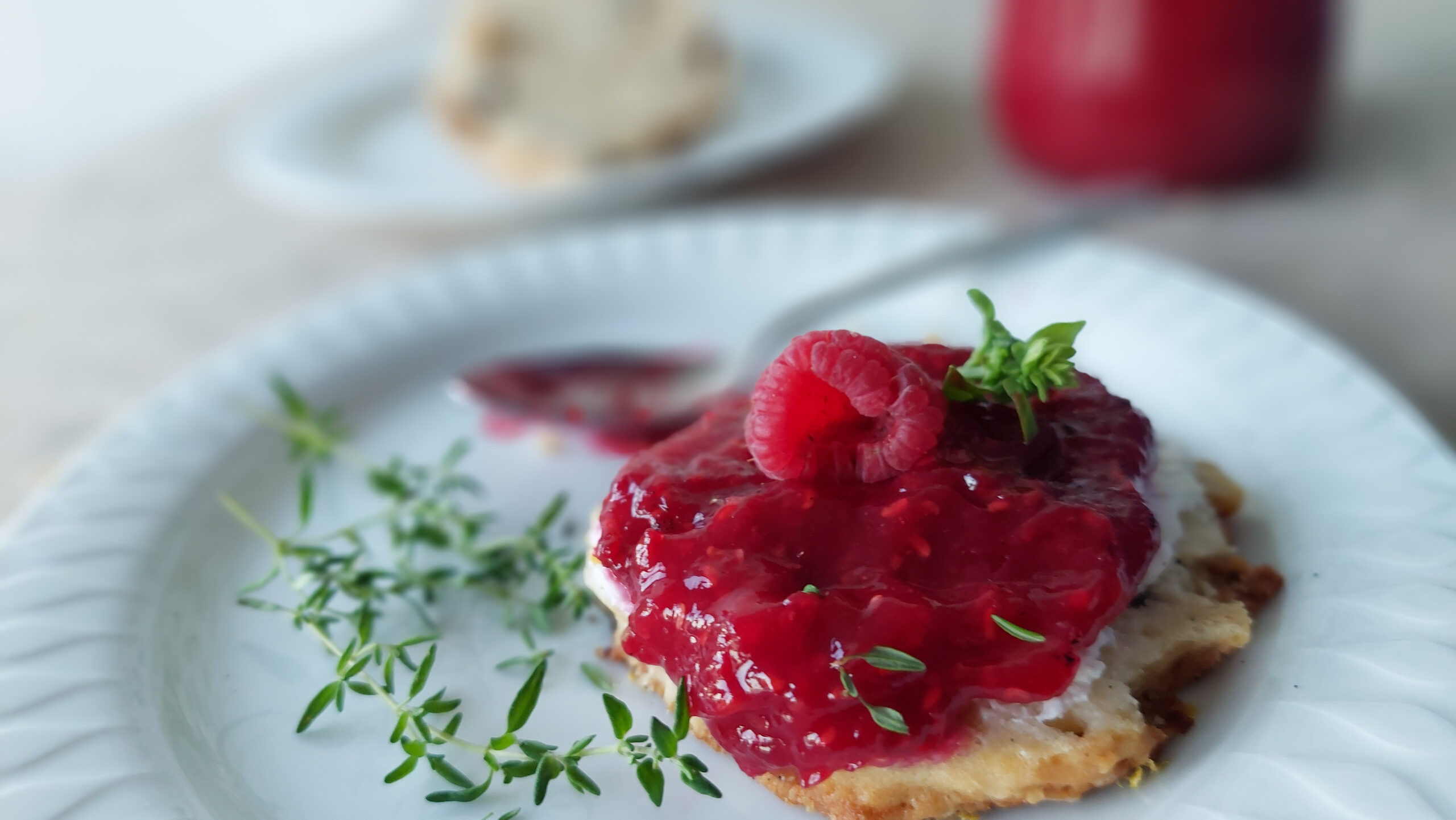
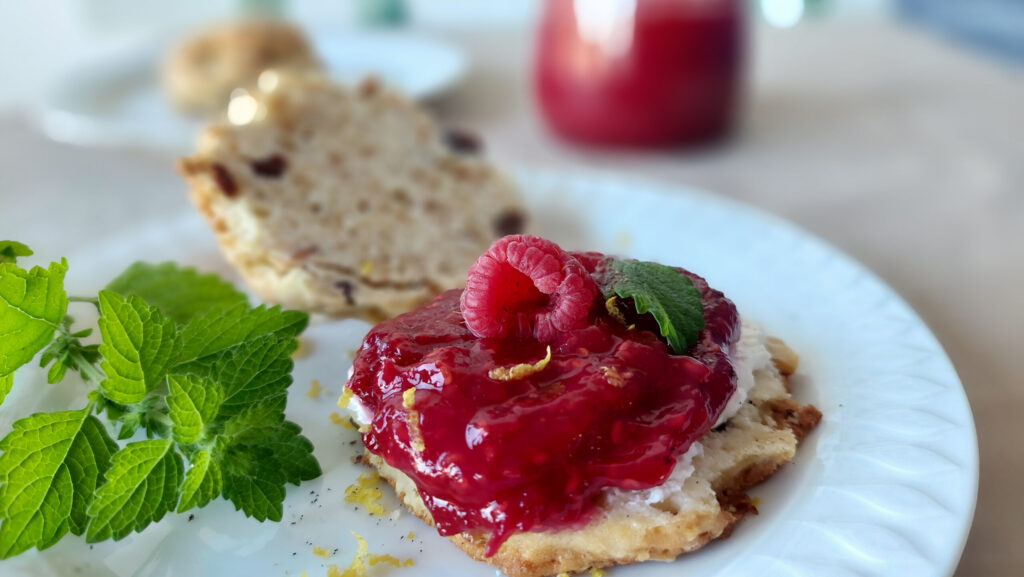
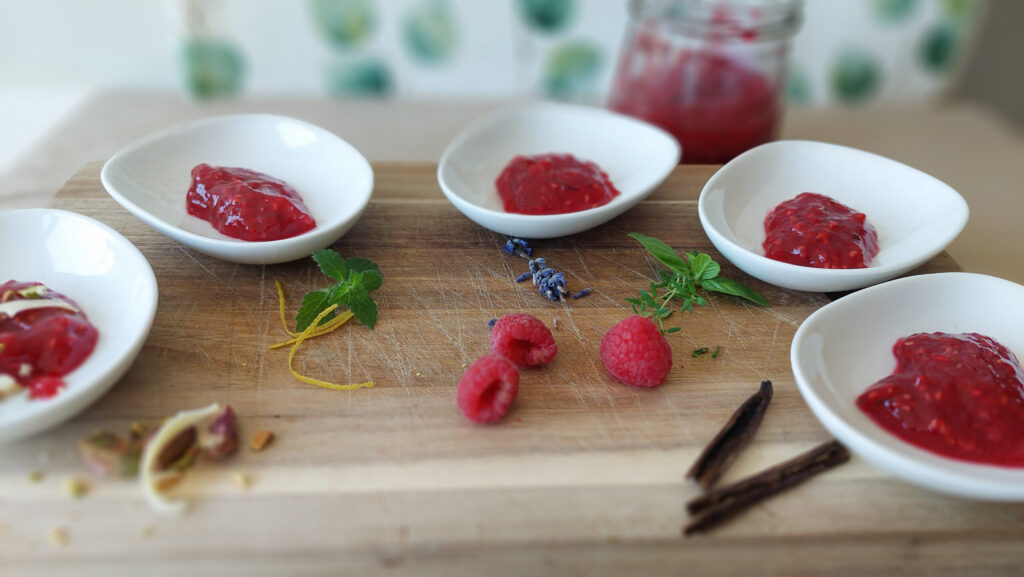
Raspberries are my favourite berries! I honestly could eat them all year-round. Although different varieties guarantee a harvest over several months, there comes a time when the last fresh berry has been devoured. That’s usually the time when I’m grateful to my summer self that it managed to keep back enough raspberries to make jam. While traditional raspberry jam is really wonderful in itself, I like to experiment with flavours, and I’m happy to show you my favourite raspberry jam variations.
Here are five of my favourite flavour combinations, from timeless vanilla to indulgent white chocolate and pistachios.
Note: Before you start, sterilise your jars and lids properly to prevent your jam from spoiling. In this guide, you can see how it’s done.
Raspberry Vanilla Jam
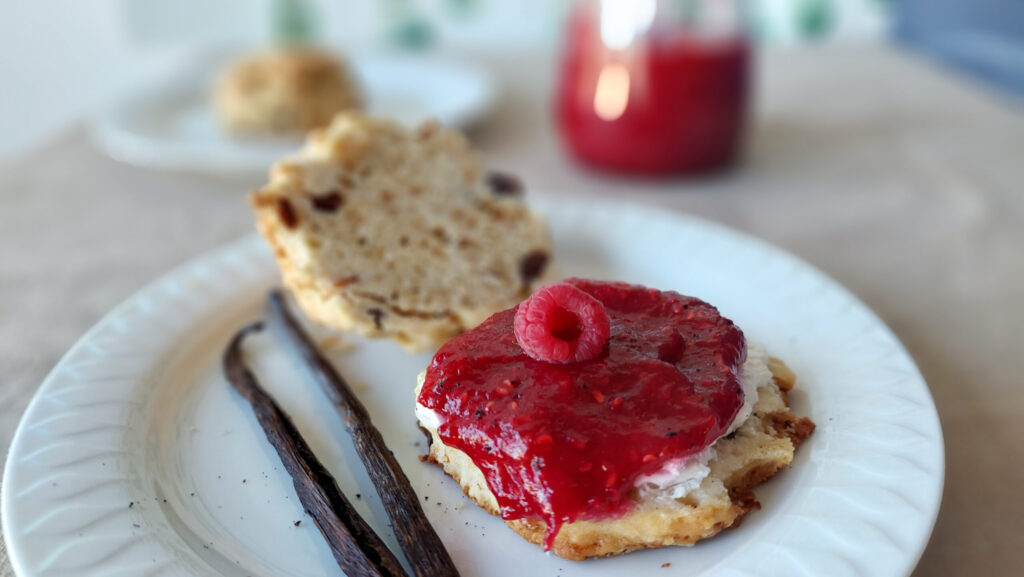
This is a classic variation, yet a very satisfying one. The vanilla adds smoothness and velvety richness and takes the edge off the raspberries’ acidity.
It goes exceptionally well on toast and makes for a wonderful breakfast treat.
Raspberry Jam with Vanilla
A smooth flavour combination of sweet raspberries and the soft, velvety fragrance of fresh vanilla.
Sterilise the jars and lids and let them cool down.
Put the raspberries, sugar and pectin or the preserving sugar in a pot and stir them gently so that everything is evenly mixed.
Let the mixture sit for about 10 minutes. During that time, the raspberries release a bit of juice.
Blend the fruit-sugar mix.
Cut the half vanilla pod open lengthwise and scrape the pulp out. Add this and the pod to the fruit mix into the pot.
Bring the mixture to a rolling boil and let it boil for 4 minutes.
Check if the jam is ready by putting a dollop of it onto a cold plate. If the jam thickens and leaves a trace when you wipe through with a finger, it's ready to be put in jars.
Fill the raspberry-vanilla jam in jars and close them immediately with the lids.
Put the jars upside down on a dishcloth for about 10 minutes. Then, flip them back and let them cool down completely.
Notes
Raspberry Vanilla Jam can be stored for up to one year in a cool and dark place (e.g. the basement). Once opened, keep the jar in the fridge and consume it within two weeks.
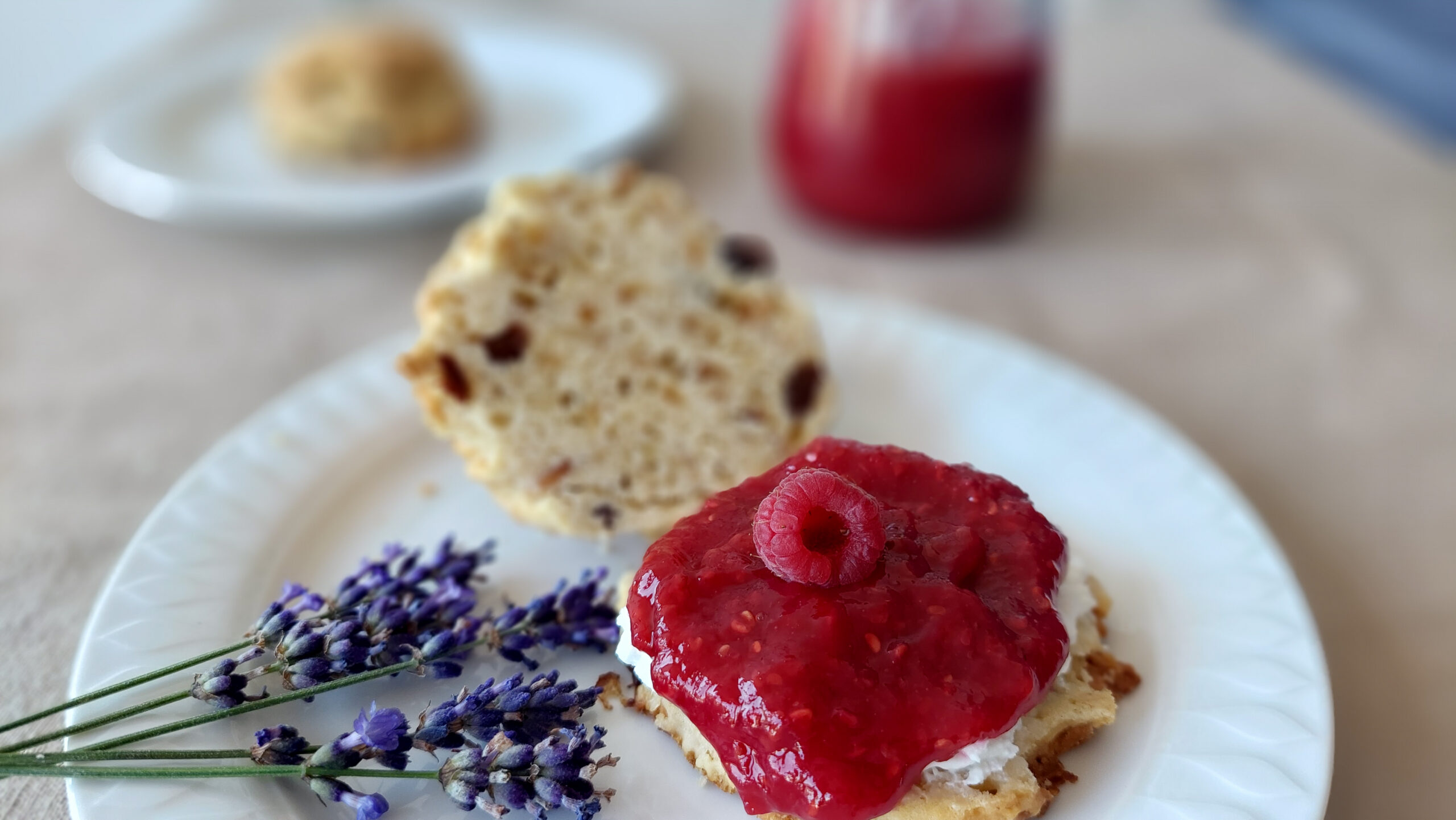
Raspberry Lavender Jam
Lavender and raspberry are not only in the same colour range but also pair really well in flavour. The lavender’s distinct floral note complements the raspberries’ natural acidity.
One note, though: stick to the amount of lavender I indicated in the recipe. Lavender tends to develop a stronger flavour over time, and when you use more initially, it could taste soapy after a while.
Raspberry lavender jam with its extravagant, floral flavour, is a sophisticated addition to a fine tea party. It matches well with scones, shortbread or stirred in yoghurt.
Raspberry Lavender Jam
A deliciously floral and fruity jam in a more extravagant twist on classic raspberry jam. The lavender adds an elegant note to the raspberries. Use it sparingly.
Sterilise the jars and lids and let them cool down.
Put the raspberries together with the preserving sugar or the sugar and pectin in a pot and mix it all together.
Let the mixture sit for about 10 minutes until the raspberries release a bit of juice.
Blend the fruit mix with a stick blender.
Add the fresh or dry lavender flowers and bring the mixture to a rolling boil.
Let it boil for 4 minutes.
Check if the jam's ready by pouring a dollop of it on a cool plate. When you tilt the plate, the jam shouldn't run off.
When the jam's ready, pour it into the jars and seal them tightly with their lids.
Put the jars upside down on a dishcloth for about 10 minutes. Then, flip them upwards again and let them cool down.
Notes
Raspberry Lavender Jam can be stored for up to one year in a cool and dark place (e.g. the basement). Once opened, keep the jar in the fridge and consume it within two weeks.
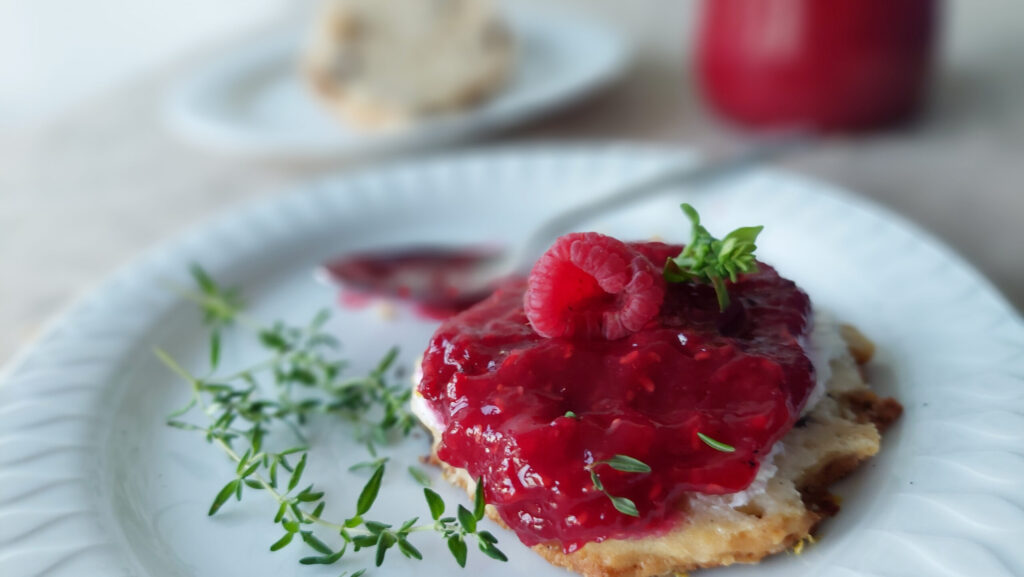
Raspberry Jam with Thyme and Basil
If you’ve never added herbs to jam before, this combination might surprise you. The earthy note of the thyme and the smooth, balsamic flavour of basil make a wonderful contrast to the natural raspberry flavour.
Raspberry jam with thyme and basil is not only a delicious spread on your morning toast, but also a great addition to a cheese board.
Raspberry Jam with Thyme and Basil
Fresh thyme and basil lend this raspberry jam an unexpectedly delicious herbal flavour. The result is a sophisticated jam that pairs just as well with cheese as it does with breakfast toast.
Sterilise the jars and lids and let them cool down.
Put the raspberries and the preserving sugar or the sugar and pectin into a pot and mix it all well.
Let the mixture sit for about 10 minutes until the raspberries release a bit of juice.
Blend the fruits with a stick blender.
Add the thyme leaves and bring it all to a rolling boil.
Let it boil for about 4 minutes.
To check if the jam is ready, pour a dollop of it onto a cool plate. When you tilt the plate, it shouldn't be runny but gooey to solid.
When the jam is ready, pour it into the jars and close them tightly with the lids.
Put the jars upside down on a dishcloth for about 10 minutes.
Flip them back up again and let them cool down.
Notes
Raspberry jam with thyme and basil can be stored in a cool and dark place (e.g. basement) for up to one year. Once opened, keep the jar in the fridge and consume it within two weeks.
Raspberry Jam with Lemon and Lemon Balm
Now, this raspberry jam variation doesn’t attempt to smooth over the raspberries’ slight acidity. On the contrary, it aims to underline it by adding a different kind of acidic fruit, the lemon. To round it off, we add a few leaves of lemon balm, which add a natural freshness and, well, balmyness.
Raspberry jam with lemon and lemon balm tastes wonderful in yoghurt and as an extravagant ingredient in dressings for leaf salads.
Raspberry Jam with Lemon and Lemon Balm
Bright lemon juice and fresh lemon balm give this jam a wonderfully refreshing flavour. It's light, vibrant, and perfect for anyone who enjoys a hint of citrus.
Sterilise the jars and lids and let them cool down.
Put the raspberries and the preserving sugar or the sugar and pectin into a pot and mix it all well.
Let the mixture sit for about 10 minutes until the raspberries release a bit of juice.
Blend it all with a stick blender.
Add the juice and zest of lemon and bring the mixture to a rolling boil.
Let it boil for about 4 minutes.
Check if the jam is ready by dropping a dollop of it onto a cool plate. When you tilt the plate, the jam should not be runny, but gooey or solid.
When the jam is ready, pour it into the jars and close them tightly with the lids.
Put the jars upside down on a dishcloth and leave them for about 10 minutes.
Flip the jars back again and let them cool down.
Notes
Raspberry jam with lemon and lemon balm can be stored in a cool and dark place (e.g. the basement) for up to one year. Once opened, keep the jar in the fridge and consume it within two weeks.
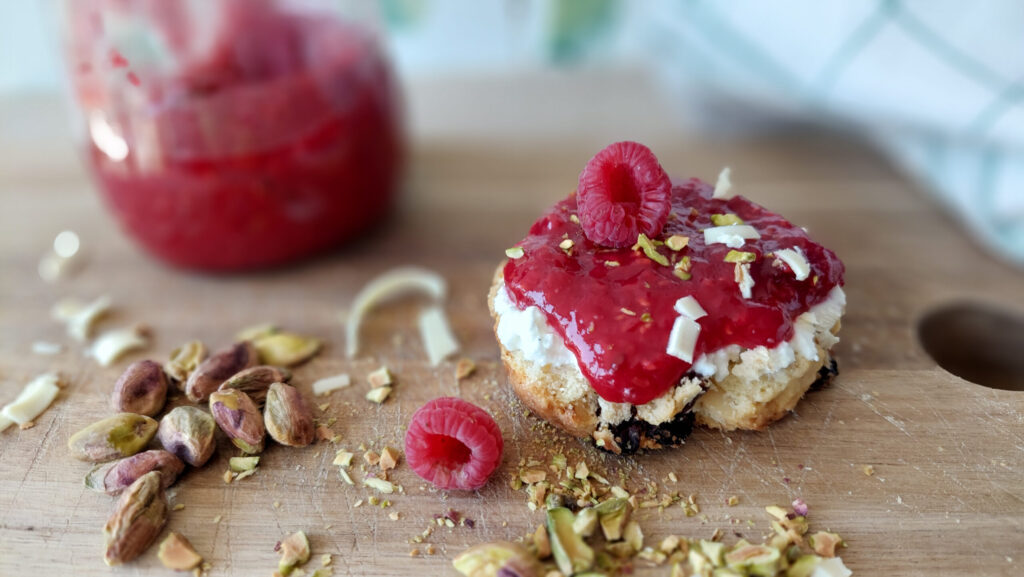
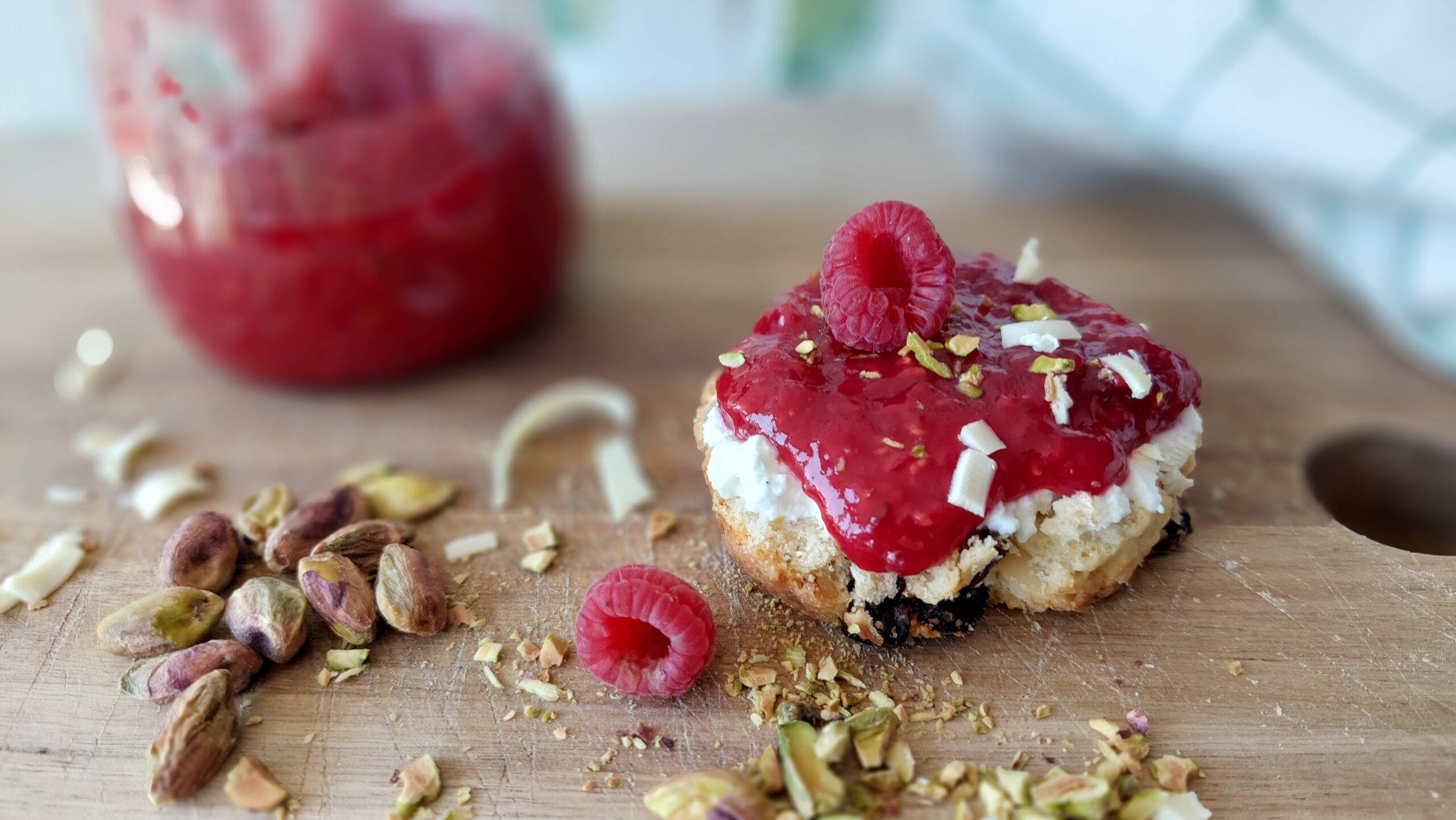
Raspberry Jam with White Chocolate and Pistachios
Looking for something a little more luxurious? This raspberry jam is my boys’ (and their girlfriends’) favourite variation. It’s deliciously rich with the white chocolate chunks that, if added right before filling the jar, are still visible in the jam. Coarsely chopped pistachios increase the luxurious feel. In fact, raspberry jam with white chocolate and pistachios on a scone, for example, makes almost a cake. 😊
This creamy raspberry jam with white chocolate and pistachios not only transforms simple bread into an indulgent treat; it can also be used as one, for example, as a cake filling.
Raspberry Jam with White Chocolate and Pistachios
Creamy white chocolate and crunchy pistachios transform raspberry jam into an indulgent treat. Rich, fruity, and slightly nutty, it's a wonderful choice for desserts, pastries, or a special breakfast.
Put the raspberries and the preserving sugar or sugar and pectin into a pot and stir it all well.
Let the mixture sit for about 10 minutes until the raspberries release a bit of their juice.
Blend it all with a stick blender.
Add the roughly chopped pistachios and bring the mixture to a rolling boil.
Let it boil for about 4 minutes.
Check if the jam is ready by dropping a dollop of it on a cool plate. When you tilt the plate, the jam should be viscous or solid.
Now add the roughly chopped white chocolate and swiftly stir it into the jam. The chunks should not melt down completely.
When the jam is ready, fill it into the jars and close them tightly with the lids.
Put the jars upside down on a dishcloth and leave them like that for about 10 minutes.
Flip the jars back and let them cool down.
Notes
Raspberry jam with white chocolate and pistachios can be stored in a cool and dark place (e.g. a basement) for up to one year. Once opened, keep the jar in the fridge and consume it within two weeks.
Which Raspberry Jam Variation Should You Try First?
Not sure which recipe to try first? Here’s a quick overview:
Join my newsletter and receive seasonal recipes, preserving ideas, fermentation projects and simple ways to make the most of every season. I’ll also let you know whenever a new recipe goes live.
Frequently Asked Questions
Can I use frozen raspberries to make jam?
Yes. Frozen raspberries work just as well as fresh ones and don’t even need to be thawed first. Simply add them to the pot and allow a little extra time for them to release their juice before bringing the mixture to a boil.
Can I reduce the amount of sugar?
Not if you want to preserve the jam safely for long-term storage. The sugar-to-fruit ratio is important for proper setting and preservation. If you prefer a less sweet jam, choose a preserving sugar designed for lower sugar recipes rather than simply reducing the amount.
Do I have to strain out the raspberry seeds?
No, but you certainly can if you prefer a smoother jam. Simply press the cooked raspberries through a fine sieve before adding the flavouring ingredients and finishing the recipe.
Which raspberry jam variation is best for gifts?
The white chocolate and pistachio variation makes a particularly luxurious homemade gift, while the lavender version looks elegant and is perfect for afternoon tea lovers. Decorate the jars with a pretty label and a ribbon for a thoughtful seasonal present.
Can I double the recipe?
Yes, although I generally prefer making two separate batches. Smaller batches reach the setting point more reliably and preserve the fresh raspberry flavour better.
Which flavour should I try first?
If you’re making flavoured raspberry jam for the first time, start with vanilla. It’s a gentle variation that complements the berries without changing their classic flavour too much. Once you’ve tried that, branch out into lavender, herbs, or white chocolate.
Raspberries – The Rubies of Summer
Raspberries are the epitome of endless summers, walking barefoot into the garden and snacking on warm berries fresh from the bush. I know how much self-restraint it can cost, but try not to eat them all up. It’s so worth preserving them as jam for the cold winter months. And as for variations: the ones I showed you today are only the beginning. Get creative with flavours and try adding different herbs, homemade syrups, nuts or other berries to your raspberry jam.
I’ll keep adding new flavour combinations whenever I discover one worth sharing. Stay curious and, until the next time, enjoy!
If making raspberry jam is one of your favourite July traditions, you might enjoy my July Reflections, where I celebrate everything this generous month has to offer in the garden and beyond.
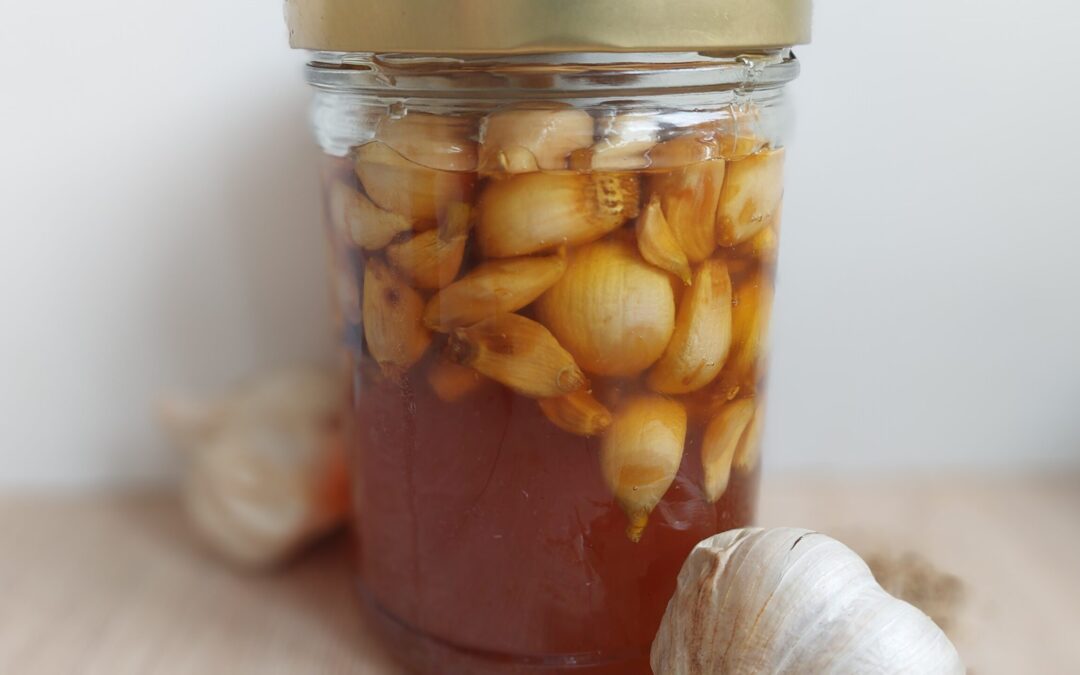
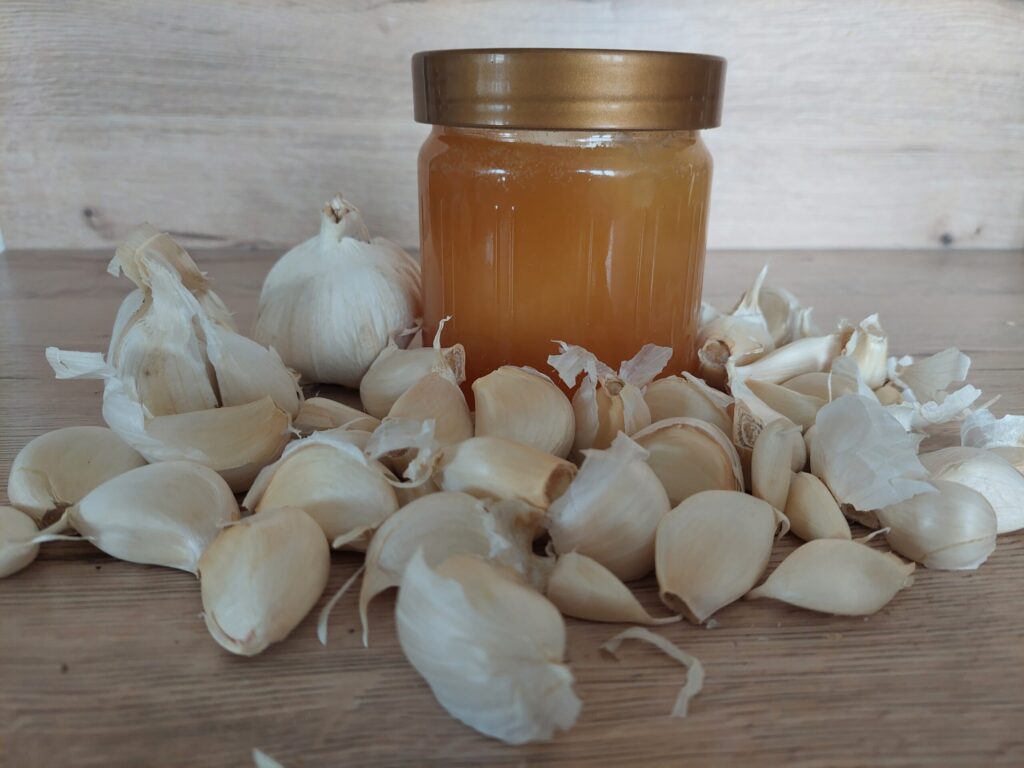
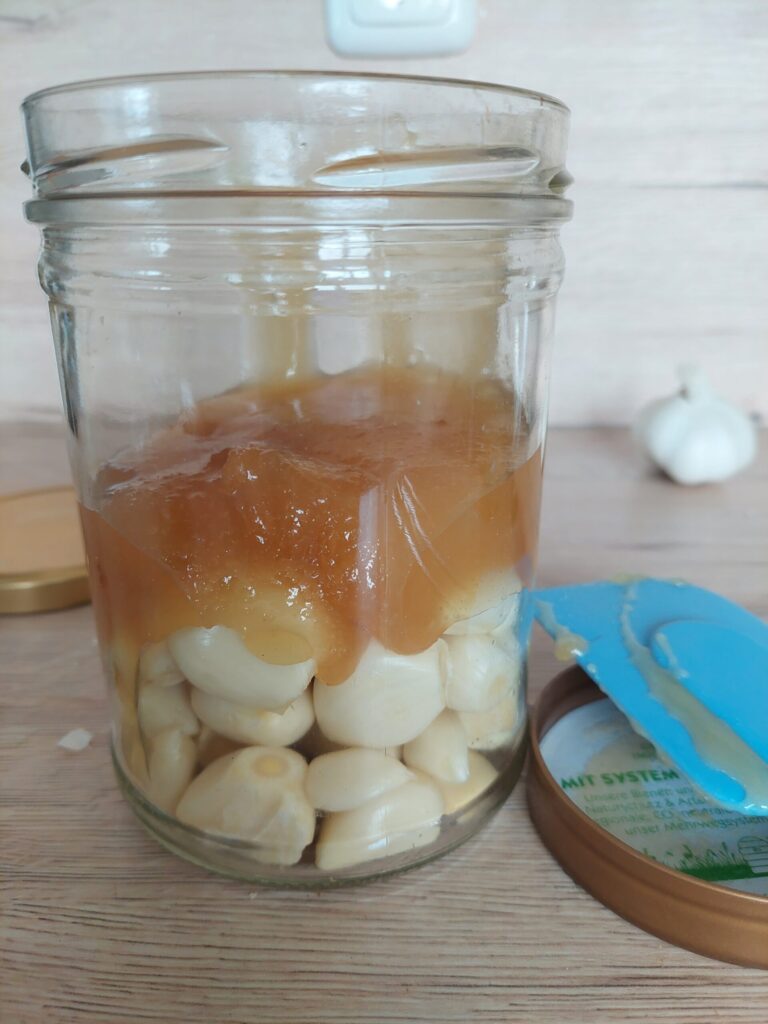
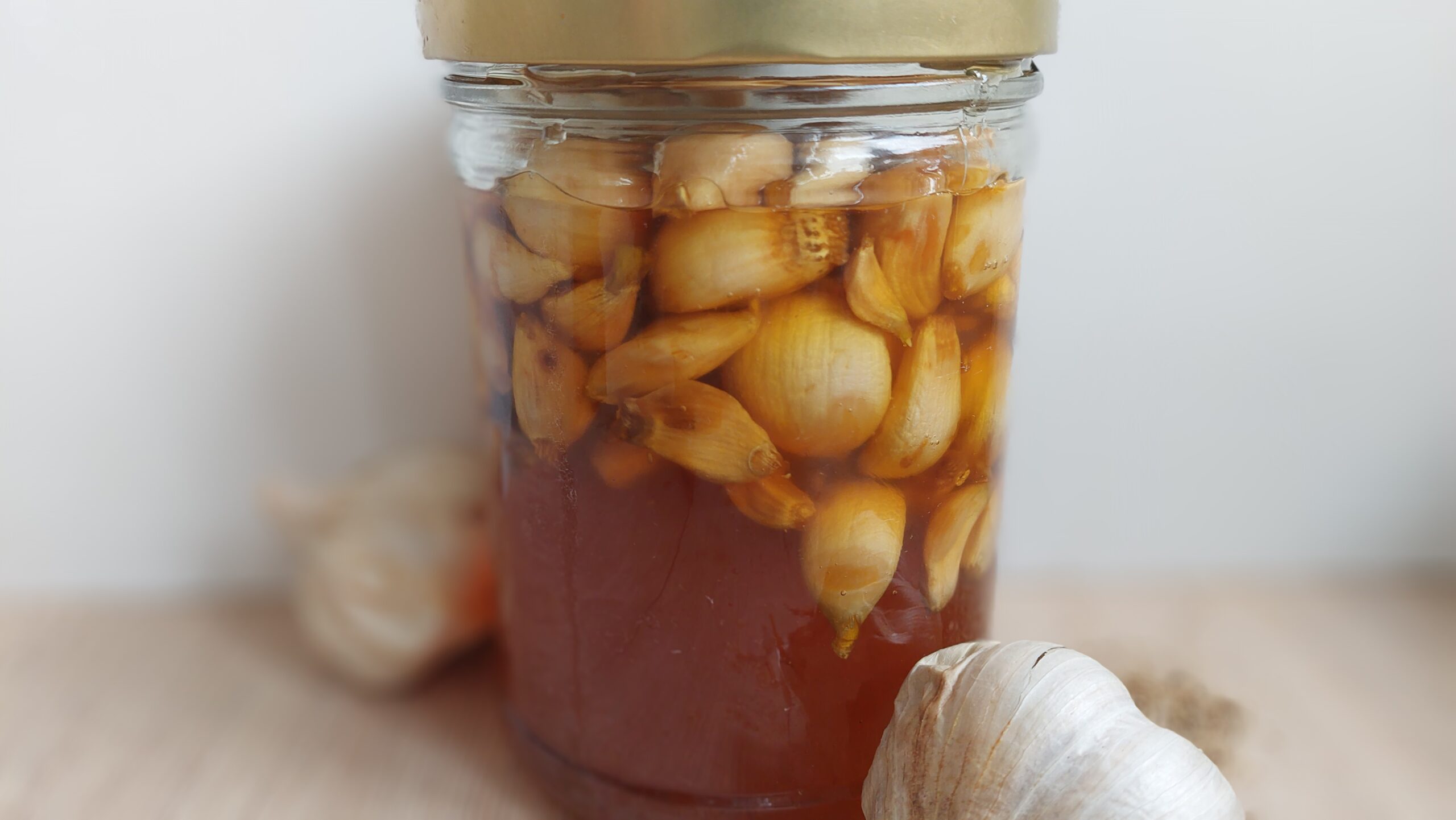
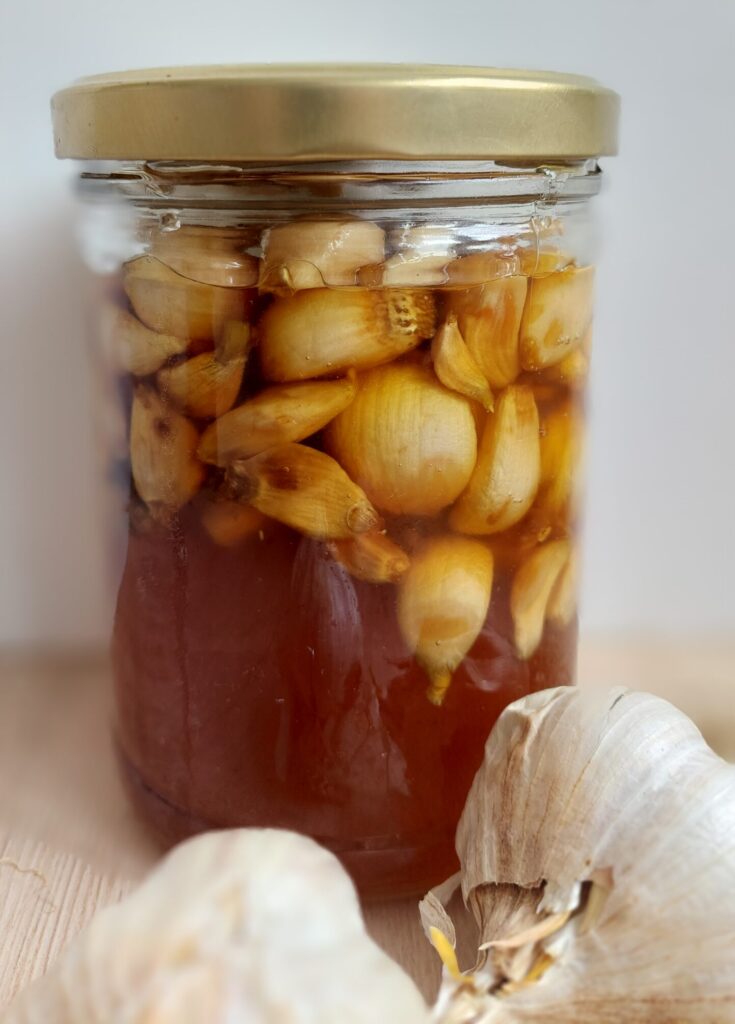
Fermented Garlic in honey is a very beginner-friendly ferment that requires only two ingredients.
I always have some jars of fermented garlic in honey in the house, usually in different stages of fermentation.
First, because it’s incredibly delicious and wonderfully versatile: The longer the garlic ferments, the milder it becomes, while absorbing the honey’s sweetness until the cloves are delicious enough to snack on straight from the jar.
Another reason I always keep a jar on hand is that many people value garlic-infused honey during the cold and flu season.
My main reason for making this ferment, however, is that it tastes marvellous and is very easy to make.
Quick Overview
Prep time
15 minutes
Fermentation time
At least 3 months
Difficulty
Easy
Best for
Beginners
Storage
At least 1 year
Flavour
Garlicy-sweet
I guess by now, you wonder what honey-fermented garlic tastes like, don’t you? Let me tell you:
How does fermented garlic in honey taste?
We all know that garlic alone has a sharp and sometimes even biting flavour. When it’s fermented in honey, its flavour mellows over time, and it becomes sweeter over time due to the honey. Even people who normally find raw garlic too strong often enjoy the mellow fermented cloves.
Meanwhile, the honey becomes beautifully infused with garlic, more “spicy” and complex in flavour.
Convinced? Then let’s dive in.
Fermented Garlic in Honey
As promised, you only need a few things:
Equipment
To make fermented garlic, you only need a bowl to soak the cloves, a spoon to scrape out the honey and one large, clean jar with a lid, either twist-off or flip-top.
If you’re just getting started, have a look at my guide to fermentation equipment. It explains which jars and accessories are actually useful and which ones you can safely skip.
Ingredients
To make fermented garlic in honey, you just need
5 – 6 bulbs of garlic
about 500 g of raw honey (enough that all cloves are well-covered)
It’s best, of course, to use garlic you cultivated yourself in the garden. If you want to learn more about it, read my complete garlic growing guide here. It’s not necessary to use it freshly harvested; you can make the ferment later in the year, when you’re not up to your ears in preserving. Make sure, though, that the cloves haven’t dried up or started sprouting.
It doesn’t matter if you take liquid or crystallised honey. The garlic naturally releases moisture, which quickly turns even crystallised honey liquid again. It’s important, though, that you use raw honey. Raw honey works best because it contains naturally occurring yeasts and other microorganisms.
Instructions
Step 1: Peel the garlic
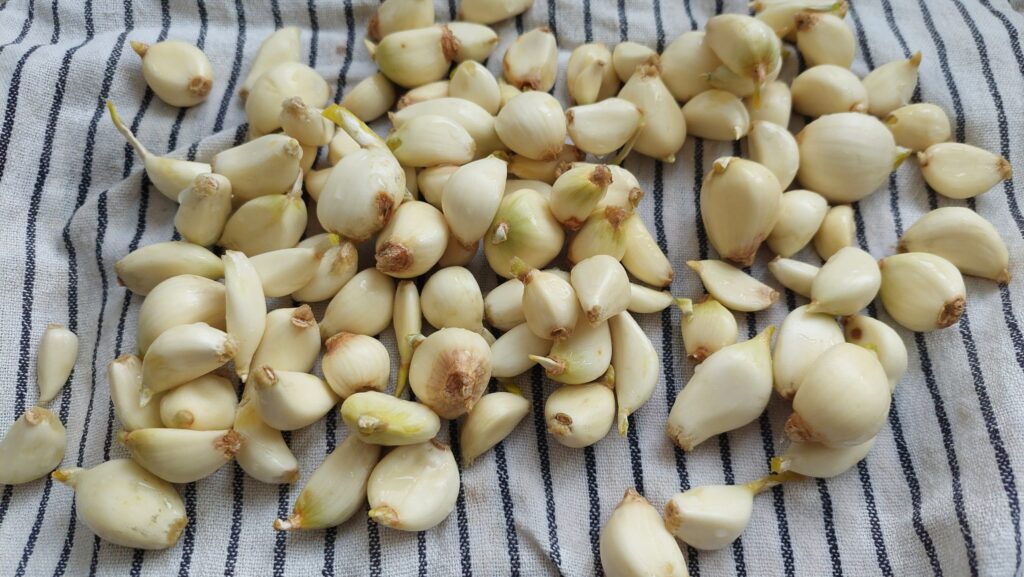
Remove the outer skin from the garlic bulbs and separate the cloves.
Some people say that the cloves can be easily peeled when you put them in a bowl, cover it with a second bowl and shake them vigorously.
That method never worked for me, though.
Instead, I put the cloves in a bowl and pour hot (not boiling!) water over them. Then I let them sit for about three minutes. Afterwards, the peels remove fairly easily.
Step 2: Fill the jar
Put the peeled cloves in a jar and keep in mind that you need enough room left for the honey.
Every ferment needs some headspace because the ferment can become bubbly and occasionally overflow. This is particularly important for honey ferments. Honey ferments can become surprisingly active during the first weeks and often foam considerably. That means it’ll most likely need about 1.5 – 2 inches of space between the surface of the honey and the rim of the jar.
Step 3: Pour the honey
Now, pour the honey into the jar. This is easier when the honey is liquid, but you can, of course, also use crystallised honey, as long as it’s raw.
No matter which sort you use, gently stir the garlic through the honey until every clove is completely coated.
Step 4: Close the jar loosely
Loosely tighten the twist-off lid or close the flip-top lid. Within a few days, pressure begins to build as fermentation produces gases and pushes the honey upwards. A loosely closed lid or a flip-top jar allows the fermentation gases to escape while limiting the amount of fresh air entering the jar.
If the lid is closed too tightly, however, gases are trapped inside, and the pressure will build up, which could even lead to the jar exploding.
Due to the pressure building during fermentation, honey may leak out of the jar. That’s normal. Just wipe it off with a damp cloth. To prevent your kitchen surface (or wherever you put your jar) from becoming sticky, put the jar into a tray or a small bowl. That way, overflowing honey can be cleaned off more easily.
Step 5: Turn the jar daily
Garlic cloves are lighter than honey and tend to float on the surface, and even above it. Although they’ve been covered in honey at the beginning, over time, the honey drips away, and the cloves could mould.
To prevent that, we turn the jar upside down at least once a day. Flip it over and wait until the garlic cloves rise to the surface. Then flip it back again.
Unlike garlic stored in oil, garlic fermented in honey undergoes active fermentation. As long as the cloves remain completely submerged and the ferment develops normally, the environment becomes increasingly inhospitable to spoilage organisms.
Sometimes, honey may leak from the lid. That’s totally normal, just wipe it off.
Step 6: Let it ferment
Put the jar in a warm place of about 20 °C (68 °F). I usually keep it on the windowsill or the kitchen counter.
Within a few days, the first bubbles will show, and sometimes the honey will become a bubbling volcano! The warmer the temperature, the faster and more active the fermentation process.
In the course of fermentation, the honey will become liquid or – if you’ve used liquid honey already – thinner. That’s normal, as the water from the garlic cloves will diffuse into the honey.
After about 2 – 4 weeks, the initial fermentation is over, and you can put the jar in a cooler place. Not necessarily the fridge, we still want it to mature, but maybe a cool basement. You can, of course, use the garlic now already, but I seldom touch it before it has matured for at least 6 months. Fermented garlic in honey improves greatly with age. Like wine or cheese, it gets better the longer you let it sit.
Separate the cloves and peel them. This is easiest, when you soak them for about 3 minutes in hot (not boiling!) water.
Put the peeled garlic cloves in the jar.
Pour the honey over the garlic cloves and stir until all the cloves are completely covered with honey.
Secure the lid onto the jar, but - in case of a twist-off lid - not too tightly. That way, the gases that will form during fermentation, can leak out.
Put the jar in a tray or bowl and set it at room temperature ( about 20 °C / 68 °F).
Turn the jar upside down at least once a day and wait until the garlic cloves resurface. Then, turn it back and let the microbes do their work.
Let the garlic ferment for 2 - 4 weeks (depending on the room temperature). Afterwards, put the jar in a cool basement. Let it mature for at least 3 months, better 6 months.
Notes
You can store fermented garlic in honey in a cool place for years. Although my prediction is, it won't last that long. So delicious...
In honey ferments, yeasts usually play the main role. Lactic acid bacteria may also contribute, but alcoholic fermentation is generally the dominant process. There are naturally a few lactic acid bacteria in honey, but it’s mostly the yeasts that do the work here.
Honey has a natural water content of about 17 %. When we increase that to at least 19 %, the wild yeasts in the honey become active and start fermenting. The bubbles are one of the clearest signs that fermentation is underway, as is the fact that the honey becomes more liquid and sometimes even runny.
In this recipe, it’s the garlic juice that diffuses over time and naturally increases the honey’s water content just enough to produce a very small amount of alcohol.
The amount of alcohol produced is extremely small—far below that of alcoholic beverages. Fermented garlic in honey is generally considered safe to consume, including by children and during pregnancy. If you avoid alcohol completely for personal, religious or medical reasons, however, it’s always best to consult a healthcare professional before consuming fermented foods.
How Do You Know It’s Ready?
At first, bubbles form, usually after a few days, which shows that fermentation has started. Then, the honey will become thinner due to the garlic’s liquid.
After 2 – 4 weeks, the bubbles will die down. Now it’s time to put the jar in a cooler environment. You could eat the cloves now, OR you wait for another few months to let them mature.
Over time, the garlic cloves turn slightly translucent, and the honey becomes darker. The garlic’s aroma mellows, while the honey’s flavour becomes more complex and tastes sweet and garlicky.
I usually let the garlic ferment in honey for at least three, better six months before I use it to flavour my dishes.
How to Use Fermented Garlic in Honey
To be honest, I often snack on the cloves like sweets (not on a date night, though). But there are more ways to use fermented garlic in honey:
Try making a sweet-and-savoury bruschetta by adding garlic slices to tomatoes on bread and drizzling a bit of the honey over it.
When I feel a cold coming up, I take 1 – 2 tablespoons of the honey in a glass of warm water. The water mustn’t be hot, as natural enzymes and many of its beneficial properties are best preserved when the honey isn’t heated.
Furthermore, you can marinate meat in a mixture of this fermented honey, minced garlic and miso paste or soy sauce.
Use the garlic in hot and sweet curries or as a condiment in meatballs.
I sometimes the honey and finely chopped garlic cloves to add a sweet note to salads and bowls. Just mix it into your normal dressing.
Try roasted vegetables with fermented garlic. It’s so good, you’ll lick the plate!
Drizzle it over pizza or stir it into sauces: there’s almost no end to the use of fermented garlic in honey!
Love simple fermentation recipes?
Download my free Fermentation Starter Checklist and never wonder again whether your ferment is on the right track.
How to store fermented garlic in honey?
Here’s the good news: unlike lactic-acid ferments, honey ferments needn’t be stored in the fridge. A cool, dark cupboard or a cool basement is enough.
If you don’t have either, room temperature is equally fine. Just make sure that the jar isn’t exposed to too much light.
Fermented garlic in honey can last for years, but its flavour will change over time. In fact, I have a jar of three-year-old fermented garlic. The cloves are of a very dark brown, almost black, and they simply taste heavenly!
Tips for Success
When you observe the following few aspects, your fermented garlic in honey must become a success!
Always use clean jars
Keep the garlic covered with honey
Don’t panic if the honey becomes runny
Bubbles are good
Don’t use wet utensils
Common Problems
Here’s a quick overview of the most common occurrences with honey-fermented garlic and what (if anything) to do about them:
No. Fermentation in honey only works with fresh ingredients that diffuse their liquid into the honey.
Does the honey stay sweet?
Yes, but it also absorbs the garlic’s flavour.
Can I refrigerate it?
Yes. Refrigeration slows fermentation considerably. Most people simply store it in a cool cupboard or basement instead, so it can continue maturing.
How long does honey-fermented garlic keep?
At least one year. My experience shows that honey-fermented garlic can be stored much longer, though.
Can I reuse the honey?
Yes, there are several uses for garlic-infused honey (see above).
Can I add chilli or herbs?
Absolutely. Chillis will add a spicier note, while the herbs complement the garlic flavour.
Two ingredients + Patience = Foodie’s heaven
Garlic fermented in honey is one of the easiest ferments you’ll ever come across. It only requires two ingredients and a bit of patience. With that, you’ll create something so flavourful and versatile that I guarantee you won’t have to think about long-term storage 😄.
If you’ve tried it already, why not experiment by adding chillies, peppercorns or ginger to the mix? And herbs like rosemary, thyme or basil? There’s so much more to explore.
So let’s get out, pick some garlic and start fermenting. Your winter self will thank you for it.
Eager for more fermentation recipes? I’ve got you covered:
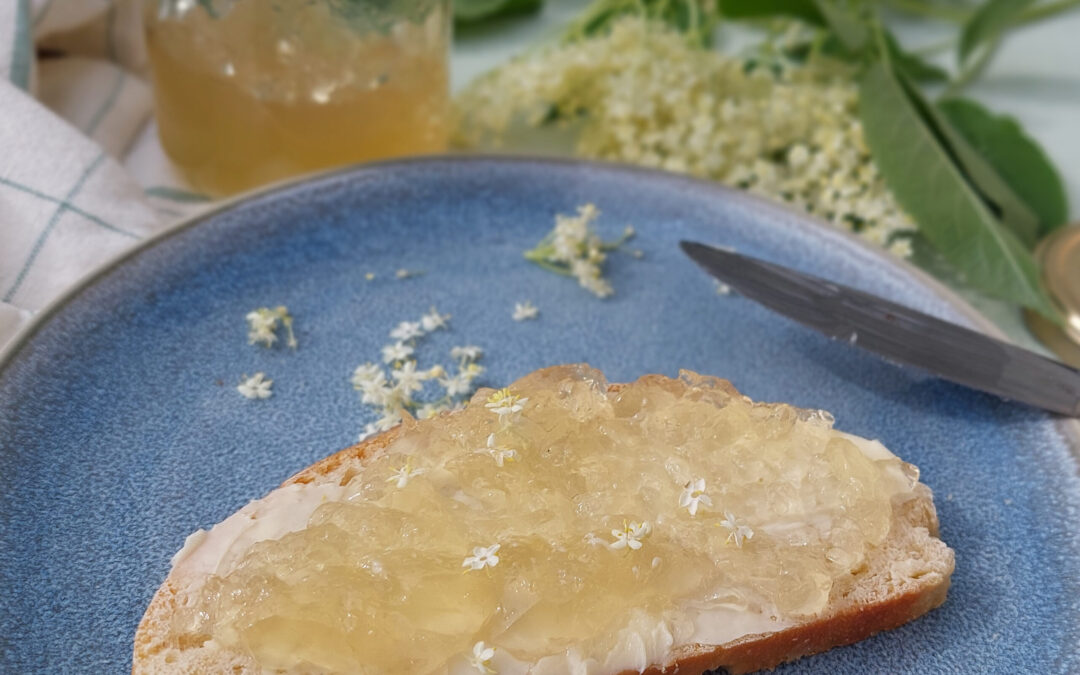
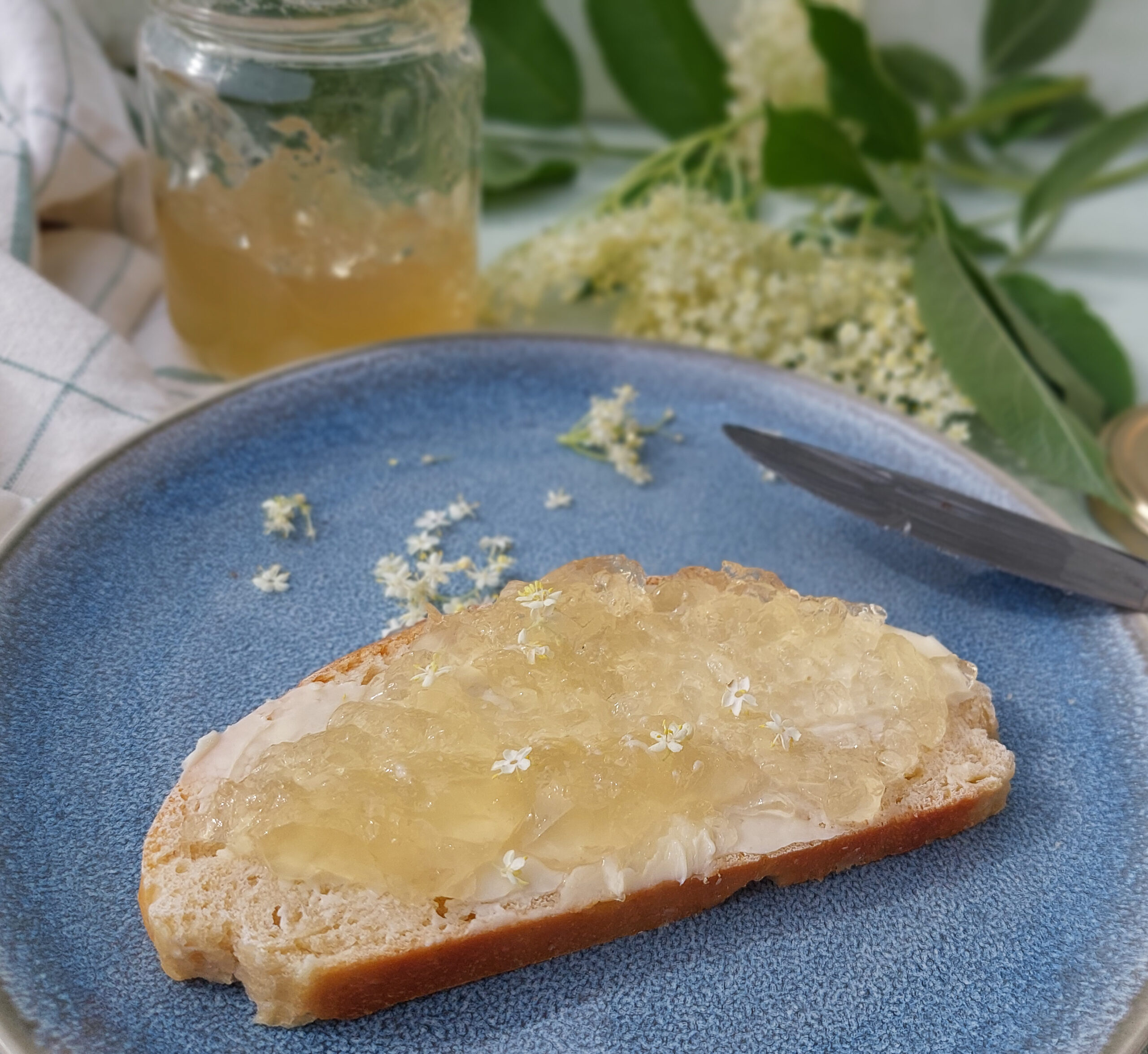
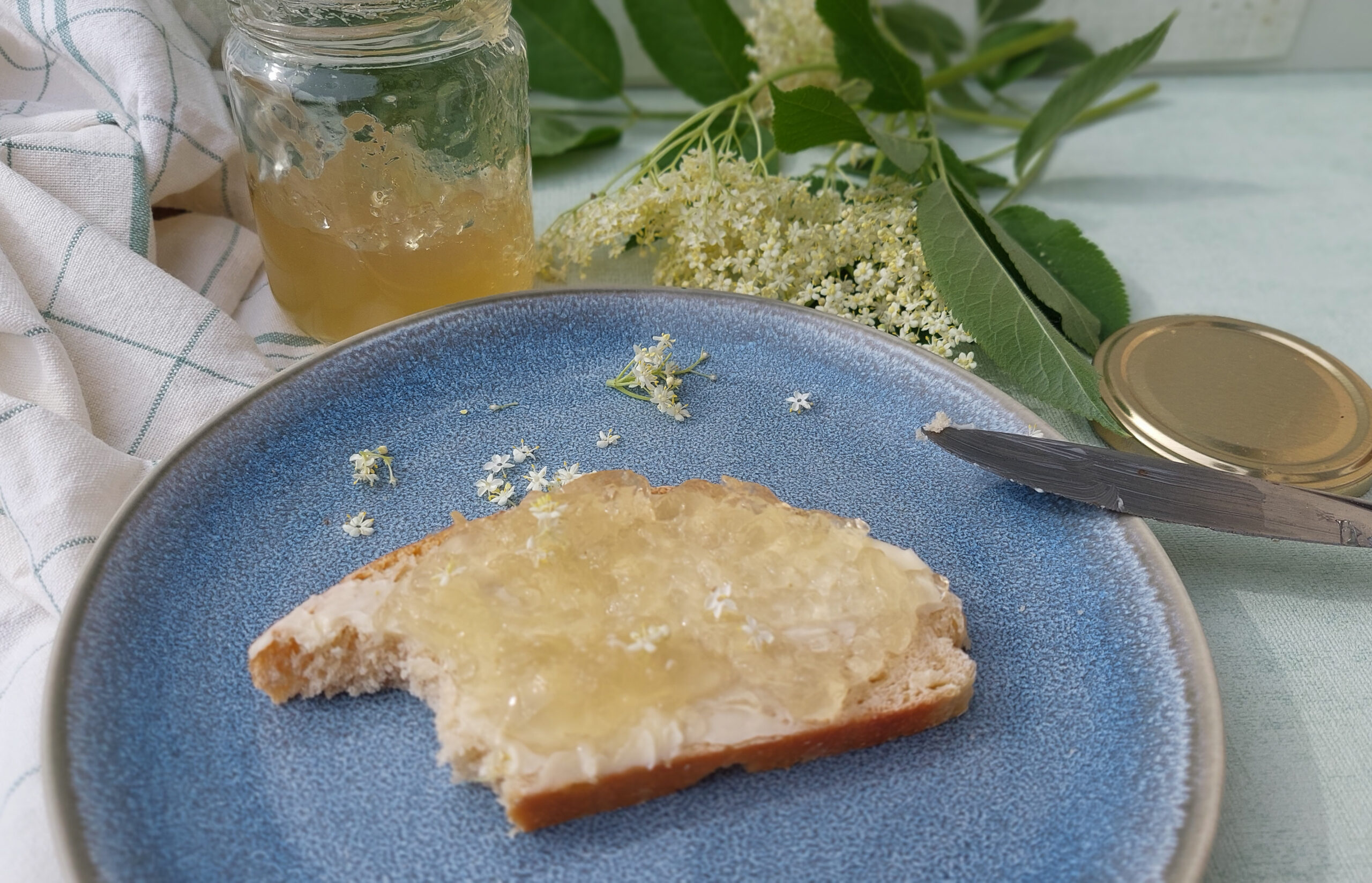
Most of us have heard of elderflower cordial or syrup, but have you ever tasted elderflower jelly? Let me show you how you can make this simple yet wonderfully floral preserve, which captures the scent of early summer.
For centuries, people have used elderflowers to flavour milk, cream, vinegar, honey, and later syrups and cordials. Elderflower jelly is another delicious way to preserve that fleeting fragrance and enjoy it long after the blossoms have faded.
Here, I want to show you a quick recipe for elderflower jelly that captures the essence of early summer in a jar. It not only tastes delicious on toast, scones and pancakes but is also an unusual but very tasty addition to a cheese board.
If you’ve never tasted elderflower before, imagine a combination of honey, pear, citrus blossom, and summer sunshine.
Now, elderflower jelly tastes floral but not perfumed and has a honey-like sweetness. At the same time, it has subtle citrus notes that are a zesty counterpart to the sweetness.
All in all, elderflower jelly tastes very light and elegant compared to berry jams, for example.
Harvesting Elderflowers for Jelly
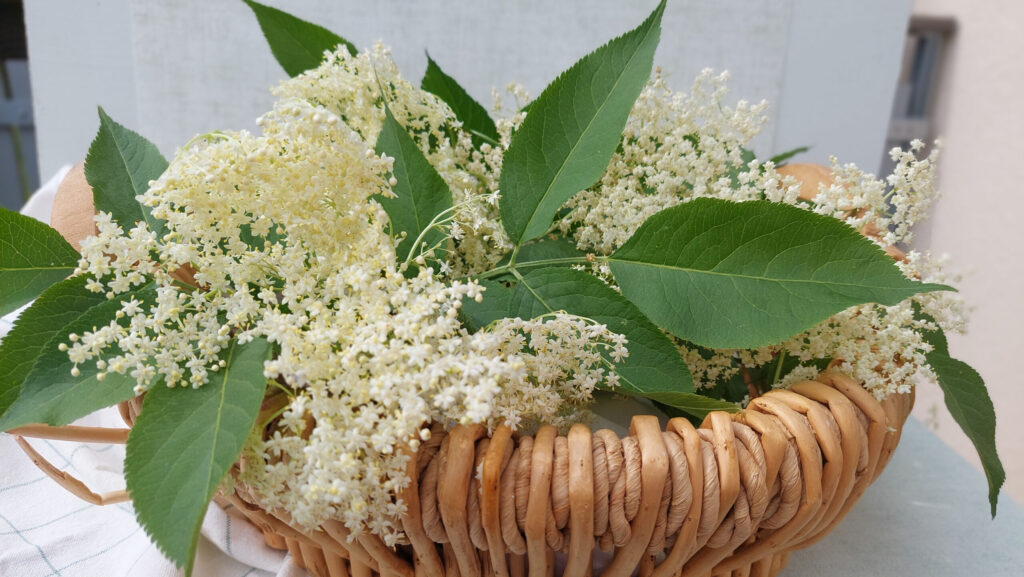
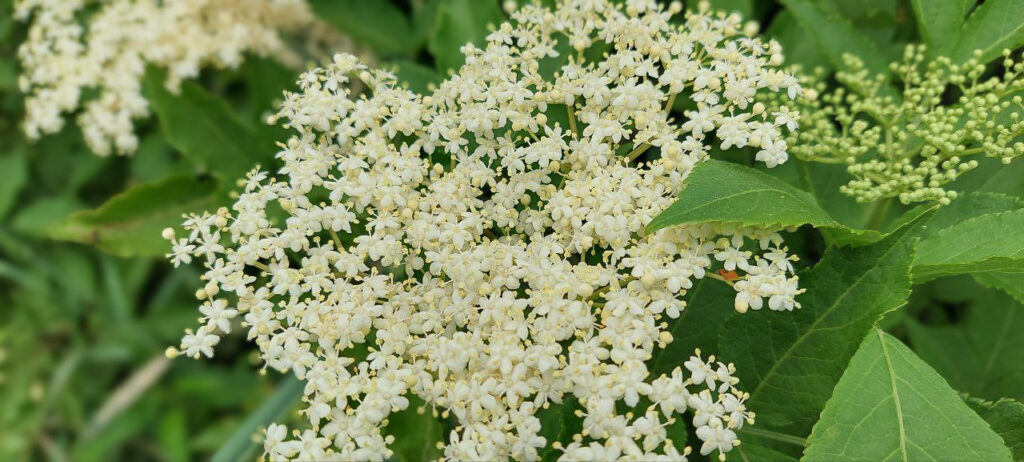
Elderflowers have creamy white flower heads that grow in an umbrella-like form with diameters of up to 30 centimetres (12 inches).
The numerous tiny single flowers form the panicles, and each of these flowers consists of five petals and yellow stamens.
When you spot them, take a basket and garden shears and head out to forage them.
Only gather umbels that grow far away from streets, at the edge of the woods, on field paths or in gardens. At those places, you can be sure that they are not polluted by exhaust fumes or other environmental toxins.
Always cut the elderflower umbels with garden shears or scissors. That way, you won’t shake the flowers too much and lose their valuable pollen and flavour.
Make sure to forage only elderflowers that are in full bloom and still fresh, meaning that the little flowers don’t fall off when shaking them. The best time for harvesting is the late morning of a sunny day. Ideally, it has been sunny for several days because that’s when the fragrance is strongest, and there are hardly any insects in the flowers.
A basket is best for carrying the harvested elderflowers home, because they lie lightly and airily without being pressed too much together.
One important request: don’t overpick! Never take more than a third of umbels per bush to leave enough for bees and birds! And to come back in autumn and harvest the elderberries 😉
Do not wash the elderflowers! Their flavour lies in the pollen, and if you wash them, the pollen – and with it the flavour – would be rinsed off. Instead, simply shake them gently to remove any insects.
Elderflower Jelly Recipe
This simple recipe for elderflower jelly requires few ingredients, and you’ll probably already have all the necessary equipment at home. See the recipe card below for exact quantities.
Elderflower Jelly
This delicate floral jelly captures the fragrance of early summer and tastes wonderful on toast, scones, pancakes, or served with soft cheeses.
Shake the elderflower umbels carefully to remove insects. If you want to be absolutely sure that no insects are left, leave the flowers outside in a dry and shady place for about 20 minutes. That way, the insects can wander off.Do not wash the elderflowers! Their flavour lies in the pollen, and if you wash them, the pollen – and with it the flavour – would be rinsed off.Once the elderflowers are clean, cut off the thick stems.
Put the elderflowers in a bowl. Boil the water and pour it over the elderflowers and let them steep for about 24 hours.
Step 2: Strain the Liquid
Lay a cheesecloth into a strainer. Now put the strainer into a pot and carefully strain the liquid through it into the pot. Squeeze the elderflowers out.
Step 3: Cook the Jelly
Add the lemon juice and preserving sugar to the infused liquid and stir it until the sugar has dissolved.
Bring it to a rolling boil and let it cook for 4 minutes.
Step 4: Test for Setting Point
To check if the jelly is ready, pour a few drops onto a chilled plate. Now tilt the plate: when the jelly is still running, let it cook for another 1 - 2 minutes; when it thickens, it's ready.
Step 5: Fill the Jars
Pour the jelly into sterilised jars and immediately seal them with the lid.
Put the filled and sealed jars upside down onto a kitchen towel for about 15 minutes. Flip them back and let them cool down.
Love Preserving Seasonal Flavours?
Variations
Instead of just making pure elderflower jelly, as I described in the recipe, you can mix it with other flavours:
Simply follow the pectin manufacturer’s instructions for the amount required.
Elderflower and Lemon Jelly
If you like it more tangy, use 200 ml of freshly squeezed lemon juice and reduce the amount of water to 800 ml. Additionally, add lemon zest to the liquid before boiling.
When you’ve filled the jelly into jars and sealed them, flip the jars every 10 – 15 minutes. That way, the zest distributes more evenly in the jelly before it sets.
Elderflowers and gooseberries make a great flavour team! Mix 500 g pureed gooseberries with 500 ml infused elderflower water or syrup, add sugar (in case of the infused water) and make a tasty jam!
How to Use Elderflower Jelly
The classic use for elderflower jelly is, of course, to spread it thickly on toast and bread and enjoy it for a lovely breakfast. But it’s much more versatile than just that!
You can enjoy it on
freshly-baked scones
crunchy croissants
in or on your pancakes
in a yoghurt
as a cheesecake glaze
with soft cheeses
with roast pork or chicken
Storage
Sealed tightly and stored in a dark place at room temperature, elderflower jelly can be stored for up to one year.
Once a jar is opened, store it in the fridge and consume it within two weeks.
Always use a clean spoon to get it out of the jar. That way, bacteria won’t contaminate the jelly, which would lead to fast spoilage.
Common Problems and Solutions
My Jelly Didn’t Set
This can be due to too little pectin or boiling it too shortly. Add some more pectin and boil it for another 2 minutes, and test again if it sets by pouring a few drops on a chilled plate.
My Jelly Is Cloudy
That’s normal because some of the pollen remains in the liquid.
My Jelly Is Too Sweet
That’s probably due to using jam or preserving sugar 1:1 instead. Next time, use a 2:1 sugar and add more lemon juice.
Frequently Asked Questions
Can I Freeze Elderflower Jelly?
Yes, you can freeze elderflower jelly, but it’s not necessary. Proper boiling and hot sealing in jars is enough.
Can I Use Dried Elderflowers?
Yes, you can use dried elderflowers, but fresh ones make a better flavour.
Can I Make Elderflower Jelly Without Preserving Sugar?
Yes, that’s possible, but then you must add pectin separately.
How Long Does Elderflower Jelly Last?
Up to a year when properly sealed.
What is the difference between elderflower jelly and elderflower syrup?
Elderflower syrup or cordial is a liquid concentrate used for drinks, desserts, and baking, whereas elderflower jelly is a spreadable preserve that can be served on bread, scones, or alongside cheese.
Early Summer Flowers in a Jar
Elderflower season lasts only a few short weeks, but a few jars of homemade elderflower jelly allow you to preserve its delicate fragrance for months to come. Whether spread on warm toast or served alongside a cheese board, this simple recipe is a lovely way to bring a little taste of early summer into your kitchen.
Want more recipes for homemade jams and preserves? Look at these:
You wanna start fermenting and dread what you have to buy for it? No worries! The cool thing about fermentation is that you don’t need any fancy fermentation equipment. After all, people have been fermenting food for thousands of years using very simple tools.
Do You Need Special Equipment to Ferment Food?
When we look at how people in the olden days fermented vegetables, they had only very simple tools. And that means that we can, too.
Don’t get me wrong: Good equipment makes fermentation easier and more reliable. If you’re beginning, though, you can start with surprisingly little.
You can successfully ferment vegetables with:
A jar
Salt
Water
A weight
A lid
Everything else is optional.
Common Fermentation Problems and the Equipment That Prevents Them
Problem
Helpful Equipment
Vegetables floating
Fermentation Weight
Mould on surface
Weight + proper lid
Brine overflow
Larger jar
Inconsistent results
Kitchen scale
Too much oxygen
Airlock or proper lid
Ready to start your first ferment?
Download my free Fermentation Starter Checklist and make sure you have everything you need before you begin. It includes essential equipment, basic ingredients, hygiene tips, and key steps for successful vegetable ferments.
Quick overview of fermentation equipment
In this chart, I’ll show you all the tools for fermentation and whether they’re absolutely necessary or just a nice-to-have:
Equipment
Essential?
Beginner-Friendly?
Approx. Cost
Jar with lid
Yes
Yes
€
Weight
Yes
Yes
€
Airlock
No
Yes
€€
Crock
No
Later
€€
pH Meter
No
Advanced
€€€
Before we talk about jars, crocks, weights, and airlocks, however, there’s one thing that’s even more important than the equipment itself: cleanliness.
Hygiene Matters More Than Equipment
The good news is that vegetable fermentation doesn’t require the same level of sterilisation as canning. You don’t need to boil every utensil or work in laboratory conditions.
However, you should always:
Wash your hands thoroughly
Clean jars, lids, bowls, and utensils before use
Remove any damaged or mouldy parts from vegetables
Use fresh, good-quality ingredients
Good hygiene gives the beneficial microorganisms the best possible start and reduces the risk of spoilage.
Now that we’ve cleared that matter, let’s have a look at the basic fermentation equipment you need and some of the fancy stuff you might want to buy later.
Fermentation equipment
Containers
First of all, avoid metal containers and unknown or non-food-grade plastics for fermentation. Metal reacts with acid, which can lead to the dissolution of metals into the brine. This can affect both the safety and quality of your ferment.
The same applies to plastic: not all plastics are acid-resistant. The softer the material, the stronger it reacts to acid. If you use freezer bags as weights, make sure they don’t contain PVC or BPA.
Glass jars and lids
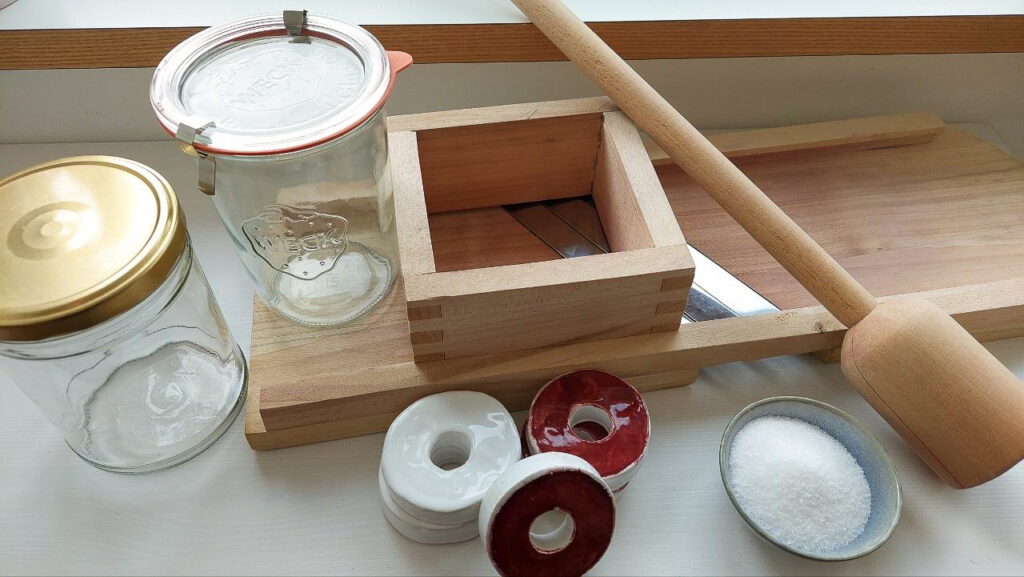
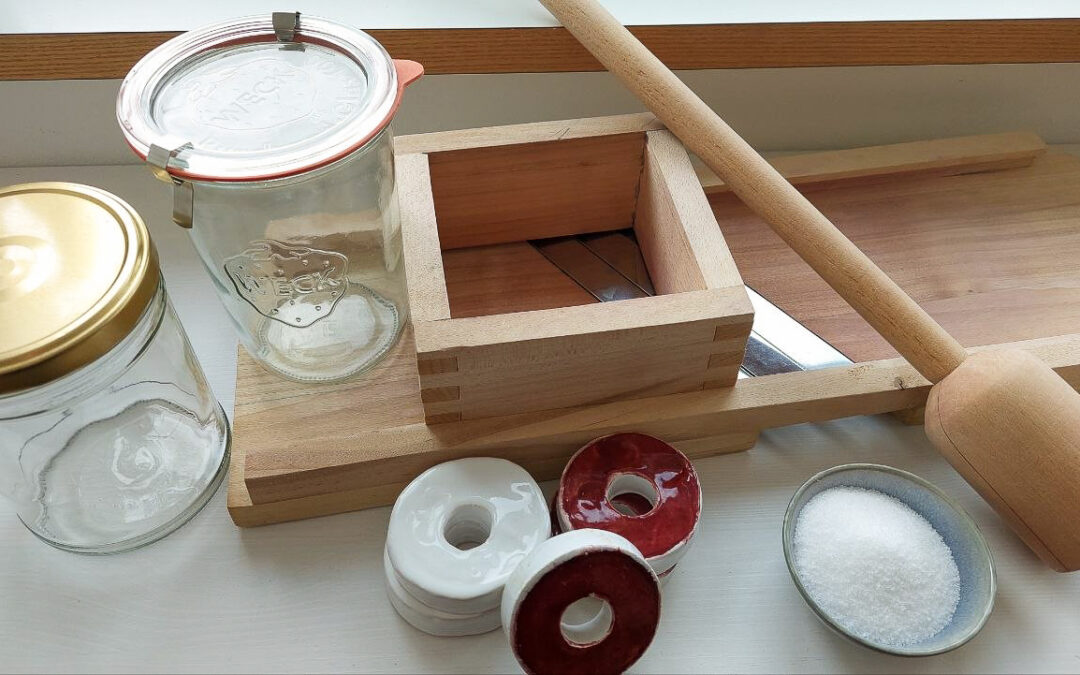
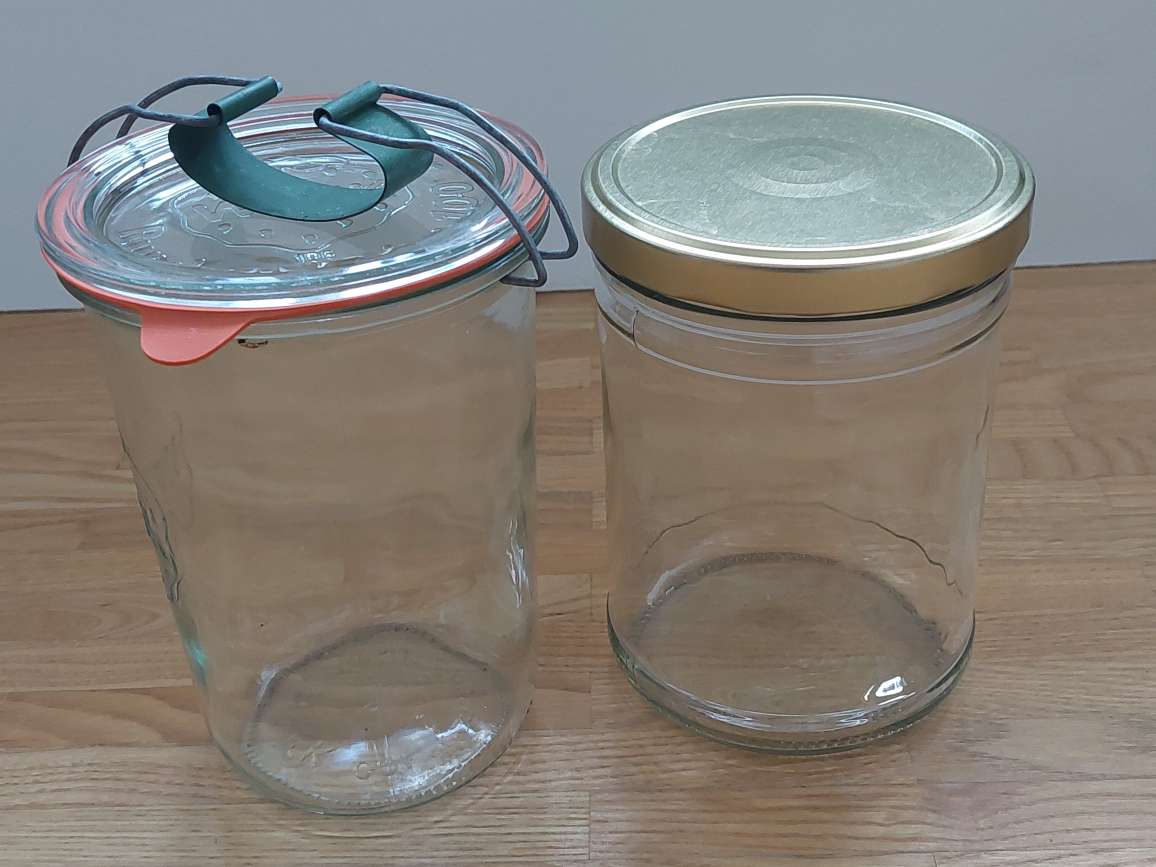
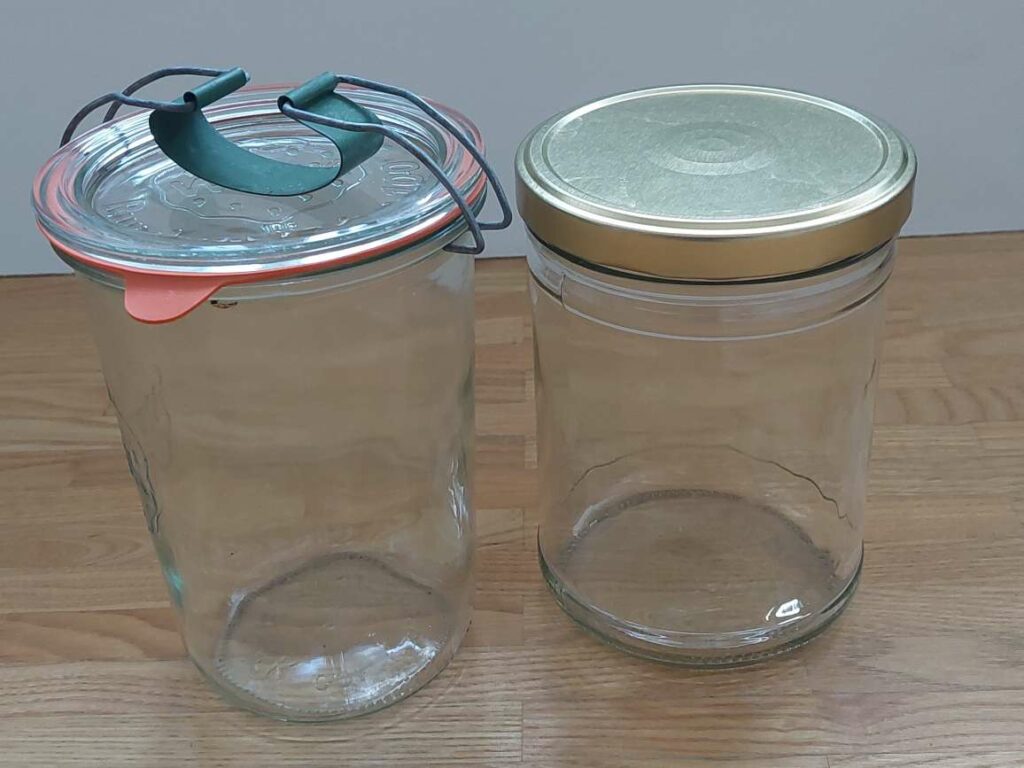
I usually use twist-off or flip-top jars. They are cheaper than crocks, and you can ferment smaller portions. Additionally, you can see through the glass what’s going on inside. It doesn’t matter if you use Mason, Weck, Kilner or Fido jars; they’re equally good.
What’s more important, or rather what makes a jar a good fermentation jar, is
a wide opening: the best jars are the ones with a straight opening
easy cleaning: jars with a straight opening can be cleaned more easily than jars with indented openings
food-safe materials: glass jars are ideal because glass is non-reactive, easy to clean, and perfectly suited to acidic ferments
appropriate size: I usually use jars of 500 ml, 1 litre and a large crock pot of 3 litres, especially when I make a large batch of fermented gherkins.
Fermentation Weights
Vegetables must always stay submerged under the brine during fermentation, or else they would mould. To ensure that nothing pokes through the surface, we use weights.
Fermentation crocks usually come with suitable weights, but if you don’t have any, you can use a dish, for example.
You can also use stones, but depending on their lime content, they might react with the acid. You should at least boil them for 10 minutes before using them.
There are also great glass weights out there. I especially love that they can be so easily cleaned and sterilised. On the downside, they’re comparatively expensive.
DIY Weight options: Freezer bags
For beginners, I recommend using freezer bags. Fill them with brine or (clean) pebbles and put them onto the covering (e.g. a cabbage leaf) to keep the veggies under the brine. The reason I recommend filling them with brine is that in the (unlikely, yet possible) event that the bag gets damaged, it’s not water flowing into the glass and watering down the brine there.
My favourite DIY fermentation weight
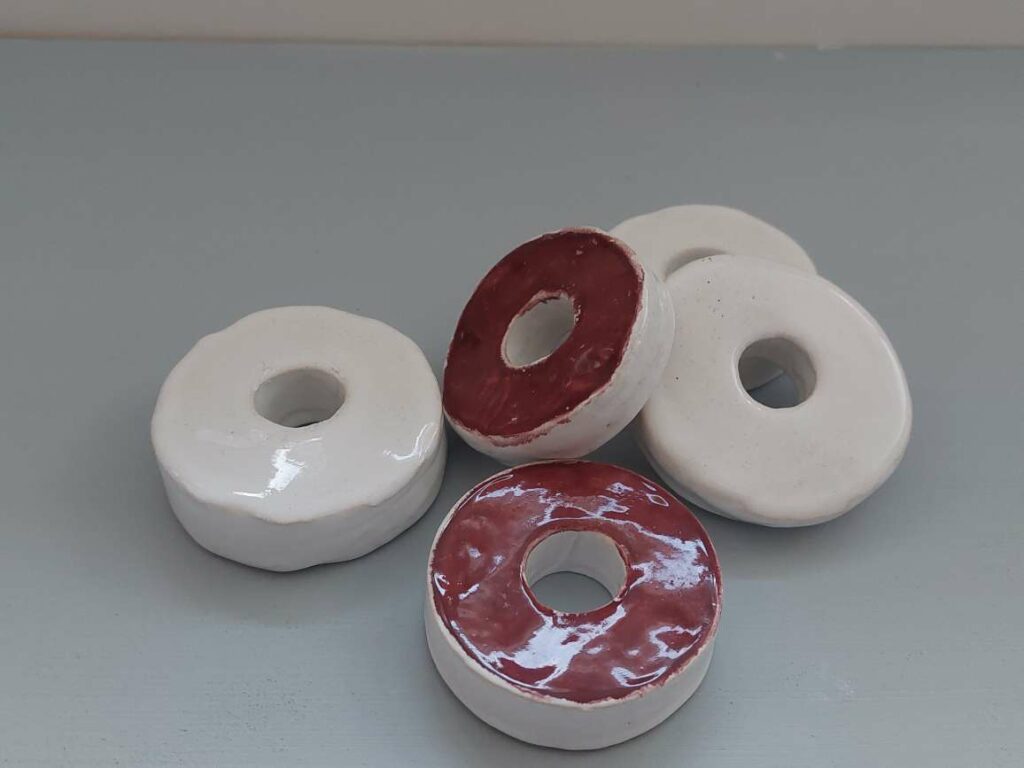
After years of using freezer bags, I made my own glazed clay weights. They’re inexpensive, reusable, easy to clean, and fit my jars perfectly. They’ve become one of my most-used fermentation tools.
I cut out circles of a 1 cm thick slice of clay, making their diameter slightly less than the opening of my jars. Then I cut a hole in the middle and glazed and baked the clay weights.
During baking, they shrank a bit further, and now their size is perfect for my jars.
You can also make weights from hardwood that doesn’t secrete resin, like walnut. Keep in mind, though, that wood swells in brine! Saw a circle with a diameter of one centimetre less than the opening and drill a hole into the middle where the brine could get through. Put the wooden weight into water for one to two days and look how much it swells before you use it. I’ve never used them, as I find the clay weights perfect for my needs, but go ahead and try making wooden weights if you like.
Fermentation Lids and Airlocks
Lactic acid fermentation needs an anaerobic environment, that is, without oxygen. For that reason, we need to cover the jars so that no air gets into them. On the other hand, the bacteria and yeasts involved in the process produce carbon dioxide that needs to get out of the jar.
So, we need a system that lets carbon dioxide get out while at the same time prevents air from flowing in.
Standard lids: they’re cheap and easy to use, but can be too tight to let the carbon dioxide get out. Through experience, however, I’ve found out that when you screw the lid on, but not too tightly, the gases can get out from under the rim. Occasional burping, which is sometimes recommended, is not necessary.
Airlock Systems: An airlock lid looks a bit like a unicorn with its horn. Airlock systems grow in popularity because they make things a lot easier. With an airlock, you can leave the jars to themselves. Just make sure that you leave enough space from the top of the brine to the top of the glass jar, at least 2 – 3 fingerbreadths.
That said, airlocks are convenient, but not really necessary.
Note: I know that many people just use a clean cloth to cover their jars or open the jars every day during fermentation, but the risk of mould-forming is so much higher with these methods! I always use the lid and – in case of twist-off jars – secure it loosely or – in case of flip-top jars – secure it tightly. The gases can leak out either under the lid or the rubber ring, and you minimise the risk of mould-building.
Kitchen Scale
While I have nothing against measuring in cups and spoons, in the case of fermentation it’s more reliable to measure the weight, not the volume of the vegetables. When we’ve sliced or grated the vegetables we want to ferment, we weigh them first. This weight is the basis for our salt calculation. In this fermentation for beginners guide, I explain how you can calculate the amount of salt you’ll need for your fermentation. And you can download a cheat sheet there that shows examples for salt ratios. Just saying.
Salt
Strictly speaking, salt isn’t equipment but an ingredient. Since no fermentation setup is complete without it, though, it’s worth mentioning here.
Salt suppresses undesirable microorganisms and helps the vegetables to release water. Furthermore, it creates a favourable environment for lactic acid bacteria so they can thrive, and it contributes to the flavour and texture of the ferments.
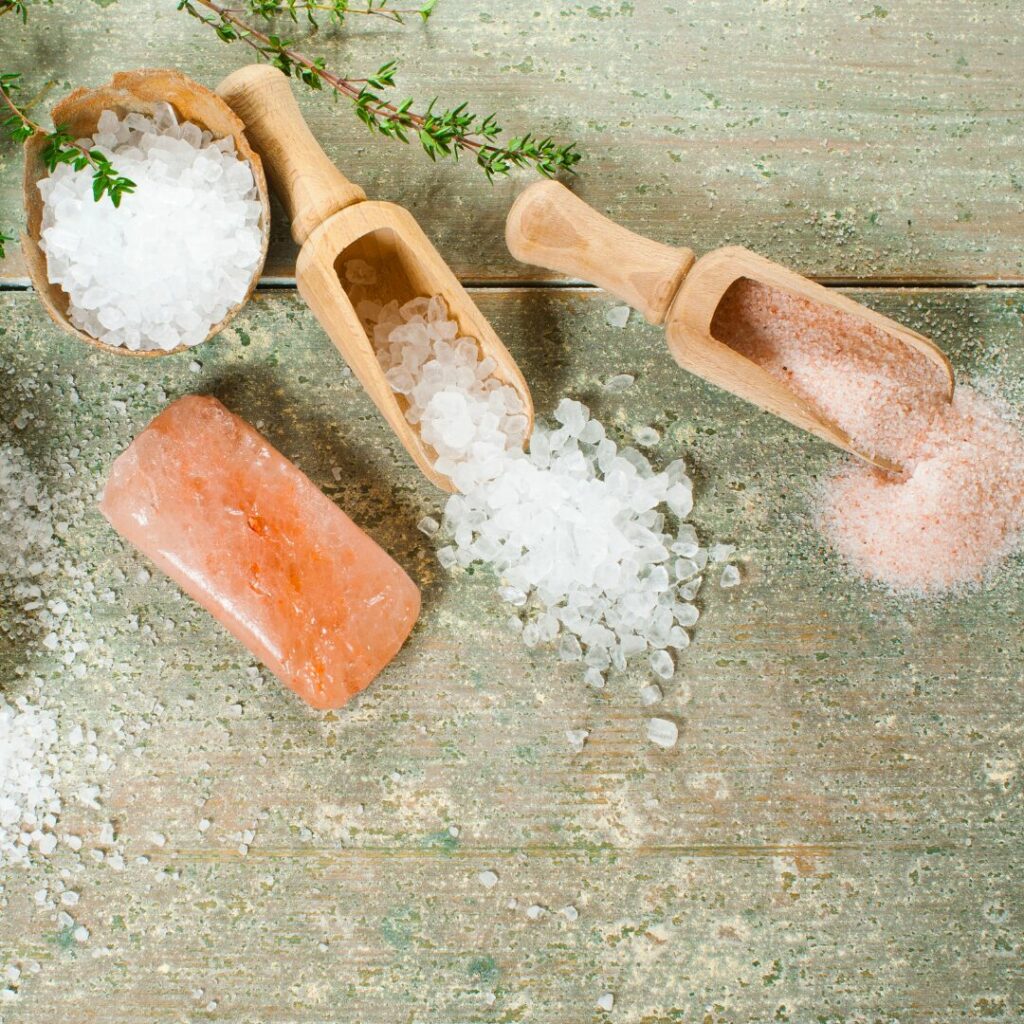
The best salt types to use for fermentation are sea salt, special pickling salt or pure rock salt.
Don’t use salts that contain anti-caking agents or any strongly flavoured speciality salts.
Apart from the right containers and coverings, there are a few tools that are really helpful when you want to ferment.
Cutting devices
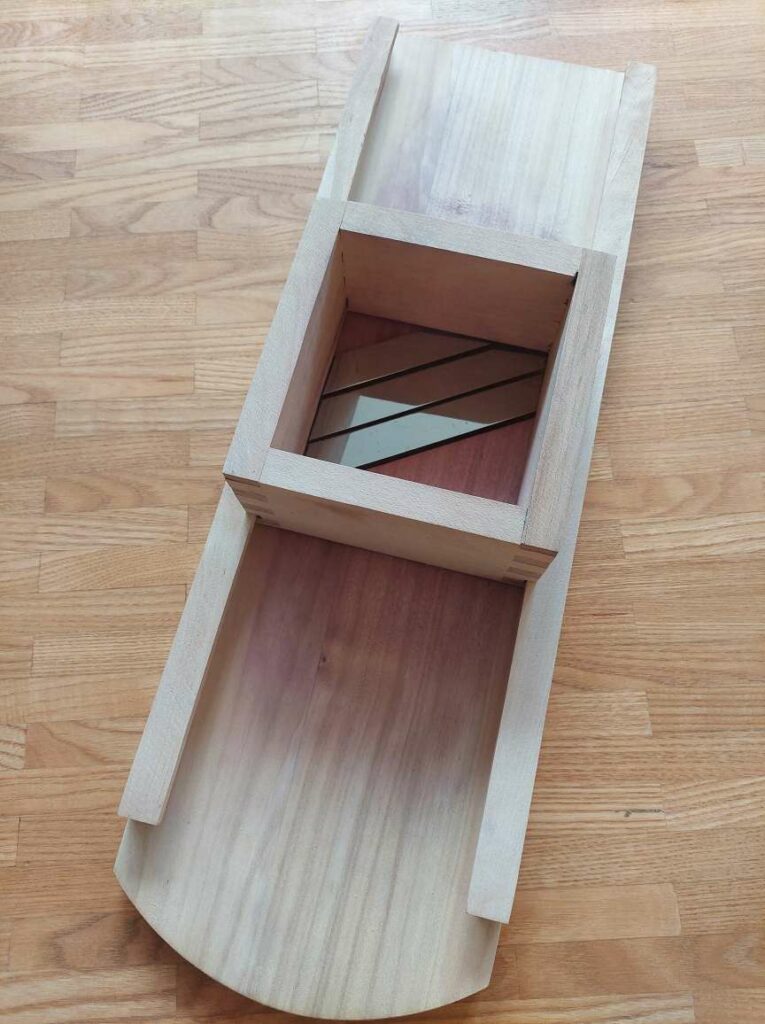
A sharp knife plus a wooden board or grater will do just fine for slicing the vegetables you want to ferment. But this list wouldn’t be complete if I didn’t mention the wonderful invention of a cabbage slicer. As the name indicates, it’s especially great for cabbage slicing (you can use it for any other veggies, though), and it’s one of my favourite tools for making my homemade sauerkraut.
If you’re just starting, however, you don’t need a slicer, as you can also do the job with a knife and a cutting board.
Note: I know that some people use the cutting or grating device of their kitchen machine. Go ahead if you like, but make sure that the slices are not too thin and mushy.
Large Mixing Bowl
When you want to make fermented vegetables, a large mixing bowl comes in handy. We usually slice or grate the veggies and mix them with salt, and that’s where the bowl comes in. You can use bowls made of glass, metal or plastic in which you gather all your sliced vegetables and mix them with salt.
Yes, I know, earlier I said that you should avoid metal or plastic containers, but that’s only for the actual fermentation process. For mixing the vegetables with salt and letting them sit for a while until brine forms, metal or plastic are just fine. After all, the time the salt is in there is too short to induce a reaction.
Vegetable Tamper or Pounder
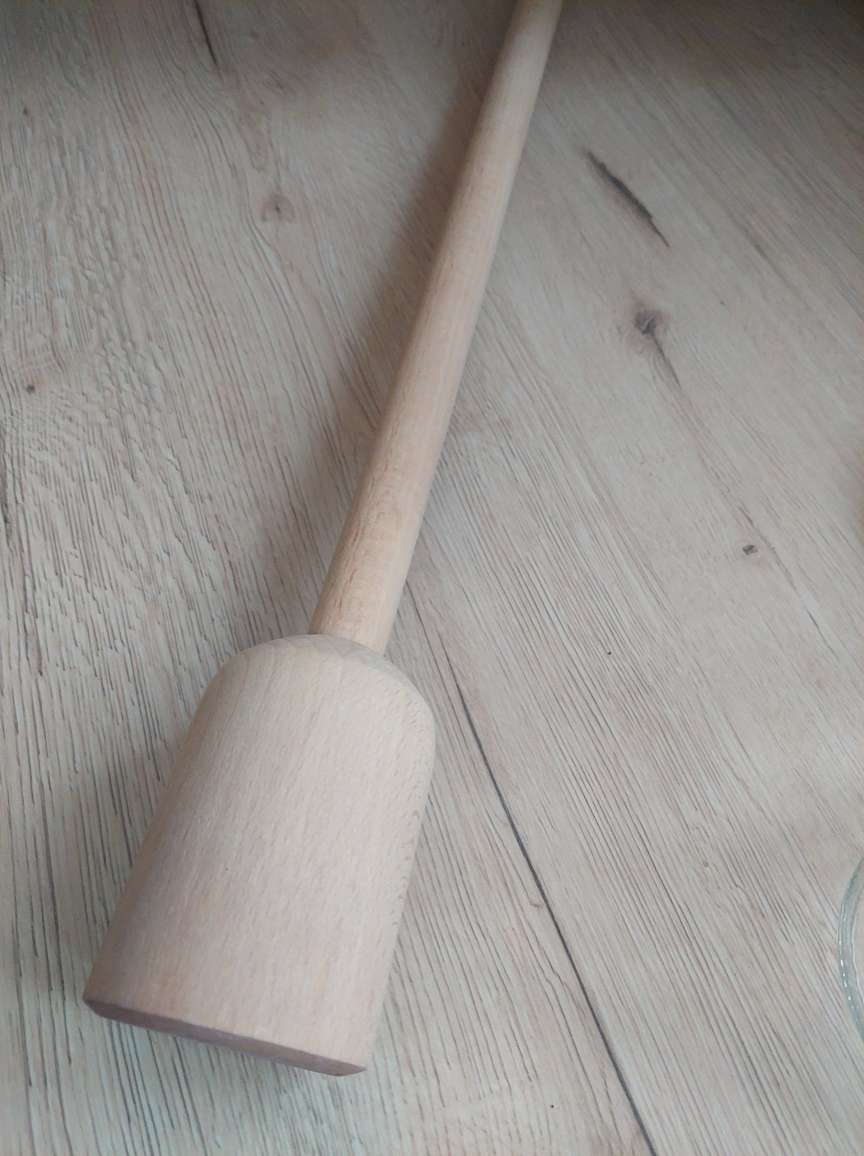
This is a convenient tool for pressing the vegetables tightly into the jars. Especially a wooden cabbage tamper (yep, I got one) is a great help to squeeze the vegetables tightly into the jars. Cool as a tamper is, though, it’s not really necessary when you start fermenting. You can always use your hands or a (clean!) empty bottle to press the vegetables into your containers.
Funnel
I find it easier to get the vegetables into the jar with the help of a funnel. The only requirement is that the funnel has a wide opening.
Labels and Marker Pens
Labelling the jars is unfortunately often overlooked. And before you think I’m exaggerating, let me tell you the story when I wanted to cook sauerkraut and ended up with a pot full of fermented kohlrabi instead. Just because I thought I could distinguish them easily and couldn’t be bothered with putting labels on the jars.
Don’t make the same mistake and always write clearly what’s in the jar. You’ll thank yourself later.
If you like or want to compare different recipes, also add the start date, the salt percentage and batch notes.
Optional Equipment for Serious Fermenters
Once fermentation becomes a regular part of your kitchen routine, you may enjoy some specialised tools.
Fermentation crocks
Traditional fermentation crocks made of stoneware have proved their worth as they store the vegetables dark and cool. If you buy a new one, check out its net weight, as they are usually very heavy. Then add the weight of the vegetables and brine and check if you can lift it when it’s full.
Another great advantage of crocks is that they have a water-seal in the form of a trough around the rim. When the vegetables are packed into the crock, we put the lid on top, and it fits right into the trough. Next, we fill the trough with water. That way, the gases that form during the fermentation process can get out (and you’ll hear a cute blubber), while at the same time air can’t get in.
pH Meter
Fermentation needs specific pH ranges in which the bacteria and yeasts can do their work. Checking the pH level makes sure that we have just the right environment for the microorganisms to thrive. In acidic conditions, they’ll happily go about their work. When the pH gets too high, though, the risk of spoilage increases.
Checking pH can be useful for consistency and food safety, but most home fermenters (like me) never use a pH meter and rely on established recipes and proper salt concentrations.
Temperature Monitoring
To start the fermentation process, we need temperatures between 18 and 24 °C. Later, temperatures must be lower to slow down the process.
A simple room thermometer is often enough to show us where in the house the temperatures are ideal for the different stages of fermentation.
Dedicated Fermentation Fridge or Chamber
This is a device that I only recommend for enthusiasts. I have the incredible luck of having a relatively cool basement where I can store all my ferments safely. Temperatures are just within the right range to make sure that the fermentation process slows down considerably and thus that the ferments don’t get too sour.
Most people, however, don’t have that luxury. If you fall among that group and intend to make many, many ferments, a fridge for storing them may be a good investment.
If you – like me – want to make ferments like koji that require very specific temperatures and humidity, a fermentation chamber might come in handy. But that’s really advanced and nothing a beginner should be troubled with.
Equipment You Can Skip as a Beginner
If you’re like me, you’re trying to convince yourself now that you need everything I mentioned. Or that it’s too much of a bother to get all those tools before starting. But really, if you just want to dip your toe into the fermentation sea and see if it’s right for you or if you’ve been fermenting quite some time but on a small scale, you can easily do without the following things:
Expensive crocks: Glass jars with lids will do perfectly
pH meters: Most vegetable ferments can be assessed by following a trusted recipe and paying attention to their smell, appearance, and taste.
Fancy airlock systems: Just don’t screw the lid tightly and the gases can get out
Fermentation chambers: Too expensive, need too much space, too much bother
Start simple. In fact, starting simple is miles better than not starting at all just because you think you need something fancy. When later you’re hooked on fermentation (and I’m confident you will), you can always upgrade and invest in more specialised equipment.
My Recommended Beginner Fermentation Setup
For beginners, the following equipment is what I’d recommend:
1-litre jar
Weight
Bowl
Kitchen scale
Salt
Most likely, you’ll already have all that at home. And honestly, you can make a lot of ferments just with that basic equipment.
When you want to do more, you can eventually invest in some of the following tools:
More jars, maybe in different sizes
Airlocks
Glass weights
Crock
My Beginner Fermentation Shopping List
If you had to buy everything from scratch:
2 x 1-litre jars
glass or DIY weight
kitchen scale
sea salt
Total cost: roughly €15–25
Frequently Asked Questions
Can I ferment vegetables in ordinary jars?
Absolutely, as long as you’ve got the appropriate lid. In fact, ordinary jars are what most fermentistas have started with.
Are airlock lids necessary?
No. You can use twist-off or flip-top jars as well. As long as you don’t screw the lid too tightly, gases can get out, and air is prevented from getting in.
Do I need a fermentation crock?
No, glass jars will do nicely.
Are plastic containers safe for fermentation?
Avoid unknown or non-food-grade plastics. Food-grade HDPE fermentation buckets are commonly used and generally considered safe for fermentation.
How many jars should a beginner buy?
One is enough if you just want to give fermentation a try. You can always buy more later.
Do fermentation jars need to be airtight?
Not completely. Fermentation produces carbon dioxide, which must be able to escape. That’s why loosely fitted lids, flip-top jars, or airlock systems work well.
Final Thoughts
The most important thing with fermentation is to get started. Don’t let equipment stop you from making your first batch of sauerkraut or fermented gherkins! Or why not try out fermented radishes?
Simple tools that you probably have already at home are enough to make safe, delicious fermented foods. After all, our ancestors didn’t have fancy equipment when they fermented vegetables thousands of years ago. And you can always add the fancy things to your next birthday wish list 😏.
Focusing on understanding how fermentation works is much more essential than buying any fancy gadgets right now. So, get some vegetables, whip out the jar, bowl and weight and get started. Happy fermenting!
Wanna learn more about preserving? No problem: in my preserving hub you’ll find guides and recipes for fermentation, pickles, jams and more.
Fermentation may sound mysterious, but it’s one of the simplest and oldest ways to preserve food. With very little effort, you can create delicious, probiotic-rich foods right in your kitchen. In this beginner’s guide, I’ll show you exactly how fermentation works, how to do it safely, and which easy ferments to start with.
But what exactly is fermentation, and how can you ferment vegetables?
Question
Quick Answer
What is fermentation?
Preservation using beneficial microbes
Is it safe?
Yes, when basic rules are followed
How much salt?
Usually 2–3% by weight
How long does it take?
5 - 14 days
Best beginner ferment?
Sauerkraut
What Is Fermentation?
The (originally Latin) word „fermentation“ means „transformation of a substance“. This transformation is carried out by the smallest creatures called microorganisms or microbes, for example, bacteria and yeasts. Microorganisms transform organic substances, for example sugars, into alcohol and acids, depending on the kind of fermentation.
In simple terms, fermentation is a preservation method that uses beneficial microorganisms to transform and protect food.
Fermentation is NOT the same as pickling. In fact, those are two very different ways to preserve food.
Fermentation vs Pickling
While fermentation is carried out by live bacteria and takes time to develop, pickling relies on vinegar or another preserving medium to preserve food quickly. Harmful microorganisms are killed by briefly cooking the vegetables (or showering them with boiling water). Afterwards, the products are preserved in vinegar, salt brine, oil or alcohol. Pickled vegetables, therefore, have a sharper flavour, while the taste of fermented food is more complex.
Maybe you’ve heard the story of Captain Cook, who prevented scurvy by making his crew eat sauerkraut every day. We know today that scurvy is caused by a severe vitamin C deficiency due to a limited diet. We also know now that the vitamin C content of vegetables increases through fermenting, as well as the content of other vitamins and minerals. Fermented foods can contribute valuable nutrients and beneficial microbes to the diet.
Science has also found that the iron content in lacto-fermented vegetable juices is, to a certain extent, more soluble than that in raw juice.
Some fermented foods may contain small amounts of B vitamins, depending on the ingredients and fermentation process. As the only other sources for these nutrients are of animal origin, this is especially interesting for vegetarians and vegans.
While adding all this good stuff, at the same time, fermentation eliminates various toxins such as polyphenols and tannins.
But that’s not all.
Emerging research suggests that there is a connection between the ingestion of probiotics through fermented food and a reduction in blood pressure.
Some studies indicate that fermented food can also help regulate inflammation in the gut and boost anti-inflammatory cytokines.
And, last but not least, fermented goods are said to improve digestion.
So you see: the question should not be why we should eat fermented food but rather why not more often?
Improved flavour
Fermentation adds more depth and creates new nuances to the original product. As a ferment contains live microorganisms, the flavour keeps changing slightly over time.
Preserving seasonal harvests
Living seasonally has always included preserving abundance for leaner months, and fermentation is one way of doing that.
If you have a garden or a patio, a balcony or even just a south-facing windowsill, you can grow vegetables. Sometimes the harvest is more than we can eat, and that’s where preserving comes in. Why not cut that cabbage head into thin slices and make sauerkraut from it for the winter? Or let’s grate these carrots and parsnips and ferment them? Later in the year, when fresh vegetables are just a distant memory, this ferment will make a delicious and healthy side dish and provide us with all the good stuff I told you earlier about.
Reduced food waste
Despite all the amenities of modern life, such as freezers, fridges, and canners, one-third (!) of food is still thrown away, most of it in the Western world. According to studies, 90 kilograms of food are thrown away per capita in Western Europe.
Look, I’m guilty, too. That half head of broccoli, the two spears of leek that couldn’t fit into the soup any more or that bunch of radishes you harvested but no one wanted them that day, and then they had wilted and gone wizened – I had my share of vegetables I let go to waste.
Had I been a fermentista back then already, none of these presents from Mother Nature would have been thrown out. I’d definitely have them fermented.
Environmental benefits
Most fermentation processes don’t require electricity, neither in the making nor for storing. You don’t need a freezer, fridge (although it might come in handy) or a canner. All the energy you need is a bit of muscle to chop and slice the vegetables and press them into a jar.
At the same time, when you ferment vegetables that you have grown yourself or bought locally, you make sure to keep transportation routes short. That said, fermentation is the most sustainable way to preserve. Isn’t that cool? Fermentation is seasonal living in a jar!
Inexpensive
The fact that you neither need electricity nor fancy equipment (although I don’t say you couldn’t), makes fermentation a very low-budget way to preserve food. Even more so, when you cultivate the vegetables or fruits you use for fermentation by yourself.
I don’t know about you, but to me, fermentation sounds perfect: it provides nourishing, healthy food for the winter months, reduces food waste, is sustainable and doesn’t cost much. Above all, it’s a deeply satisfying, traditional preservation skill. So, where’s the flaw? You might ask. Let’s have a look at the question, most people ask themselves before starting to ferment anything:
Is Fermentation Safe?
The short answer is: Yes, BUT you must observe some basic rules
The golden rules of safe fermentation
Fermentation Safety Checklist:
✓ use clean equipment
✓ use correct salt ratios
✓ keep food submerged
✓ avoid contaminated ingredients
✓ trust smell + visual cues
✓ use tested methods
Use clean equipment: Thoroughly wash jars, lids and utensils with hot water and soap.
Use the correct salt ratios: You may think that all that salt in a ferment can’t be good for your health, and you’d rather take a smaller amount. That’s a sure way to a spoiled ferment! The salt is necessary to keep harmful bacteria out and create an acidic environment where only beneficial microorganisms can grow. Besides, we only use 2 – 5 % salt, which is less than, for example, in some sausages.
Keep the food submerged. When food swims on the surface, it can spoil and destroy the whole jar. As long as everything stays under the brine surface, all is fine.
Avoid contaminated ingredients: never use mouldy, rotten or otherwise contaminated products. You can only make something good from something good.
Trust your nose and eyes: Before you taste a ferment, check the smell and appearance. When it looks and smells fine (see the next point), it’s safe to eat.
Use tested methods: Fermentation hasn’t changed much over the course of millennia – not because people weren’t creative, but because tried and tested methods lead to great results.
Signs a ferment is going well
As I said before, the eyes and nose are good agents to check if a ferment is going well.
Within a few days, a new ferment should be bubbling; that’s a sure sign of microbial activity and exactly what we want.
Some days later, the brine will change and become cloudy. That’s perfectly normal and a sign of maturing.
Now, check the smell: it should smell, of course, sour and a bit tangy. It should NOT smell mouldy, fishy or rotten.
If everything’s fine, taste your ferment. The vegetables should have softened but still have some crunch. They should smell sour, tangy and a lot more complex than in their original state.
Signs something went wrong
Some indicators will tell you that, alas, something’s gone wrong with your ferment:
The first indicator is the appearance: when fuzzy mould, pink or orange slime or some black growth has formed on the surface, it’s a sure sign of spoilage. Throw the whole jar out.
Even when there are no visual clues, the smell usually gives away that there’s something rotten in the state of Denmark – or rather your jar: It should NOT smell mouldy, fishy or rotten.
Our senses will warn us when something’s off.
If you’ve never fermented anything before, don’t worry. Thousands of people successfully make their first ferment every year with nothing more than a jar, vegetables, salt, and a little patience.
Your First Ferment in 6 Steps
1. Prepare the vegetables
Whatever vegetable(s) you choose, wash them thoroughly to remove any dirt. If necessary, peel them and then either slice or grate them.
2. Salt correctly
Weigh the prepared vegetables in grams/kilograms or pounds. It doesn’t do to measure the volume in cups! When you’ve determined the weight, you can calculate the amount of salt you’ll need. Let me give you an example:
Let’s assume we’ve got 750 g of grated carrots and need a salt ratio of 2 %. Divide the weight by 100 to get one per cent and multiply it by 2. That makes
750 / 100 = 7.5
7.5 * 2: 15
For 750 g of carrots, we need 15 g of salt.
3. Knead in the salt
Mix the salt and vegetables thoroughly in a bowl and knead them strongly. Then let it rest for a few minutes so that the brine forms.
4. Pack tightly
Put the vegetables in a jar, handful by handful, and press them tightly so that all air is removed.
If necessary, fill the jar with brine so that everything is covered, and there’s about an inch between the brine surface and the jar rim.
5. Keep submerged
Now put a weight on top of the vegetables to keep them submerged. This is a critical point, as only under the brine, that is, in anaerobic conditions, can the beneficial bacteria do their work.
6. Ferment at room temperature
Close the lid slightly and put the jar in a place without direct sunlight and at room temperature. After 1 – 3 days, you should see the first bubbles, and the brine may even be pressed out from under the lid.
7. Taste and store
After about 7 days, when bubbling has visibly slowed down, it’s time to taste the ferment. When you’re satisfied, put the jar in a cooler place, for example, a cool basement or the fridge, to slow down the fermentation process.
If it’s not yet to your liking, let it ferment for another few days. Taste it daily to see if it’s ready.
Want to Start Fermenting With Confidence?
Get my free Fermentation Starter Checklist and avoid the most common beginner mistakes.
✓ Safe salt ratios ✓ Equipment checklist ✓ Fermentation timeline ✓ Signs of a healthy ferment ✓ Troubleshooting guide
5 Easy Ferments for Beginners
You know all the theory now, so let me show you some beginner-friendly ferments you can try your hand at.
Easy Sauerkraut
Sauerkraut is the most widely known ferment in Europe and the US, and it’s very easy to make. A classic ferment that’s done in no time, yet tastes wonderful!
Fermented carrots can be eaten as a quick, ready-made salad or on a bagel with cream cheese.
Fermented Garlic Honey
A slightly different ferment, as it’s made with honey instead of salt. An epiphany for the taste buds!
Fermented Lemons
Wonderfully salty and tangy, fermented lemons are a must-have for oriental cuisine, but also add an interesting flavour to salads, couscous and rice dishes.
When you stick to the step-by-step description, nothing should go wrong. But as a beginner, you may come across several issues you’ll want to know about.
How Fermentation Works (Simple Science)
Fermentation describes the microbial or enzymatic transformation of organic substances into acids, gases or alcohol. We either ferment by adding bacteria, fungi or other microbial cultures or by adding enzymes. These microorganisms are partly already on the initial product, inducing a wild fermentation.
When it comes to fermentation, we need certain bacteria and must prevent others. In the case of lacto-acid fermentation, the most important of the beneficial bacteria we need is called Lactobacillus. Several species of lactic acid bacteria work together during fermentation, creating the acidic environment that preserves food.
Lactic acid bacteria are practically everywhere: on vegetables, on our skin, and in our house, which is great for wild fermentation. During this process, they transform carbs into lactic acid and carbon dioxide (CO2) and prevent harmful bacteria from growing.
Think of fermentation as creating the perfect home for good microbes while making life difficult for the bad ones.
There are two methods of lacto-fermentation
The brine method
Here, chopped or whole vegetables like carrots and cucumber sticks or cauliflower roses are put into a jar, which is then filled with brine until the vegetables are completely covered. Brine is essentially a water-salt solution with 25 – 50 g salt per litre of water, depending on the vegetables. Put the containers in a place without direct sunlight and temperatures between 13 and 24 °C, and let the contents ferment. If necessary, fill up with brine. The time of fermentation depends on the recipe.
The dry-salting method
Despite the name, this process is not dry. The vegetables are sliced as thin as possible and mixed with salt. Slicing breaks up the cell structure so that the salt can act more effectively and draw water out from the vegetables that gather as brine. Tightly press the vegetables into your containers and fill up with the remaining brine. Leave the containers in a place without direct sunlight at a temperature between 13 and 24 °C. The time of fermentation depends on the recipe.
Lacto-Fermentation for Beginners
Lacto-fermentation is not the only type of fermentation, though. Let me show you some other variants.
What are the different types of fermentation?
Here’s an overview of the most important types of fermentation:
In this guide, we’ll focus on lactic acid fermentation because it’s the easiest place for beginners to start.
Although we don’t need much to start our first ferment, there are some basic things we can’t do without.
Equipment You Need to Start Fermenting
The good news is that you can buy fancy equipment, but it’s not a must. In fact, if you just want to start, you probably have all you need already at home. I have written a comprehensive article on fermentation equipment, but let’s have a quick look at the basics :
Glass jars: Twist-off jars, mason jars, or Weck jars with rubbers and clips are equally fine
Weights: There are really cool fermentation weights you can buy, but to start, simple freezer bags filled with water will work just fine
Lids/airlocks: You need to cover the jars with lids, but you don’t necessarily need airlocks. The gases that form during fermentation will get out as long as you don’t twist the lids too tightly.
Digital kitchen scale
Non-iodised salt: Iodine will slow down or prevent fermentation
Cutting board
Knife
Apart from good starter products and equipment, there are a few conditions that fermentation needs to work.
Fermentation conditions
There are a few factors that are crucial for a successful fermentation:
Hygiene
Before you start fermenting, wash your hands thoroughly with warm water and soap. Don’t use antibacterial soap, as this could inhibit the fermentation process – especially if you knead the cabbage. Wash your vegetables just with cold (!) water and don’t sterilise your equipment as this could kill our lactic acid bacteria. Just warm water and a bit of soap are enough to clean your equipment.
Temperature
I recommend a temperature between 13 and 24 °C for fermentation, as this is the range where lactic acid bacteria thrive. It’s important to keep the temperature constant. The warmer it is, the faster acid is produced. If it’s too warm, however, the microorganisms can’t develop quickly enough, and the taste will suffer.
If it’s too cold (especially at the beginning), the lactic acid bacteria can’t increase fast enough, which may lead to spoilage.
Light
A dark place is ideal for fermentation. This doesn’t mean that you have to store your fermentation crock in a pitch-dark hole, but it should also not be in direct sunlight. A shadowy corner in your kitchen or pantry where you can keep an eye on it is great.
Oxygen
As talked about earlier, fermentation happens without oxygen, so we must make sure that the vegetables are always under the brine. With the brine technique, this can mean that we have to add brine after several days. When applying the dry-salting technique, we can make sure that our veggies are constantly covered with brine by putting a weight on them and pressing them down.
Time
So, how long does it take until the fermentation process is complete and you can eat your fermented veggies? That depends, mostly on the kind of vegetables, but also on other factors like temperature and season. Technically speaking, veggies are fermented when they have reached a pH of under 4.6 (a pH of 7 is neutral, and the lower the pH, the more acidic the medium). If you want to determine the pH, go ahead and put a pH test strip into the brine. But you can also just rely on your taste buds: try your fermented food and eat it when you like the taste.
Ready to get started? Here’s a list of beginner-friendly fermentation recipes.
Best Ferments for Complete Beginners
Difficulty
Ferment
Very Easy
Sauerkraut
Very Easy
Carrots
Easy
Radishes
Easy
Garlic
Medium
Fermented lemons
The role of salt in fermentation
Salt can preserve fresh vegetables, including all their vitamins, for months or even years. It removes water from the cells, which gathers as brine in the fermentation crock. Brine again is important as lactic acid bacteria live anaerobically, i.e. without oxygen, which lots of other microbes need. To prevent the growth of those unwanted microbes, fermentations happen under the exclusion of oxygen, that is: in brine.
Salt also improves the consistency of the vegetables. It hardens the cells’ pectin so that they stay more stable and thus “crunchy”.
It may come as a surprise, but salt makes things salty and thus adds to the taste.
It also helps to keep unwanted bacteria and yeasts in check that are more sensitive to a salty environment than lactic acid bacteria.
Without salt, there could be an increase of yeasts that transform sugar not into lactic acid but into alcohol.
The best salts for fermentation are rock salt, sea salt and kosher salt. Always make sure that the salt you use doesn’t contain iodine, as this substance may slow down or even prevent fermentation.
Where to store fermented food
Storing fermented foods in the fridge slows fermentation almost to a standstill and helps preserve the flavour you enjoy.
If you are lucky and have a cool (below 10 °C but above 0°C) basement or even a root cellar, this is a great storage place for your fermented food! In that case, I recommend fermenting in larger containers because the food lasts longer the larger the container is. It is no coincidence that people used large fermentation crocks in the past.
Alternatively, you may preserve your fermented food in a water bath. With this method, you must be aware that precious vitamins and nutrients may be destroyed by the heat.
My basement is luckily very cool, and I can store all my fermented food there. If your cellar is too warm for that, I recommend a second fridge.
Common Fermentation Problems & Fixes
Here’s a short overview of common problems. For more detailed explanations, read my guide about fermentation problems and what to do.
Why is my ferment cloudy?
It’s perfectly normal that in the course of fermentation, the brine gets cloudy. You can eat it.
Is kahm yeast safe?
Kahm yeast is a thin white film on the brine surface that gets destroyed when you stir it slightly. Although it looks a bit suspicious, it’s safe.
Why do no bubbles form?
The most likely reason is that it’s too cold. Fermentation is best carried out at room temperature.
Why is it too salty?
Either you’ve added too much salt (stick to the ratio indicated in the recipe), or it’s too early, and you need to let it ferment a bit longer.
Why is my ferment mushy?
When you add too little salt, the fermented vegetables get mushy. Another reason would be that the ferment is older than a year.
Why is mould forming?
Most likely because the vegetables are not completely covered by brine. Lactic acid fermentation must be anaerobic.
Fermentation FAQ
How long does fermentation take?
That depends on the product you want to make and the type of fermentation. Lactic acid fermentation, for example, takes 5 – 10 days, while maturing a vinegar can take years.
Can fermentation happen without salt?
Salt is only necessary for lactic acid fermentation. Other types of fermentation don’t need salt.
Can I use tap water?
Yes, as long as it’s clean and unchlorinated.
Do fermented foods contain alcohol?
Some do, for example, beer, cider, and wine, which are fermented by yeasts. Other ferments like sauerkraut, sourdough or koji don’t contain alcohol.
Can I ferment fruit?
Yes, but it takes way shorter and should be eaten within 2 weeks. Due to the high sugar content, it can produce more bubbles and even become alcoholic.
Should fermentation smell bad?
To some people, cheese or sauerkraut smells “bad”, so that’s a very subjective term. As a rule of thumb, when you don’t like the smell, don’t eat it.
Can I ferment in metal containers?
No, as salt and acid will react with the metal over time.
Enjoy Traditional Food Skills?
Join the Seasonal Simple Life newsletter for seasonal gardening tips, preserving recipes, fermentation projects, and simple ways to live closer to nature.
Let’s revive a wonderful traditional preservation method
Fermentation connects beautifully with seasonal living because it teaches patience, trust, and making the most of abundance.
And it’s easier than you might have thought!
Our ancestors did it without any modern equipment – and you can do it, too. The most important thing: Just start. Your first sauerkraut needn’t be perfect, but with every new project you’ll gain experience.
Fermentation is more than a preservation technique. It’s a way of slowing down, working with nature instead of against it, and turning seasonal abundance into nourishing food for months to come. Start with a simple jar of sauerkraut and see where the journey takes you.
Welcome to the world of fermentation!
Continue Your Fermentation Journey
If you’re ready to start fermenting, these beginner-friendly guides will help you take the next step: