When the days grow short and St. Martin’s geese are finished, it’s finally time for Christmas cookies. While I love trying new recipes each year, some are non-negotiable in our family. Vanillekipferl top that list.
Compared to American Christmas cookies with their frosted sugar and chocolate dips, these pale crescents tell a quieter story. But don’t be fooled—they’re far from bland. One bite releases the flavour of vanilla sugar and toasted almonds, and those delicate half-moons crumble on your tongue in the most satisfying way.
Vanillekipferl are essential to German and Austrian Christmas celebrations, passed down through generations. My great-grandmother made them, my grandmother made them, my mother made them—and now I do too. When Mum baked Vanillekipferl each December, their vanilla scent filled the house. My brother and I could barely wait for them to cool. Mum would dust them with powdered sugar while still warm, and we’d sneak one. Or ten.
One year, we’d really overdone it—half a tray gone. Mum, naturally, scolded us thoroughly until my brother protested, “But how come Daddy can eat them?” She turned just in time to catch my dad finishing off the last Vanillekipferl from the tray…
Well, that’s the thing about Vanillekipferl: they disappear fast. Their buttery texture and subtle vanilla-almond flavour make them dangerously addictive, and making them has become as much a part of my December ritual as the eating. Let me show you how to make these beloved Austrian Christmas cookies so you can start your own tradition.
200gpowdered vanilla sugarsee blog section on how to make powdered vanilla sugar
Method
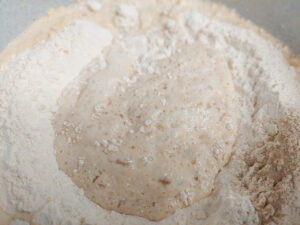
Put the flour, sugar, almonds, salt and the vanilla seeds in a bowl.
Cut the cold butter into small cubes and add it to the ingredients in the bowl.
Quickly but gently mix the ingredients with your hands until just combined - overworking makes the cookies tough.
Form rolls from the dough (see blog section for why rolls) and put them in the fridge for at least 1 hour, better overnight.
Cover a baking tray with parchment.
Remove the rolls from the fridge and cut off pieces of about 1 cm.
Roll each piece into a small rope of 5 - 6 cm, tapering the ends.
Shape into crescents by bending the ropes and set them onto a baking tray.
Chill the tray with the kipferl for 15 - 20 minutes (see blog section on chilling the cookies).
Preheat the oven to 140 °C (285 °F) upper-lower heat or 120 °C (250 °F) circulating heat.
Bake the Vanillekipferl in the hot oven for 15 - 20 minutes. They're ready when you can lift them easily from the tray and they're still pale, don't let them brown!
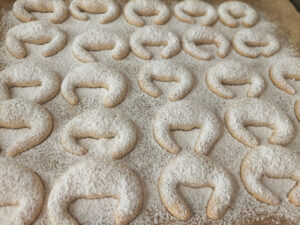
Right after removing them from the oven, roll the kipferl in vanilla sugar OR dust them with vanilla or icing sugar.
Let the kipferl cool down completely and layer them into a cookie box.
Notes
Vanillekipferl can be stored in a tightly closed cookie jar for up to six weeks. But honestly, they won't last that long 😉...
Great tips for even greater Vanillekipferl
There are a few things you need to observe to make really great Vanillekipferl:
Be quick
You must be quick when mixing the pastry dough. Take the butter directly from the fridge and cut it into small cubes. Then, quickly mix the ingredients with your hands until they’re well combined and the dough is homogeneous. Overworking activates the gluten, which makes cookies tough instead of tender.
Use powdered sugar
You can use granulated sugar, but powdered or icing sugar makes the dough finer and the cookies more tender in the end.
Form rolls
You can, of course, refrigerate the dough in a ball shape, but I find it more convenient if you form rolls. That way, you can cut off slices of roughly the same size and form them into the typical Vanillekipferl crescent.
Cooling the dough
I know it can be tempting to skip the cooling part of the dough, but the dough must be refrigerated for at least one hour (and preferably longer). Otherwise, the cookies will spread during baking, and instead of beautiful crescents, you’ll get flat, unshapely “pancakes”. So, when you plan to bake cookies with your family on Saturday, prepare the dough on Friday evening and let it rest in the fridge overnight.
Forming the cookies
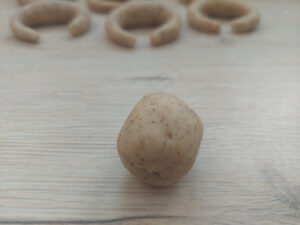
Cut slices of about 1 cm from the cooled cookie rolls and roll them into a ball.
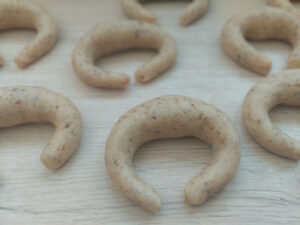
Then, roll them gently into a rope about 5 – 6 cm long and taper the ends.
Form the typical crescent by bending the rope.
Sometimes, the dough falls apart during rolling. In that case, press it all together and knead it slightly until it becomes more pliable.
Cooling the cookies
While forming the Vanillekipferl, the dough naturally becomes warm again. To prevent the cookies from spreading, cool the cookies before baking. As it’s usually cold outside, I normally put the trays with the ready-to-bake Vanillekipferl on my balcony to cool for about 15 minutes. During that time, I preheat the oven and clean up the kitchen.
Preheating the oven
Baking temperature must be right from the start. That’s why you must preheat the oven to the required 140 °C (285 °F) and only put the trays in when the oven has reached this temperature.
Stay close
Each oven is different and the baking time can only be an estimate. Therefore, stay close to your ovenand watch the Vanillekipferl while they bake. They should be light-coloured in the end. If they’re golden-brown, they’ve been in the oven for too long.
Homemade vanilla sugar
Don’t throw the vanilla pod you used earlier for the dough away. Instead, carefully dry it in the oven or a dehydrator and mix it with sugar in a food processor. The result is a wonderfully fine, vanilla-flavoured sugar you can use to dust the Vanillekipferl with!
Covering with sugar
When you dust the Vanillekipferl with powdered or your homemade vanilla sugar while they’re still warm, the sugar will stick better to the cookies. To dust, you can either sprinkle the sugar on the cookies with a sieve or you can carefully roll the Vanillekipferl in a bowl with vanilla sugar.
How long can Vanillekipferl be stored?
Let the cookies cool down completely after baking before you put them in an airtight container (cookie box or jar). In a cool and dry place, the Vanillekipferl store well up to 6 weeks, but honestly, they won’t last that long.
Already one missing!
If you start baking your Christmas cookies really early and want your Vanillekipferl to be at their best when serving them, you can freeze the baked cookies. Just don’t dust them with icing sugar.
By the way: you can also freeze the cookie dough. When you finally want to bake the cookies, put the dough out of the freezer and let it defrost at room temperature.
Vanillekipferl variations
Now that you know the classic, traditional Vanillekipferl recipe, you can get creative if you like:
Go nuts: Swap the almonds for ground hazelnuts or walnuts.
All things chocolate: Replace 50 g of flour with 50 g of baking cocoa for a chocolaty version of Vanillekipferl
Dark coat: dip the ends of the Vanillekipferl in melted chocolate; this is also a great way to add to the chocolate kipferl
Cinna-licious: Coat the Vanillekipferl in cinnamon sugar (powdered sugar mixed with cinnamon) instead of vanilla or pure icing sugar.
Add like crazy: Add pistachios to the dough, or freeze-dried strawberries or raspberries, or replace the almonds with ground poppy seeds. Add lemon or orange zest to the dough or – if you like it hot and spicy – 1/2 a teaspoon of ground chillies!
The tradition continues…
Making Vanillekipferl connects me to generations of women in my family who also baked these delicious Christmas cookies before me – and all the men who loved eating them (looking at you, Dad!). Now, I’d love you to start your own tradition, and it doesn’t matter if you have German or Austrian roots or have just discovered this recipe for the first time.
Admittedly, Vanillekipferl take some patience with the forming and double cooling, but the payoff is so worth it: while baking, your house will smell of vanilla and roasted almonds, and there are only a few things more satisfying than seeing the perfectly shaped little crescents on a cooling rack and powdered vanilla sugar on your fingertips.
Early December is the perfect time to bake your first batch of Vanillekipferl, and if you manage to keep them away from all the sweet tooths, you can proudly present your own Vanillekipferl at Christmas.
Whether this becomes your new December tradition or reminds you of your own family’s cookie rituals, I hope these little crescents bring you as much joy as they’ve brought mine.
November 11 is St. Martin’s Day, an important holiday in German-speaking regions. We celebrate this day extensively with lantern processions: Children (and their parents) walk through their town or village with handcrafted lanterns, singing songs about St. Martin and performing a play about his good deeds. Afterwards, everybody gets hot tea and Saint Martin’s geese, sweet yeast pastries that are shaped like geese (more on the geese connection later). Although my boys are no longer children, the scent of spiced tea and the rich dough of Saint Martin’s geese bring up treasured memories of the lantern-lit streets and the wonderful sense of community at the procession. To keep the seasonal traditions alive (and satisfy our sweet teeth), we still bake Saint Martin’s geese every year, and I want to show you how it’s done.
The Story Behind the Tradition
Martin was a Roman soldier, born around 316. When riding along on a cold winter’s day, he came across a hungry and freezing beggar. Martin, moved by pity, cut his warm cloak in half with his sword and gave half to the beggar. At night, the beggar appeared in Martin’s dreams, revealing that he was Jesus Christ.
Why geese?
After this incident, Martin converted to Christianity and studied the Christian faith. Later, the people of Tours (France) asked Martin to become bishop. Martin, however, modest as he was, didn’t consider himself worthy enough for the task and hid in a goose barn. The geese started quacking, betraying Martin’s whereabouts. He became bishop and served for about 30 years, said to have worked several miracles during that time. Martin died on November 11, 397 and was later canonised. After his death, eating goose on his memorial day became a tradition.
But is that really the reason why we eat geese (real or baked ones) on that day? Historians have another explanation for the tradition of the Saint Martin’s geese: for one, November 11 was the day when taxes or feudal dues were collected. The payment was often made in goods, such as a goose. At the same time, November 11 was the last day before the 40 days of Advent fasting (historically called “Saint Martin’s Lent”) before Christmas, and people indulged in a last hearty (goose) roast and other food that were taboo during the fast.
From harvest fires to lantern processions
I can’t believe how long it has been since that day when my boys attended St. Martin’s lantern processions! And did you see that my youngest had made a goose? 😏
And what does Saint Martin have to do with lantern processions? Light processions were already a tradition among early Christians, and this practice was adopted to honour Saint Martin on his memorial day. Additionally, people lit fires in November in the fields in gratitude for the harvest and as a symbolic farewell to the harvest year. The children crafted torches from straw and lanterns from hollowed turnips with which they wandered through the streets. Sound familiar? Rightly so: this is similar to the original Celtic harvest traditions that resulted in Halloween.
About the Dough: Enriched Yeast Dough
Now that we’ve covered the tradition’s history, let’s dive into baking Saint Martin’s geese!
While you may find recipes using different doughs, the classic dough to make the geese is an enriched yeast dough. “Enriched” simply means that apart from flour and yeast, our dough includes ingredients like butter, eggs, milk and sugar. Enriched yeast dough is perfect for special occasions as it’s sweet, softer and, well, richer than just plain yeast dough. It’s also perfect for shaping, which is ideal for cutting out our geese. Another sweet treat made from enriched dough is this braided yeast bun.
One of the secrets of enriched dough is to give it enough time to rise properly. Once you’ve got your core dough right, you allow it to rise and prove fully. You must be patient here and give it enough time; otherwise, you’ll end up with a brick.
But don’t worry: once you know what to watch for, it’s straightforward to make and a real treat to eat.
Ingredients & Equipment Needed
For making the enriched yeast dough for our Saint Martin’s geese, you’ll need
Flour: Pastry or all-purpose flour is equally good
Yeast: You can either use fresh or dry yeast, but keep in mind that you have to activate fresh yeast before adding it to the other ingredients
Sugar: either use granulated sugar or icing sugar
Egg
Milk: whole milk is best – I don’t recommend low-fat milk
Butter: alternatively, you could use margarine, but honestly, the taste will not be the same
For the decoration, you’ll need
Raisins for the eyes
Pearl sugar
You don’t need any special equipment to make Saint Martin’s geese. A goose-shaped cookie cutter makes the job easier, but it’s not essential – I cut out my geese using this template (download and print at 100%):
Put the flour and sugar in a large bowl. If you use dry yeast, add it as well. In case you use fresh yeast, however, you must activate it now: warm up the milk until it is lukewarm (not warmer or the yeast will die!) and crumble the fresh yeast into it. Stir until it’s dissolved. Make a well in the centre of the flour and pour the yeast milk into it. Cover the bowl and let the yeast activate for about 20 minutes. After that time, the yeast liquid will be bubbly and considerably risen.
Melt the butter and pour it into the bowl. Now add the egg and start kneading the dough, either by hand or with a food processor. Knead for about 5 minutes. The dough is ready when it’s soft and smooth and doesn’t stick to your fingers.
First rise
Form the dough into a ball, put it back in the bowl and cover it with a kitchen towel to prevent it from drying out. Let it sit for about 60 minutes in a warm place. The dough is ready when its volume has at least doubled.
This dough has risen perfectly and is ready to be rolled out and cut into Saint Martin’s geese!
Cutting the geese
Line two to three baking trays with parchment paper or brush them with some butter, lard or tallow so that the geese won’t stick.
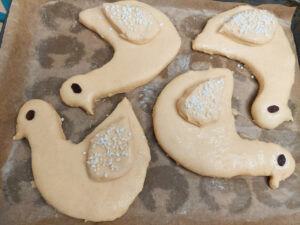
Lightly flour your work surface and roll out the yeast dough to about 1 cm (1/2 inch). Cut out the geese with a cookie cutter, the template or by hand and put them on the baking trays, leaving some space between them as they’ll expand during rising. If you use my template, also cut out one wing per goose.
Brush the wings with egg wash and gently press them onto the geese. Press a raisin into place for the eye.
Second rise
Now, let the geese sit for another 20 minutes. During that time, the dough will rise again, making the baked pastry all fluffy and soft.
In the meantime, preheat the oven to 175°C (350 °F).
Last decorations and baking
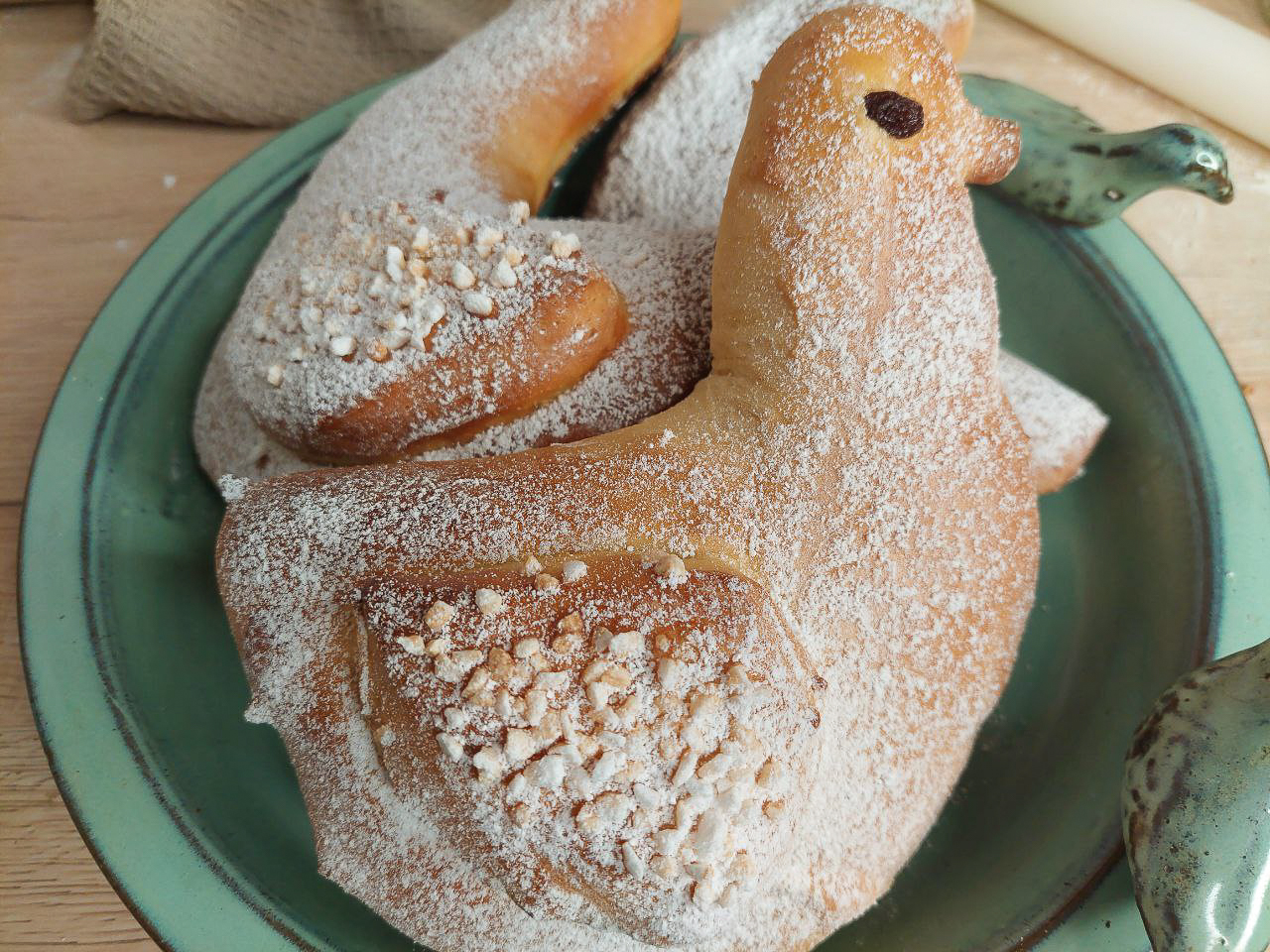
After the second rise, lightly brush the geese’s wings with egg wash and sprinkle pearl sugar on them. I prefer to sprinkle just the wings, but you can, of course, sprinkle the whole goose with pearl sugar.
Put the trays in the preheated oven and bake them for 20 minutes until they are golden brown.
When the geese are baked, take them out of the oven and let them cool down. If you like, you can dust them with icing sugar.
Put the flour and sugar in a large bowl. If you use dry yeast, add it as well. In case you use fresh yeast, however, you must activate it now: warm up the milk until it is lukewarm (not warmer or the yeast will die!) and crumble the fresh yeast into it. Stir until it's dissolved. Make a well in the centre of the flour and pour the yeast milk into it. Cover the bowl and let the yeast activate for about 20 minutes. After that time, the yeast liquid will be bubbly and considerably risen.
Melt the butter and pour it into the bowl. Now add the egg and start kneading the dough, either by hand or with a food processor. Knead for about 5 minutes. The dough is ready when it’s soft and smooth and doesn’t stick to your fingers.
First rise
Form the dough into a ball, put it back in the bowl and cover it with a kitchen towel to prevent it from drying out. Let it sit for about 60 minutes in a warm place. The dough is ready when its volume has at least doubled.
Cutting the geese
Line two to three baking trays with parchment paper or brush them with some butter, lard or tallow so that the geese won’t stick.
Lightly flour your work surface and roll out the yeast dough to about 1 cm (1/2 inch). Cut out the geese with a cookie cutter, the template or by hand and put them on the baking trays, leaving some space between them as they’ll expand during rising. If you use my template, also cut out one wing per goose.
Brush the wings with egg wash and gently press them onto the geese. Press a raisin into place for the eye.
Second rise
Now, let the geese sit for another 20 minutes. During that time, the dough will rise again, making the baked pastry all fluffy and soft.
In the meantime, preheat the oven to 175°C (350 °F).
Last decorations and baking
After the second rise, lightly brush the geese’s wings with egg wash and sprinkle pearl sugar on them. I prefer to sprinkle just the wings, but you can, of course, sprinkle the whole goose with pearl sugar.
Put the trays in the preheated oven and bake them for 20 minutes until they are golden brown.
When the geese are baked, take them out of the oven and let them cool down. If you like, you can dust them with icing sugar.
Notes
The baked geese store well in a linen bag or bread bin for several days. Alternatively, you can freeze them for up to 6 months, but remove any sugar because it will turn liquid when defrosted.
FAQs
How to tell when the yeast is properly activated?
After 20 minutes, properly activated yeast will be bubbly and noticeably risen. If it looks flat or unchanged, your yeast may be dead, or the milk was too hot.
What’s the right dough consistency?
Once you have added all ingredients to the bowl, mix them well together and knead the dough for about 5 minutes. Another option is letting it knead in a food processor. Anyway, the dough is ready for rising when its surface is smooth and it doesn’t stick to your fingers, your work surface or the bowl.
How do I keep the shapes defined during rising and baking?
The geese will enlarge by about 10% during rising, but the shape will stay the same, only become, well, larger. After rising, you can make small adjustments if you deem them necessary, like changing the bend of the neck, for example, or sharpening the beak. All in all, though, the shapes will stay much the same as the freshly cut out dough.
During baking, there may be a slight additional rise, but that’s it.
How long can I store baked Saint Martin’s geese?
Put any leftover geese in a linen bag or the bread bin, where they can be stored for several days.
Alternatively, you can freeze them. Just make sure not to use icing sugar and scrape off the pearl sugar, as it would turn liquid when the geese are defrosted. Frozen geese can be stored up to 6 months.
Serving Suggestions
Traditionally, Saint Martin’s geese are given to the children after the lantern procession, but they also make a great gift for friends and neighbours. A few years ago, I brought a batch to work and left them in the teachers’ room. Boy, it was like throwing a steak in a lion’s den! The geese were gone within a few minutes.
If you host a tea or coffee party at St. Martin’s Day, the geese make a wonderful treat with coffee, spiced tea or hot cocoa (my favourite!). Any seasonal hot drink, like pumpkin spice latte or gingerbread hot cocoa, as well as chai tea, is also a wonderfully fancy pairing for Saint Martin’s geese.
If there are some geese left the day after baking (or if you’ve made enough to store or freeze them), try them instead of bread for breakfast. The sweet pastry goes marvelously with butter and jam, for example one of these pear jam variations.
Variations & Creative Ideas
Now that you’ve mastered the sweet yeast dough, you can get creative.
Different shapes
Who says that you can only make geese from this dough? Try making large gingerbread men shapes that you decorate with raisins for the eyes and buttons for the shirt. For New Year’s Eve, you can form tiny pig heads or fish; they‘re considered to bring luck. Or you can just make this braided yeast bun.
Flavour additions
In this post, I’ve shown you the recipe for a basic enriched yeast dough. If you like, you can add different flavours to the dough, like for example the zest of an orange, the pulp of half a vanilla pod or ¼ teaspoon of cardamom.
Filling options
Try filling the geese with marzipan, Nutella or jam. For that purpose, roll out the dough only to 0.5 cm (1/4 inch), cut out the geese and put your preferred filling in the middle of the belly of half of the geese. Brush the edges of the geese with egg wash and stick the unfilled geese on top, gently pressing the seams closed. Let the geese rise as described in the recipe, decorate them as you like and bake them for 20 – 25 minutes.
Bake Saint Martin’s Geese!
Although we have stopped attending lantern processions, we still make Saint Martin’s geese every year to celebrate this day – and indulge in these sweet, fluffy pastries. I think it’s important to keep traditions, even if you bend them slightly. It would be a pity if these recipes and traditions vanished! And besides, for me, this seasonal recipe is the signal to start baking Christmas cookies!
These geese are so easy and fun to make that I encourage you to try making them with your children or grandchildren, nieces, nephews or friends’ kids. They’ll love it, cherish this memory of baking geese with you forever and hopefully will carry on this tradition.
Looking for Christmas recipes? These may interest you:
When the leaves start to paint warm hues on the landscape, it’s time for us gardeners to roll up our sleeves for the last time this year and do an autumn garden cleanup.
But what does autumn garden cleanup mean? In short, it’s the process of preparing your garden for its winter rest. Just like preparing a child for bedtime by brushing their teeth, giving them a bath and putting on their PJs, we clear out dead plants from our garden, manage fallen leaves and protect it from cold weather damage.
In this guide, I’ll walk you through the essential steps of autumn garden cleanup, from timing your efforts to sustainable practices that benefit both your garden and local wildlife.
Importance of an autumn garden cleanup
An autumn garden cleanup isn’t just for appearances, but helps our garden to stay healthy for the seasons to come.
It prevents the overwintering of pests and diseases and improves soil health for the next growing season.
Additionally, an autumn cleanup enhances our garden’s appearance during the winter months.
And lastly, it will reduce our workload next spring.
Timing your autumn cleanup
It’s important to choose the right timing for your autumn cleanup. Starting too early may deprive beneficial insects of their habitat, while starting too late may make cleaning up more difficult.
Roughly put, an autumn garden cleanup typically takes place between late September and early November. There is no one-size-fits-all date, though; it rather depends on the climate you live in:
Northern regions have earlier frost dates, starting in September to early October, while southern regions have their first frost later in the year, sometimes not before November or even December. In coastal areas, frost also comes late.
Also, growing seasons are shorter in northern areas and longer the nearer you get to the equator.
An additional factor is the altitude of our region: the higher we live, the earlier the first frost may come.
Knowing all that, we’ll want to start cleaning up our garden early in colder and/or wet climates. The warmer the climate we live in and the drier, the later we may leave the time to clean up.
Keep in mind, however, that these are general guidelines. Local weather patterns, microclimate variations, and specific plant needs should always be considered when determining the optimal timing for autumn garden cleanup.
Signs that indicate it’s time to begin
There are several signs that indicate it’s time to start a garden cleanup:
Nighttime temperatures consistently drop below 10 °C (50 °F).
The first frost date is approaching.
The leaves change colour and start to fall.
Annual plants finish their life cycle.
Perennials begin to die back.
Tasks for autumn garden cleanup
I always recommend a gradual approach over several weeks to cleaning up your garden. It’s way better than trying to do everything at once, which will only lead to overwhelm. Besides, a longer cleanup time allows for a longer enjoyment of all those beautiful late-blooming plants.
Vegetable garden
✅Harvest late vegetables like beetroots, carrots, celery, parsnips and parsley roots.
✅Before the first frost, cover spinach and winter lettuce like lamb’s lettuce with a special gardening mesh that will protect your vegetables from the cold.
✅ Plant garlic and winter onions to give them a head start for next year’s harvest. Look here for a comprehensive guide on cultivating garlic: How To Grow Garlic: Complete Planting Guide
✅ If you haven’t sown cover plants in August or early September, cover the soil with mulch.
Orchard
✅ Harvest the last fruits from the trees to avoid pests and diseases from overwintering and spreading.
✅ Remove and destroy any mummified fruits, that is, dried, shrivelled fruits that are still on the branches. Also, clean up fallen fruit to prevent disease spread.
✅ Check for and remove pest egg masses or cocoons.
✅ Trim dead, diseased or crossing branches from trees and shrubs. For the overall pruning of fruit trees and bushes, late winter is a better time.
✅ If your area is prone to winter sunscald, consider whitewashing the tree trunks. The white colour will reflect the sunlight so that the bark will not heat up too much. The tree temperature changes only slightly, which is great, considering that extreme temperature fluctuations are the cause of sunscald.
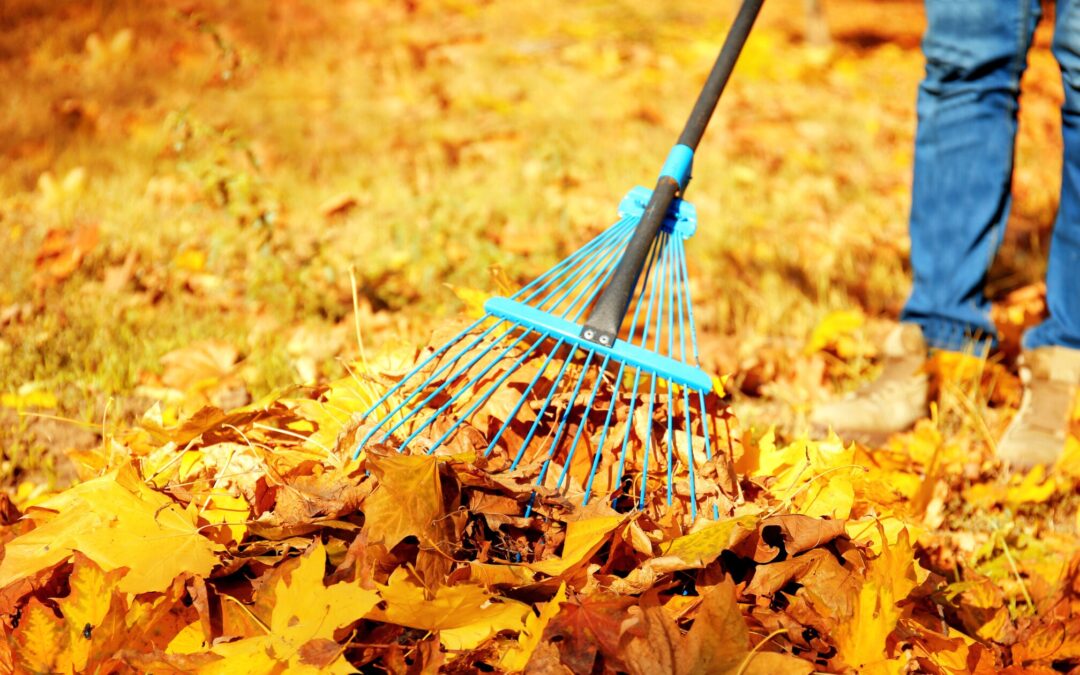
✅ Rake fallen leaves and remove those with a disease. Use the remaining leaves as mulch, either under the trees or in the vegetable garden. You can also create a leaf compost. The leaves will rot very fast, and the compost will be available in spring. Additionally, this compost heap will make a shelter for hedgehogs and insects.
✅ Spread compost or well-rotted manure under fruit trees and shrubs. Make sure to avoid direct contact with the trunks.
✅ Cover the soil beneath the trees and shrubs with mulch and make sure to extend the mulch to the trees’ drip line, which means the radius of the treetops.
Ornamental garden
✅ Remove spent annual flowers and compost any disease-free plant material.
✅ Cut back the dead foliage of perennials but leave some stalks for wildlife habitat. Note that some plants, like ornamental grasses, can be left standing for winter interest and wildlife habitat as well.
✅ Spread mulch around perennials and shrubs, and give sensitive plants insulation with extra mulch.
Remember, a thorough fall cleanup doesn’t mean creating a sterile environment. Leaving some areas slightly untamed can provide crucial winter habitats for beneficial insects and wildlife. That way, we can strike a balance between garden health and ecological responsibility.
Protecting sensitive plants
Depending on your hardiness zone, some plants require special protection to survive cold winters. In my garden, for example, I need to care especially for Mediterranean herbs like rosemary, thyme, and oregano, as well as the artichokes in my DIY greenhouse.
I mulch the plants with leaves, hay or straw. Then, I put straw onto them so that they are covered with it and fix that with twigs. You can also use protective wrapping made of non-woven material or jute. Do not use plastic, though, as moisture will build up beneath it and cause the plant to rot.
During winter, especially when it’s wet, you should check the plants for rotting. In that case, remove the mulch and protective layers and replace them with new, dry material.
Tool maintenance
Once you’re finished with cleaning up your garden, it’s time to care for your garden tools.
✅ First, clean all your garden tools thoroughly by removing any dirt and debris. Soak the tools in warm, soapy water, then scrub the dirt off and rinse. Let them dry well.
✅ If necessary, sharpen your tools with a file or a sharpening stone.
✅ Repair any damage (if possible), tighten loose screws, bolts and nuts and replace any broken or worn parts.
✅ Apply vegetable or machine oil to the metal parts to prevent rust and keep them moving smoothly.
✅ For wooden handles, use linseed oil to protect and nourish the wood
✅ Lastly, store your tools in a dry space, for example a garden shed, a garage or the basement, to prevent moisture build-up.
Conclusion
A garden cleanup in autumn is more than just tidying up: it’s an investment in the health and vitality of our garden.
By removing spent plants, protecting sensitive specimens and using fallen leaves as mulch or compost, we not only prevent pests and diseases from overwintering but also create a fertile environment for the next growing season.
Your garden has given you months of joy and abundance; now is the time to return the favour by preparing it for its winter rest. So, embrace the crisp autumn air, put on your gardening gloves, and tackle your autumn cleanup with enthusiasm.
Happy gardening, and here’s to a productive autumn cleanup and a glorious garden in the year to come!
When I wander around in autumn and come across a chestnut tree, I always remember making little animals and people from chestnuts and toothpicks as a child. Today, I still can’t pass chestnuts lying on the ground, and I always stuff my pockets with as many as I can get into them. First of all, for decoration, but then for making chestnut laundry detergent. It’s so simple, sustainable, and eco-friendly – plus it’s completely free!
Which Chestnuts Are Suitable?
Just to clarify: When I speak of “chestnuts” in this recipe, I’m referring to the common horse chestnut (Aesculus hippocastanum) as opposed to the edible sweet chestnut (Castanea sativa). Horse chestnuts naturally contain soap compounds, so-called saponins. Due to this, chestnuts were (and still are) widely used as a washing detergent, much like a local alternative to washing nuts. Today, however, we want to use the saponins to enhance the washing characteristics of our homemade laundry detergent.
You can also use chestnuts to make homemade chestnut soap – check out my complete chestnut soap recipe for another sustainable way to use foraged chestnuts.
How to Make Chestnut Laundry Detergent – Step-by-Step Instructions
Step 1: Gather and prepare chestnuts
That’s easy: take a wonderful stroll in the crisp autumn air to your nearest (or most beautiful or largest, that’s up to you) horse chestnut tree. Advanced collectors always bring a bag. When you’ve reached your destination, bend down and gather as many chestnuts as you can carry.
Bring them home and wash them thoroughly.
Step 2: Chop chestnuts
To extract the saponins, you must chop the chestnuts, either doing it roughly with a knife or – and this is my recommendation – by shredding them in a food processor. Process small amounts at a time to avoid damaging the blade or motor. And just in case you’re wondering: yep, I learned this the hard way!
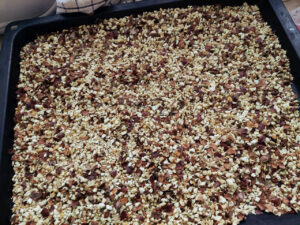
If you want to store chestnuts for future use, you can shred them in the processor and dry them in the oven or a dehydrator.
Make sure they are completely dry; otherwise, they’ll mould. Store the dried chestnut shreds in a jar.
Ok, so there are two ways of making chestnut laundry detergent.
The short method is to put the chopped chestnuts into a pot, fill it up with water, and let the mixture simmer for about 15 minutes, then let it cool down.
An alternative way – and that’s the one I always use – is to put the chopped chestnuts into a bottle or a jar, fill it up with water, and let it extract for about 24 hours.
Either way, strain the liquid laundry detergent through a fine-meshed sieve.
Homemade chestnut laundry detergent does not store very long. It’s best to make it fresh every few days or when needed, and use it up within a few days. I usually make about one litre and use it up within 5 – 7 days. I’ve heard that you can freeze it and use it just like the fresh detergent once it’s thawed, but I’ve never tried it myself.
How to wash with chestnut laundry detergent
While making homemade chestnut laundry detergent is already easy, washing with it is even simpler: Take your dirty laundry, put it in the washing machine, and add your homemade chestnut laundry detergent where you’d normally put your store-bought wash powder or liquid. Start the washing programme and that’s that.
I always use about 200 ml per load.
Industrially manufactured laundry detergents are made for severely dirty clothes, while our homemade chestnut laundry detergent only contains as much cleaning agent as necessary. That way, we not only save the fibres but also the environment.
Chestnut Laundry Detergent – FAQs
How can I store the chestnuts?
Unfortunately, chestnuts get mouldy quickly. For that reason, it’s best to dry them properly, either whole or shredded, and store them in an airtight container like a jar with a lid to keep moths away.
Can I just put the chestnut powder into the washing machine?
You can, yet not loosely, but in a sealable fine-meshed net or a sock. Otherwise, the powder or shreds will make your laundry dirty and clog the drain filter. However, the washing effect is better with the liquid laundry detergent because the saponins are better extracted this way.
How many chestnuts do I need per wash cycle?
I always use 2 – 3 tablespoons of chestnut shreds and add one litre of water. This laundry detergent is enough for about five wash cycles. I’d estimate then, that you need about 2 – 4 chestnuts per wash cycle.
My chestnut laundry detergent is yellow. Is that normal?
Unpeeled chestnuts make a yellowish extraction, but it won’t colour your laundry. To avoid greying of white laundry, you can peel the chestnuts before using them.
My chestnut laundry detergent has made my machine’s detergent dispenser dirty. What can I do?
Remove the dispenser and clean it with vinegar or citric acid. Use a cleaning brush, if necessary.
Is the chestnut laundry detergent suitable for all types of laundry?
Basically, it’s suitable for every laundry and every wash temperature. You can even use it for wool or delicate laundry. Pretreat stains with bile soap or curd soap before washing.
Can I wash white laundry with chestnut laundry detergent?
Homemade chestnut laundry detergent doesn’t contain optical brighteners like store-bought laundry detergent. For that reason, white laundry may develop a greyish tint after some wash cycles. You can prevent that by adding wash soda to your dispenser or vinegar where you’d normally put your fabric softener.
For bright white laundry, I also recommend adding one tablespoon of oxygen bleach.
Is chestnut laundry detergent safe for baby’s clothing?
Chestnut laundry detergent is milder than industrial washing detergents and thus suitable for baby clothing.
How does chestnut laundry detergent smell?
Chestnut laundry detergent doesn’t have a scent, so the laundry comes out fragrance-free. If you like, you can add essential oils and some alcohol as a binding agent to the detergent. However, essential oils are volatile and only last for a few hours in the detergent. For that reason, I use store-bought, eco-friendly washing powder for our sports clothing.
Do I need a fabric softener?
No, that’s not necessary. If you like, though, you can add vinegar to the fabric softener dispenser. It not only prevents greying but also makes the fabrics softer.
Aren’t horse chestnuts food for wild animals?
Yes, they are, but considering that there are so many horse chestnut trees in parks or on streets, and bearing in mind that we only need a small amount to make a year’s worth of laundry detergent, we don’t deprive the wild animals of their food.
If you want to help wild animals further, collect horse chestnuts and bring them to a forestry office or game park where staff can use them as feed.
Is chestnut laundry detergent eco-friendly?
Yes, definitely! First of all, chestnuts grow locally and therefore there’s no long-distance transportation. They also don’t need to be processed extensively.
The chestnuts’ saponins are milder than the washing agents in commercial laundry detergent. They’re much gentler than harsh surfactants (tensids) and other additives.
These gorgeous chestnuts we are showered with in autumn are not only a cute decorative element, but we can also use them for making a sustainable and completely free laundry detergent! If that’s not the perfect excuse for an adult to go foraging for chestnuts, I don’t know what is.
Admittedly, homemade chestnut laundry detergent is different from commercial detergents. It doesn’t carry a scent and its shelf life is only a few days, but it’s definitely worth a try. But honestly? You’ll be hooked once you try it! 😁
I feel so proud every time I make a new batch of creating something from foraged chestnuts. The feeling of having received a gift FROM nature and making the most of it is so wonderfully rewarding. But don’t just listen to me, try it for yourselves!
I don’t know about you, but whenever I pass a chestnut tree in autumn and see aaaaall those beautiful, smooth, glossy chestnuts lying there on the ground, I simply cannot pass them without taking as many as I can store in my pockets. First, of course, I use them as a decoration, sprinkling (or rather: throwing) them between all the pumpkins I use for decorations. Once the pumpkins make way for Christmas decorations, however, I don’t throw out the chestnuts but use them for making chestnut soap. Here’s how I do it:
Why Chestnuts?
Just to clarify: When I speak of “chestnuts” in this recipe, I’m referring to the common horse chestnut (Aesculus hippocastanum) as opposed to the edible sweet chestnut (Castanea sativa). Horse chestnuts naturally contain natural soap compounds, so-called saponins. Due to this, chestnuts were (and still are) widely used as a washing detergent, much like a local alternative to washing nuts. Today, however, we want to use the saponins to enhance the washing and foaming characteristics of homemade soap.
You can also use chestnuts to make homemade chestnut laundry detergent – check out my complete chestnut laundry detergent recipe for another sustainable way to use foraged chestnuts.
Disclaimer: This tutorial is for educational purposes. Soap-making involves sodium hydroxide (lye), which is caustic and can cause serious injury if mishandled. Always follow proper safety procedures, wear protective equipment, and work in a well-ventilated area. I cannot guarantee results or accept liability for any injuries, damages, or outcomes. You are responsible for your own safety when following this tutorial.
How to make chestnut extraction
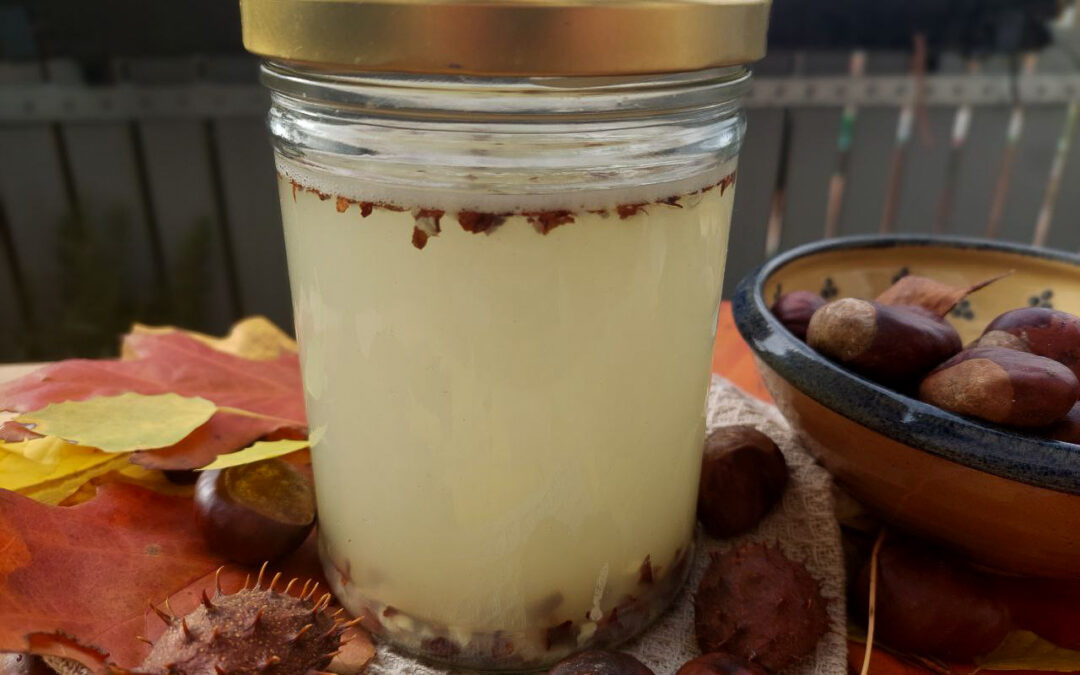
To use the chestnuts for soap-making, we have to extract their soap-making properties first. To do that, we roughly chop the chestnuts, fill about 1/3 cup of the chopped chestnuts into a glass jar or bottle and fill it up with 500 ml of distilled water. This makes more than you need for making the chestnut soap (330 g), but it’s always good to have a backup.
Some people recommend peeling the chestnuts first, but for just making an extraction, that’s not necessary. The skin neither darkens the fluid nor does it have any other negative influence on the extraction.
Leave the jar with the chestnuts and water for at least 24 hours and up to 3 days. I personally couldn’t find a difference between the short (24 hours) and the long soaking time regarding washing properties or lather enhancement. 24 hours, however, are at least necessary to extract the saponins into the water.
Shake the mixture well twice a day and then pour the liquid through a fine-mesh sieve. Discard the chopped chestnuts and either use the extraction right away or store it in the fridge for up to 2 days.
How to make chestnut powder (optional)
If you want to give your chestnut soap a peeling effect, you can add chestnut powder. Now, to make that powder, we definitely have to peel the chestnuts first!
For this recipe, peel about 10 – 15 chestnuts (depending on the size) and let them dry for 5 – 10 days. Alternatively, you can dry them in the oven or dehydrator. Let them cool down and grind them finely in a food processor or a coffee mill. If you want to make sure that no coarse particles get into your soap, strain the powder through a fine-mesh sieve.
This will make more chestnut powder than you need for the soap, but as with the extraction, better safe than sorry, and you can use the excess fluid as laundry detergent.
How to Make Chestnut Soap – Step-by-Step
Step 1: Put on Your Protective Gear
In soap-making, we deal with lye, which is potentially hazardous. To protect ourselves from any accidental harm, therefore, we must wear protective gear throughout making the soap. This gear contains safety goggles, protective gloves and a face mask (the latter only until you’ve mixed the lye into the fats/oils), but you should also wear long-sleeved shirts that cover your arms and, if possible, an apron to protect your clothing. For more details about safety in soapmaking, especially if you’re new to soapmaking, read this article on soapmaking safety guidelines.
Step 2: Get all your Ingredients and Equipment Together
When making soap, we have several narrow time frames, which is why it’s crucial that we have all the ingredients and our equipment ready before we start. I usually weigh all my fats and oils first and then make the lye, but you can also start with the lye and heat the fats while the lye cools down. Nevertheless, make sure everything’s within reach. You cannot afford to head off and look for an oil or a spatula at a crucial point.
Step 3: Weigh the Ingredients
I always start by weighing all the fats and oils first and putting them in a pot for heating up later. Use a 0.5-gram-precise scale, as it’s essential to obtain the measures as accurately as possible. Even deviations of a few grams can have a negative effect on your soap, the worst being that you have to throw it away.
After weighing the fats and oils, weigh the chestnut extraction and pour it into a heat-resistant container.
Afterwards, carefully weigh the sodium hydroxide. Now, at the latest, should you wear your protective gear, including safety goggles, protective gloves and a face mask!
Step 4: Make the Lye
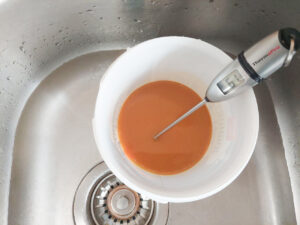
Pour the sodium hydroxide into the chestnut extraction, never the other way round! I always mix the lye in a heat-resistant glass jar that I put in the sink. That way, if anything should go wrong, both I and my kitchen surface are protected. Insert a thermometer into the lye and measure the temperature.
Gently stir the mixture with the thermometer to make sure that all the sodium hydroxide dissolves properly. The lye must now cool off to a temperature between 40 and 42 °C (104 – 107 °F). To speed up that process, you can put the container with the lye into a cold water bath or fill up the sink with cold water.
Step 5: Heat up the Fats and Oils
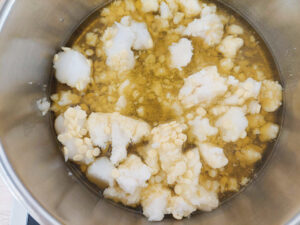
When the lye’s temperature approaches the recommended temperature range, it’s time to heat the fats and oils to the same temperature. Start with gently heating the solid fats, in this case the coconut oil, until it’s completely melted. Remove it from the stove and add the oils, stirring gently to combine all the ingredients. Measure the temperature and, if necessary, heat the mixture up again until it also reaches 40 – 42 °C (104 – 107 °F). Either leave the fat mixture in the pot (if it’s used for soap-making only) or fill it into a second container.
Step 6: Combine the Fats and Lye
Once the lye and the fats have reached the desired temperature, it’s time to combine them. I take the lye container out of the sink and put it onto the draining rack while putting the container with the liquid fat into the sink. For me, that’s the safest method to make soap.
Insert the stick blender into the fat mixture and slowly add the lye (not the other way round). Once all the lye is in the fat, start blending everything together without adding too much air. Do not turn on the blender until it’s fully submerged.
Stir the mixture well until it becomes thicker and shows traces when you move through it. It should have the consistency of Greek yoghurt.
When you can see those traces in the soap batter, it’s ready to be poured into the mould.
Step 7: Mix in the Additives
If you want to add chestnut powder for a peeling effect in your soap, now is the time. Add the powder all at once and carefully stir it into the soap batter with a whisk, as at this point, the blender might speed up trace too much. Also, take into consideration that adding the chestnut powder may accelerate the tracing process. So, make sure everything is combined homogeneously and work fast.
Step 8: Pour the Chestnut Soap into the Mould
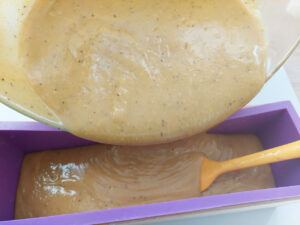
Once everything is combined well together and the batter starts to thicken, pour it into your mould. Scrape the edges of the bowl with a rubber spatula to make sure that you get all the soap into the mould. Flatten the batter in the mould with the spatula so that you achieve a smooth, level surface.
Step 9: Cover the Mould
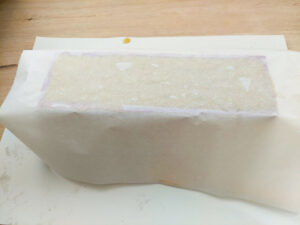
Cover the soap surface in the mould with a greaseproof paper or baking paper and wrap the whole thing with a towel to insulate the soap. This technique encourages the so-called gel phase, where the soap heats up before it hardens off.
Step 10: Cleaning your equipment
Although we’ve mixed the lye into the fat, the fresh soap batter is still slightly caustic. For that reason, we mustn’t just rinse off large quantities of residual soap batter into the sink. A good way to get rid of most of the soap batter is by wiping it off with a paper towel or toilet paper (which works just as well and is cheaper!) that you throw directly in the bin.
There’ll still be a thin coat on the bowl, blender, spatula, etc., but that’s okay. Just wash everything well with dish soap, rinse it with a bit of vinegar to neutralise the lye and wash it again with water.
Step 11: Unmould your chestnut soap
Leave the soap in the mould for at least 48 hours before you try to unmould it. Those 48 hours are necessary for hardening the batter, and every attempt to unmould it earlier will result in a smeary, unshapely soap. Believe me, I know what I’m talking about…
Step 12: Cut and Cure
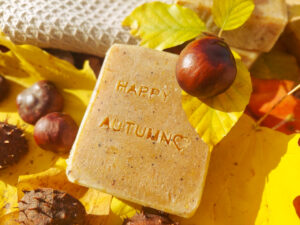
When the soap is unmoulded, you can cut it into bars. The size and shape of the bars depend on the mould you used. I mostly use a rectangular mould and cut the soap into slices of about 1.5 – 2 cm (0.6 – 0.8 inches). As a rule of thumb, cut the bars so that they fit comfortably in your hand.
You can either cut the bars with a sharp knife or you can use a soap cutter that often comes as part of soap-making kit, together with the mould.
Cut straight through the soap and slide the soap off the knife. If the soap sticks badly to the knife, let it set for another day or two in a well-ventilated place. That way, it can dry out a bit before you start cutting it again.
After cutting, let the soap bars cure – again in a well-ventilated place – for about 4 – 6 weeks. Turn the bars twice a week to make sure that they cure and dry evenly. During this curing time, the soap will become milder, and the lather will improve.
Angela Braun
Homemade Chestnut Soap (5 % superfat)
Learn how to make natural chestnut soap from foraged horse chestnuts! This beginner-friendly, sustainable soap recipe uses the natural saponins in chestnuts to create a gentle cleanser with a rich lather. Optionally, you can add chestnut powder for exfoliation.This yields approximately 1400 g of soap.
1 heat-resistant container, about 500 ml for making the lye
1 large bowl for mixing fats/oils and lye
1 0.5-gram-precise scale
2 thermometers one for the lye, one for the fats
1 stick blender
1 whisk
1 spatula
1 soap mould volume: 1.5 kg
Your personal safety gear!
Method
Prepare the chestnut extraction by putting 1/3 cup of chopped chestnuts in a jar or bottle and adding 500 ml of distilled water. Let the mixture rest for 24 - 60 hours and strain it through a fine-mesh sieve.
Prepare the chestnut powder (optional) by peeling 5 - 10 chestnuts (depending on the size) and either dry them for about 5 days in a well-ventilated area or until completely dry in an oven or dehydrator.Grind them in a food processor or coffee grinder and sieve the powder once or twice through a fine-mesh sieve.
Put on your protective gear!
Make the lye by adding sodium hydroxide to the chestnut extraction (never the other way round!)
While the lye cools down, melt the fats and add the oils
When the lye and fats/oils have reached a temperature of 40 - 42 °C (104 - 107 °F), pour the lye into the fats/oils (never the other way round).
Stir everything well together with a stick blender, but make sure that you don't insert too much air.
When traces begin to form, add the chestnut powder with a whisk.
Pour the soap batter into a soap mould, cover it with greaseproof paper and insulate it by wrapping the mould in towels.
Let the soap set for about 48 h before unmoulding it.
Cut the soap in bars and cure it for 4 - 6 weeks in a well-ventilated space. Change the soap bars twice a week to make sure that they dry and cure evenly.
Notes
The soap bars can be stored in a cool and dry place for up to 2 years.
Enjoy Your Homemade Chestnut Soap
Homemade chestnut soap is a marvelously sustainable way of cleansing ourselves, as we use foraged chestnuts that not only don’t cost a dime but also drop at our feet in abundance each autumn. Just keep your eyes open and collect some when you stumble across them. Two handfuls are about enough to make this soap. But be wise and collect extra. They make a wonderful decoration 😁