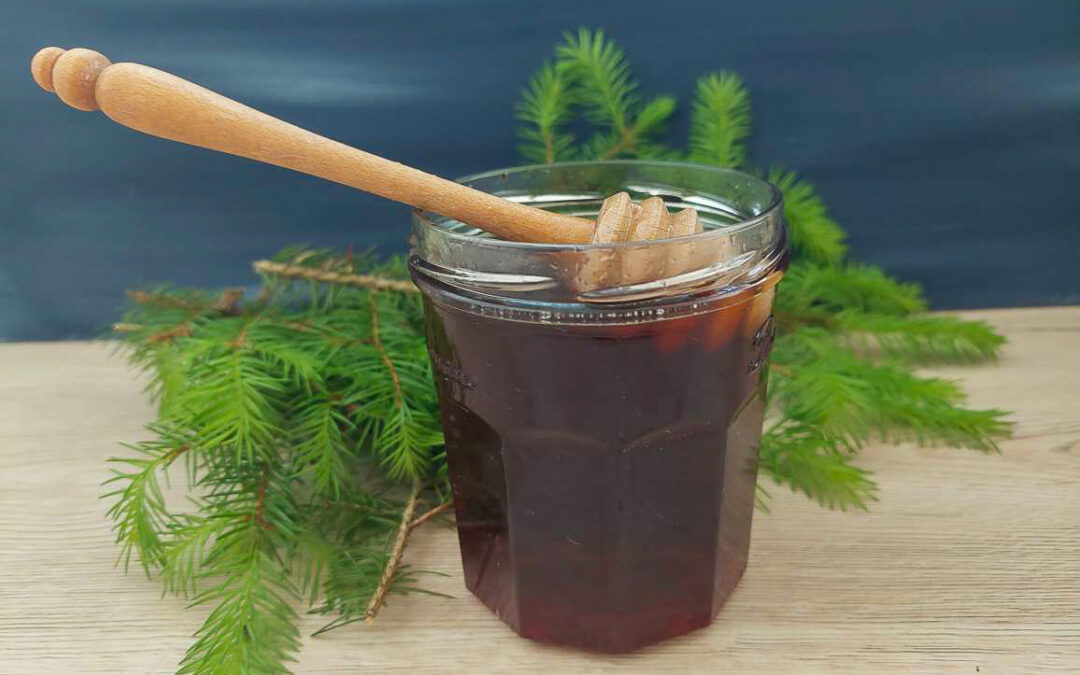
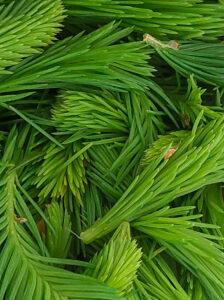
Every spring, the firs and spruces grow new, light green tips filled with the fresh scent of the forest. These tender shoots taste surprisingly citrusy – and with a little patience, you can transform them into a delicious golden-rosy syrup known as spruce tip honey.
I have been harvesting spruce tips every spring for years, and this recipe has become my favourite way to preserve their flavour.
This simple recipe captures the flavour of a spring forest and preserves it for the entire year.
Spruce Tip Honey at a Glance
🌲 Best harvest time: April–May
⏱ Active cooking time: about 2–3 hours
🫙 Yield: approx. 1.2 kg
🌿 Difficulty: Easy, but slow
🍯 Taste: citrusy, resinous, honey-like syrup
📅 Shelf life: at least 1 year
Is Spruce Tip Honey Real Honey?
Homemade spruce tip honey is not real honey; that’s only made by bees. It is, however, a vegan alternative made from foraged spruce tips and sugar.
The advantage is that we can benefit from all the valuable ingredients in the young spruce tips.
Fir and spruce tips contain a high amount of vitamin C and essential oils that are said to be expectorant, antibacterial and soothing.
What Are Spruce Tips?
Spruce tips are the young shoots that grow on the ends of spruce tree twigs. They start growing in April through May and can be identified by their light green colour, which distinguishes them from the older, dark green needles.
Spruce tips contain essential oils, but not as much as the older needles and the wood. They taste slightly citrusy and sweet, and you can eat them directly from the tree.
When to Forage Spruce Tips
Note on foraging:
Only take what you can classify without any doubts. Foraging and using foraged plants is at your own risk. Remember that some plants are toxic.
Children, pregnant women, people under medication and those with chronic diseases should additionally consult with their medical practitioner before consuming foraged plants.
Never forage near busy roads.
Depending on the weather, you can forage spruce tips from mid-April until the end of May, just as long as they are still light green. When they get darker and their colour adjusts to that of the older needles, their content of essential oils decreases, and they become harder and more resinous.
To ensure that we don’t weaken the trees, we only pick 2 – 3 spruce tips per twig – we don’t want to steal all the new needles from the tree. Even better, pick the tips from different trees.
By the way, this is a great project for children, especially as the outcome will be something sweet. 😊
How to Identify Spruce Tips Safely
Spruces (Picea) are common needle trees in Mid- and Northern Europe and Northern Asia, as well as in large parts of North America and Canada.
Their needles grow regularly around the twig (in contrast to firs that grow their needles vertically). When you touch a spruce twig, the needles will prick (again in contrast to firs, which are soft to the touch).
Spruce cones hang down from the twig, whereas fir cones grow upwards.
If you’re completely new to the topic of trees, there’s a slight risk of confusing spruce (or fir) with yew trees, which are highly toxic. To avoid that, check the needles (yews’ are very round, soft and dark green to almost black). Also, yews don’t have cones but red berries, and they grow bulbous instead of conical.
Spruce tips have been traditionally used in Northern and Central European herbal traditions for syrups, cough remedies, and spring tonics.
Let’s dive into how to make spruce tip honey at home.
Spruce Tip Honey
Ingredients
Yield: about 1,2 kg spruce tip honey
Shelf life: at least one year
300 g spruce tips
1 litre of water
approx. 750 g sugar
1 organic lemon (optional)
How to Know When the Honey is Ready
If you’ve never made spruce tip honey before, it can be a bit tricky to know when it’s ready to fill into jars. Believe me, I know what I’m talking about…
Too early, and it stays runny and will drip off your toast; too late, and it becomes too thick to spread, and you’ve got to hammer it out of the jar.
However, making spruce tip honey is less about timing and more about learning to read the syrup.
There are a few indicators you can observe to check when the honey is ready for filling:
The syrup’s colour turns to gold or rosy
The simmering mixture develops a fine bubbling foam on the surface
The syrup covers the back of a spoon and slowly drips off
When you pour some drops on a cold (!) plate, it thickens to a honey-like quality
The honey becomes even thicker when it’s cool, so it’s better to fill it sooner rather than later.
Before You Start: Helpful Tips
Once you get the knack of it, spruce tip honey is an easy-to-make staple. Just observe these tips and avoid the following mistakes:
Forage “clean” plants, that means get into the forest and never forage near busy roads.
Harvest only soft, light-green tips. Older ones don’t taste as good and are too thick to release essential oils.
Don’t skip the soaking, cooking and resting time. Each step releases flavour and essential oils.
Stay near the syrup when you boil it and stir it regularly so that it doesn’t scorch.
Check your honey for readiness and fill it immediately.
2. Wash the spruce tips and put them into a pot. Pour the water over them and cover them with a plate so that they stay beneath the surface level. Let them rest there for about 12 hours (best overnight). During soaking, the spruce tips release pollen and thus flavour into the water.
3. Cut the lemon into slices and add them to the water and spruce tips.
4. Bring the mixture to the boil and keep it at a low simmer for about 45 minutes. The water will turn cloudy; that’s perfectly normal, it’ll turn transparent again during cooking.
This simmering process slowly releases the essential oils.
5. Let the brew cool down and let it rest for another few hours. I usually let it rest overnight, which is perfectly fine.
6. Now, strain the mixture through a fine sieve or cheesecloth off the spruce tips and collect the liquid. Press the tips out thoroughly.
7. Measure the amount of liquid you gathered and add the same amount of sugar.
8. Bring the mixture to the boil while constantly stirring. Make sure that the sugar has dissolved completely. Let it simmer over a low flame for about 1-2 hours (mine took 1.5 hours). Make sure you stir the mixture from time to time so that it doesn’t scorch.
9. When the mixture starts to form a bubbly foam and gets slightly thicker, check if it’s ready (see “How to know when the honey is ready”) and fill it into the jars.
10. Securely close the twist-off lids and let the honey cool down.
For a printable version with exact measurements, use the recipe card below.
Spruce Tip Honey
Capture the essence of a spring forest with this delicate spruce tip honey that transforms young evergreen shoots into liquid gold with bright, citrusy notes.
Sterilise the jars and lids you want to use for your homemade spruce tip honey.
Wash the spruce tips and put them into a pot. Pour the water over them and cover them with a plate so that they stay beneath the surface level. Let them rest there for about 12 hours (best overnight).
Cut the lemon into slices and add them to the water and spruce tips.
Bring the mixture to the boil and keep it at a low simmer for about 45 minutes. The water will turn cloudy.
Let the brew cool down and let it rest for another few hours or overnight.
Now, strain the mixture through a fine sieve or cheesecloth off the spruce tips and collect the liquid. Press the tips out thoroughly.
Measure the amount of liquid you gathered and add the same amount of sugar.
Bring the mixture to the boil while constantly stirring. Make sure that the sugar has dissolved completely. Let it simmer over a low flame for about 1-2 hours (mine took 1.5 hours) and stir it regularly.
When the mixture starts to form a fine bubbling foam and gets slightly thicker, check if it's ready (see "How to know when the honey is ready") and fill it into the jars.
Securely close the twist-off lids and let the honey cool down.
Notes
Stored in a cool and dark location, spruce tip honey can be stored for at least one year. Once open, store the jar in the pantry and consume it within several months.
How to Store Homemade Spruce Tip Honey
Once the honey is cool, store the jars in a cool and dark place (like a basement or pantry). There it’ll last for at least one year. I usually store mine in the pantry, where it easily lasts until the next spring harvest.
Boiled sugar syrups can last significantly longer, but, honestly, I can’t tell you from experience how long, as we always eat it up well before the first year’s up.
Once a jar is opened, you can keep it in the pantry (no need for refrigeration). It can crystallise when it stays open for too long, but that’s only a matter of aesthetics and won’t alter the taste.
Uses for Spruce Tip Honey
Spruce tip honey is a wonderful vegan alternative to bees’ honey, and it can be used exactly like that.
Spread it on a warm buttered slice of bread and enjoy it for breakfast.
Sweeten your tea with a teaspoon of spruce tip honey. Its essential oils are said to help fight off colds.
Instead of sugar, add homemade spruce tip honey to salad dressings
Glaze roasted vegetables with spruce tip honey.
Use it in marinades for meat and fish. It adds a more complex array of flavours.
No — spruce tip honey is not made by bees. It is a thick herbal syrup made by extracting flavour from young spruce tips with water and sugar. Because of its colour, texture, and sweetness, it can be used much like traditional honey.
2. When is the best time to harvest spruce tips?
Spruce tips can usually be foraged from April to late May, depending on the weather and altitude. Harvest them when they are still soft, bright green, and easy to pinch off. Once they darken and become firm, they develop a stronger resinous flavour.
3. How do I know if I picked the right tree?
True spruce trees have:
sharp needles growing individually from the branch
needles that roll easily between your fingers
hanging cones (if present)
Always identify trees with certainty before harvesting, as some evergreen species are toxic.
4. How long does spruce tip honey last?
When poured hot into clean jars and sealed properly, spruce tip honey keeps for at least one year in a cool, dark place. After opening, store it in the pantry and use it within several months.
5. Why is my spruce tip honey too runny?
The syrup usually thickens as it cools. If it remains too thin, it likely needs more simmering time to reduce the liquid. You can gently reheat it and simmer a little longer until it coats the back of a spoon.
6. Can I reduce the amount of sugar?
Sugar is essential for preservation and texture. Reducing it significantly may shorten shelf life and result in a thinner syrup. If you prefer a less sweet version, make a smaller batch and store it refrigerated.
7. What can I use spruce tip honey for?
Spruce tip honey is wonderfully versatile. Try it:
in tea or warm water
drizzled over yoghurt or porridge
in salad dressings and marinades
as a glaze for vegetables or cheese
as a soothing syrup during the cold season
Spruce Tip Honey – a Cheap Evergreen Staple for Your Pantry
We gardeners, homesteaders, cooks and bakers always try to make the most of all we can harvest. It’s only natural, then, that we want to preserve the flavour of each season to use it all year round.
Making spruce tip honey is more than a recipe — it is a way of bottling spring itself. Long after the fresh green tips disappear from the trees, their bright forest flavour remains in every spoonful.
And whenever you flavour your morning toast or yoghurt with homemade spruce tip honey, when you glaze an array of roasted vegetables with it or when you stir it into your tea on a cold winter evening, you’ll not only remember the wonderful time in spring but also bite into the concentrated flavour of the forest.
For more information about preserving, you can visit my preserving site, and if you’re also interested in gardening, you might want to look at my gardening hub.
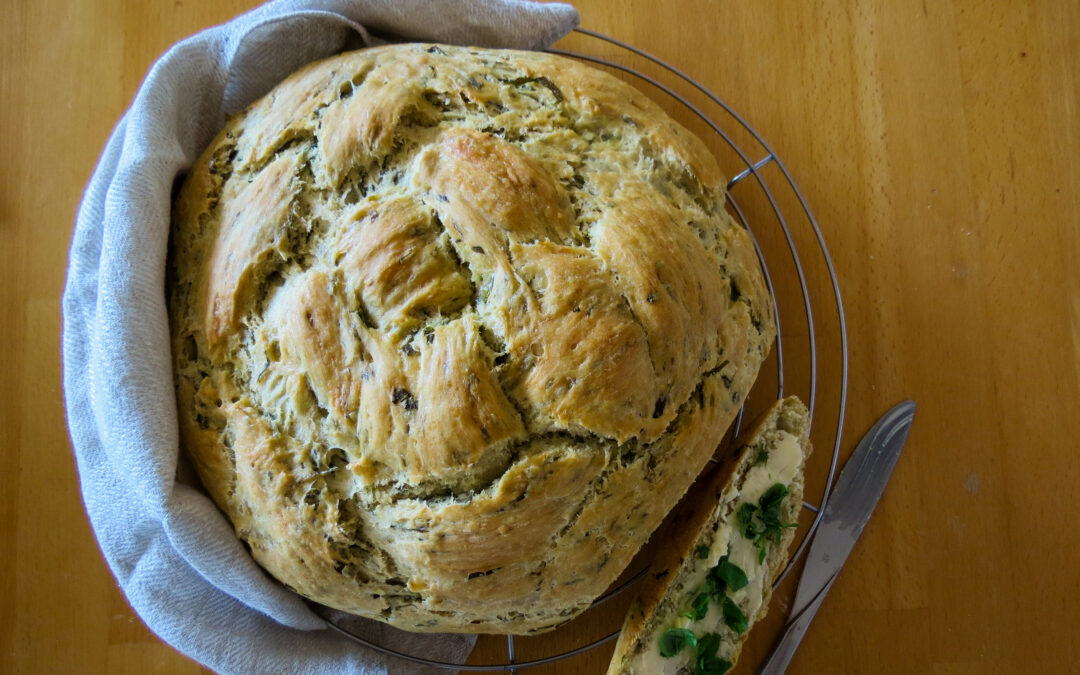
One of the first plants that we can harvest every spring is bear’s garlic (or wild garlic). It grows naturally in forest glades but you can also cultivate it in a shady corner of your garden. I’ve tried it last year but my garden lies in full sun so I think that was the reason it didn’t sprout. Bear’s garlic tastes similar to garlic but lighter and not so extreme. The same goes for your breath afterwards: you’ll smell of garlic but not as strongly as if you had eaten real garlic. Nevertheless, I know a spot in the forests where bear’s garlic grows abundantly and I harvested some of that. Some of it I used to make a wonderful bear’s garlic brioche braid, a savoury bread that’s a wonderful base for a hearty snack.
If you want to harvest bear’s garlic from the forests, too, make absolutely sure that you have the right plant. Bear’s garlic can be confused with lily of the valley which is toxic!
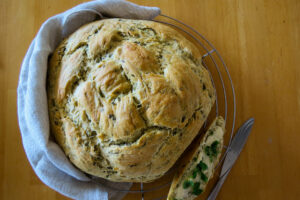
I often have baked bear’s garlic into bread like this bear’s garlic knot to add some savoury flavour to the dough. For this recipe, I have used an enriched dough, which is a yeast dough with additional fat in the form of milk, butter and eggs. Usually, enriched yeast dough is used for sweet bakes like brioches or this braided yeast bun. In this recipe, I’ve used it for a savoury light bread that marvellously captures the essence of spring.
Bear’s Garlic Brioche Braid
Ingredients:
Makes three brioche braids
700 g flour (I prefer spelt but you can use wheat)
1 tsp salt
30 g yeast or 7 g dried yeast
1 tsp sugar
300 ml milk
50 g butter
2 eggs
one handful of bear’s garlic (about 70 – 100 g)
1 red onion
50 g walnuts
olive oil
Salt, pepper
egg yolk
course sea salt
Instructions:
If you use fresh yeast, dissolve it in a bite of lukewarm milk, add some sugar and stir until becomes a uniform mass. Let it rest for 20 minutes until the liquid has visibly risen.
2. Wash the bear’s garlic, dry it, and chop it roughly. Peel the onion and cut it into fine rings. Chop the walnuts. Heat up the olive oil in a pan and add the bear’s garlic, onions and walnuts. Stew it lightly, season it with salt and pepper and let it cool down.
3. For the yeast dough, put the flour and salt into a bowl. If you use dried yeast, add it, too. Add the eggs, butter and milk (and yeast milk in case of fresh yeast) and knead these ingredients into a smooth dough. Put the dough into a bowl and let it rest for about one hour (it should double its volume).
4. Thoroughly knead the dough on a floured surface and divide it into three portions. Divide each portion again into three parts and roll each part to a string. Plait a braid from three strings so that you get three brioche braids.
5. Cover a tray with baking parchment, put the braids onto the tray and let them rest and rise for 15 minutes. Preheat the oven to 200 °C (°F). Scramble the egg yolk and brush the brioche braids with it. Sprinkle some sea salt on top of the braids and let them bake in the oven for 25 – 30 minutes.
As I said before, this bear’s garlic brioche braid is a wonderful spring bread, but you can make the same recipe with different herbs later in summer. Use chive, for example, parsley and chervil or try stinging nettle and rocket for a twist. Be creative and have fun trying out different herbs.
Bear’s garlic, or wild garlic, is one of the first spring herbs we can harvest. It grows in light forest glades but you can also cultivate it in a shady part of your garden. Apart from its benefits for our health, what I like most about bear’s garlic is that IT smells quite like real garlic but YOU won’t after eating it 😊. In this recipe, I’ve used bear’s garlic in a light yeast dough to make a savoury and eye-catching bear’s garlic knot.
You can harvest the bear’s garlic in the woods if you know a place where it grows wildly but please: make absolutely sure you know your plants! Bear’s garlic can be confused with lily of the valley which is toxic! If you’re not sure, buy it or try to grow it in your garden.
Bear’s garlic knot
Ingredients
Makes one large knot or braid
700 g four (I like spelt but you can use wheat)
20 g fresh yeast or 7 g dried yeast
1 tsp sugar
250 ml lukewarm water
5 tbsp olive oil
2 tbsp milk
Instructions:
1. If you use fresh yeast, dissolve it in a bite of lukewarm milk, add some sugar and stir until becomes a uniform mass. Let it rest for 20 minutes until the liquid has visibly risen.
2. Wash the bear’s garlic, dry it and chop it roughly.
3. For the yeast dough, put the flour and salt into a bowl. If you use dried yeast, add it, too. Add the water and 2 tbsp oil (and yeast water in case of fresh yeast) and knead these ingredients into a smooth dough. Put the dough into a bowl and let it rest for about one hour (it should double its volume).
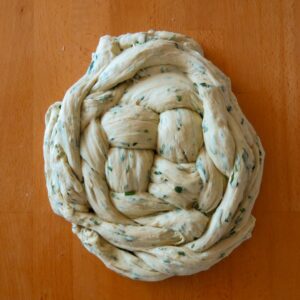
4. Thoroughly knead the dough on a floured surface and divide it into four parts. Roll each part to a string and plait a knot. First, lay the strings crosswise (see drawing) and then put the lower string across the string next to it. In the following pictures, you’ll see how to do it:
In the end, it’ll look like that:
Ready for baking
5. Cover a tray with baking parchment, put the bear’s garlic knot onto the tray and let it rest and rise for 15 minutes. Preheat the oven to 175°C (350°F). Mix the milk and remaining olive oil, brush the knot with it and let it bake in the oven for 45 minutes.
Enjoy your bear’s garlic knot with salted butter and chopped bear’s garlic on top.
If you liked this bread, you may also want to try this recipe for a braided bear’s garlic brioche braid.
A meadow full of blooming dandelions looks like the sun is shining from the ground upwards. It’s such a pretty sight! Thinking about the lifeforce and vitality of dandelions, however, I have seen gardeners go crazy: no matter how often you cut them off, they’ll always get back. Even if you try to pull out their roots and not get every last bit out, they’ll be right here again. And once they start to develop those pretty little seeds, you know you’re doomed.
Instead of fighting against those little bursts of sunshine, however, we can use them for our health and palates! A wonderful way to preserve not only the taste but also the health benefits of dandelions is by making a “honey” out of the dandelion flowers.
In my garden, there are rarely any dandelions. I’ve eaten them all. It’s still lovely to watch the look of horror passing over people’s faces when they watch me eating a dandelion flower. Ah, the little pleasures in life… Anyway, on the adjoining meadow there are numerous dandelion flowers every spring and believe it or not, I’m grateful for that. Where would I else get the flowers for a sweet and tasty dandelion honey?
Dandelion honey – Recipe
Yield: 5 to 6 glasses (ca. 120 ml)
Ingredients:
about 500 g dandelion flowers (about 4 hands full)
1,5 l water
1 kg sugar
juice of one lemon
Instructions:
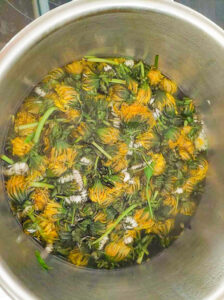
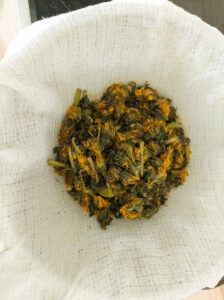
1. After you’ve gathered the dandelion flowers, put them into a bowl or flatly onto a tray and put them outside for about an hour. All the insects, especially those little black beetles will go away. Wash the flowers carefully and put them into a large pot.
Freshly picked dandelion flowers. As you see, I’ve also added some daisies.
2. Fill the water into the pot and press the flowers down into the water so that they are covered by it. Let them sit for two hours.
3. Bring the water with the flowers to the boil. Boil rapidly for 20 seconds, remove the pot from the heat and let it sit overnight (12 – 24 hours).
4. The next day, remove the flowers with a slotted spoon and ladle them into a cheesecloth. Press them out thoroughly, every drop counts.
5. Add the sugar and lemon juice to the dandelion brew and bring it to a boil under constant stirring. Make sure the sugar dissolves completely, otherwise it may set at the base of the pot and burn.
6. Let the syrup simmer without a lid for about two hours. Remove the pot from the heat and let it cool down for about half an hour (or completely if you have more urgent things to do.
7. Bring the syrup back to a boil and let it simmer again while stirring it from time to time. Do not leave the pot for long. When bubbles start to form that will not dissolve when you stir, the time to pour the thickened “honey” into jars has come. Even if it seems to be too liquid, don’t worry. It’ll thicken up when it has cooled down.
When the dandelion honey starts to look like that, it’s ready to be filled into jars.
Determining the right time to fill the jars can be tricky but when you’ve made some “honeys”, you’ll get the experience. If you’ve filled the honey too soon, it’ll stay a bit too liquid to spread onto your bread. In that case, just put the stuff back into a pot and let it simmer a bit longer. If you’ve waited too long, however, the honey may get a slightly burned taste and become too thick, sometimes even solid. In that case, the only thing you can do is throw off the whole batch (good luck with removing it from the jars). There is no chance of making a too-thick honey liquid again.
Dandelion honey: Tasting
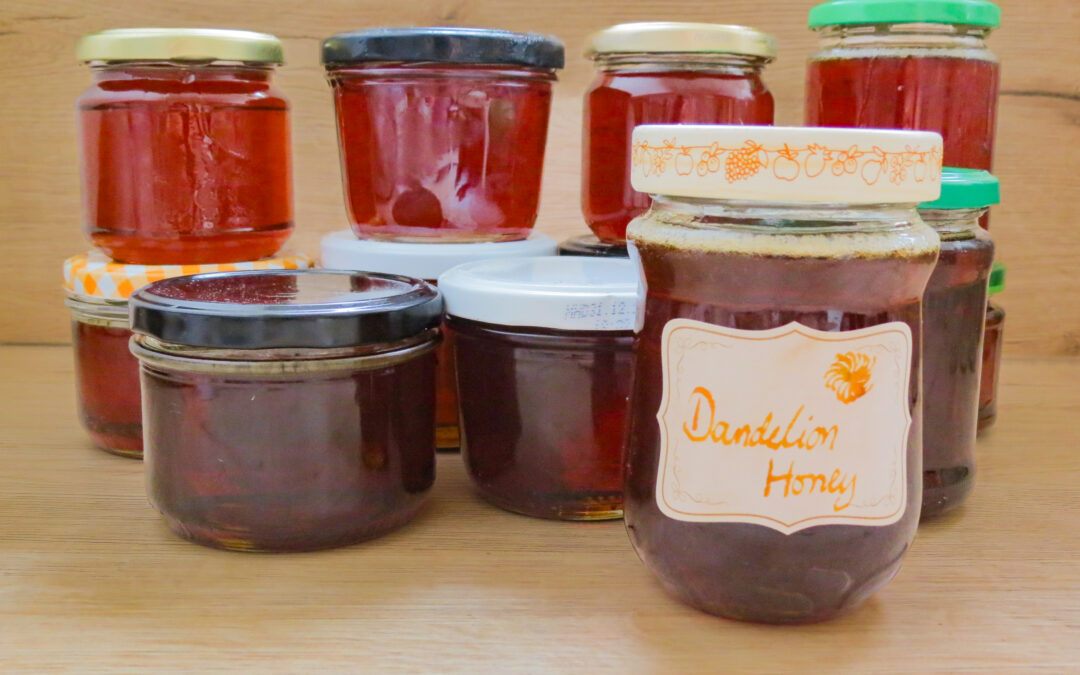
Let the jars sit overnight until they’ve fully cooled down. Your sirup will now have a wonderful brown colour and a honey-like texture. Try it on some buttered bread or a braided yeast bun. It’s sweet, tastes a bit like a spring flower meadow and very similar to real honey.
This is a great way to not only get rid of unwanted weeds but also preserve them at next to no cost. Adding to that, it’s totally easy! You only have to watch out for the right time to fill the honey in jars (remember: better too soon than too late).
And when you open one of these jars next winter and thickly spread the honey onto your buttered bread, it will certainly bring back the sunshine to you.
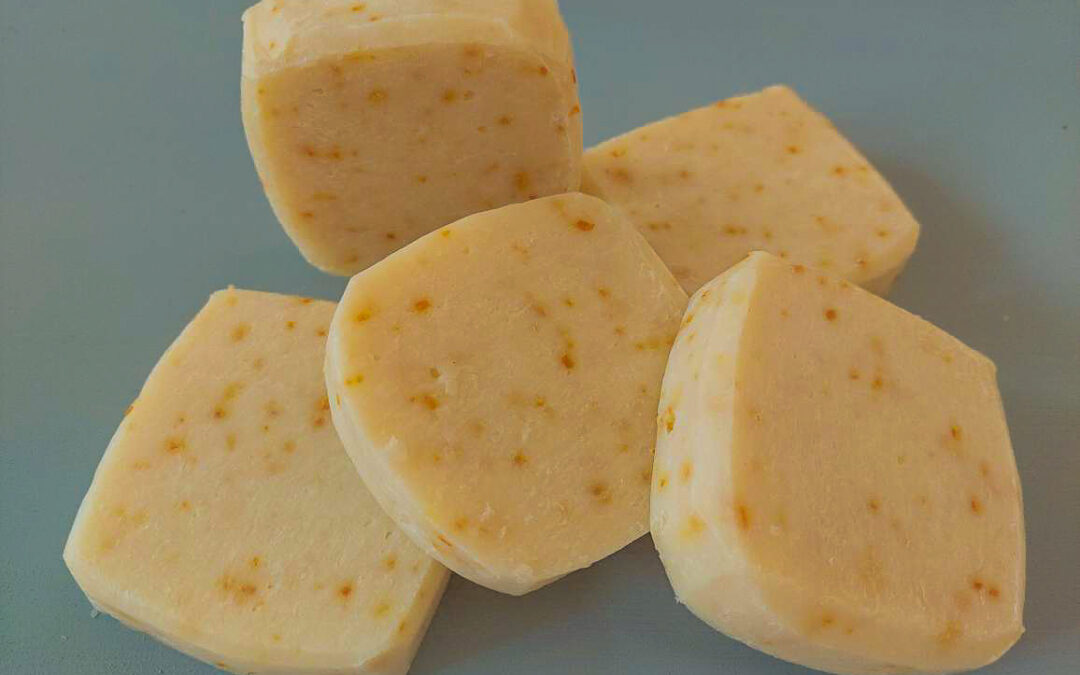
Earlier this year, I got my hands on some organic orange peel… well, ok: a lot of organic orange peel and apart from all the other things I made out of it, I tried my hand at making my first ever hydrolate. It turned out pretty well and I immediately thought about using it in a soap recipe. To enhance the “orange factor”, I added some of the dried and shredded orange peel and essential orange oil and I got a soap that smells and looks as good as it feels. This orange peeling soap appeals to (almost) all senses!
Even better, it’s an easy recipe, suitable for beginners. If you’re not familiar with the process of soapmaking yet, hop over and read this article first. Also, make sure you wear your protective gear throughout the whole soapmaking process. Better safe than sorry.
Orange peeling soap
Superfat: 7 %
Ingredients
350 g olive oil 75 g coconut oil 50 g sunflower seed oil 25 g castor oil 165 g orange hydrolate 64,5 g NaOH 5 g essential oil sweet orange 5 g essential oil bergamot 10 g dried and shredded organic orange peel
Instructions
1. Prepare your soap mould and put on an apron, gloves, breathing mask and safety goggles.
2. Weigh the oils. Slowly melt the coconut oil, then add the olive, sunflower and castor oil. Put a thermometer into the oil mixture and measure the temperature.
3. Weigh the hydrolate in a large enough, heat-proof container.
4. Weigh the essential oils and the shredded orange peel and put them aside for later use.
5. Weigh the sodium hydroxide. Put the water container into a sink and slowly pour the sodium hydroxide into the water (never the reverse!). Stir carefully and slowly with a spoon or rubber spatula until the NaOH crystals have dissolved. Put a thermometer into the lye-water and measure the temperature.
6. When the temperatures of the lye-water and the oils have fallen to 40 – 45 °C, carefully pour the lye into the oils (never the reverse!). Fully immerse a blender and mix both liquids until they are well combined. Make sure that the blender stays in the batter to prevent air bubbles. Mix the batter until a trace forms.
7. Add the dried and shredded orange peel and the essential oils to the soap batter.
8. Pour the soap batter into the mould and either cover it with cling film or spray it with isopropyl alcohol. Cover the mould with towels to keep it warm. Leave the soap in the mould for 48 hours.
9. After 48 hours, carefully remove the soap from the mould and cut it into bars.
10. Let the soap bars cure at a cool and well-ventilated place for 4 – 6 weeks before use.
Characteristics of orange peeling soap
This recipe makes for a great soap with a light peeling effect. It’s got a smooth lather (thanks to the castor oil) and is suitable even for sensitive skin. The orange and bergamot fragrance has a refreshing and awakening effect and the orange peeling particles shine out like little rays of sunlight.
All in all, it’s a perfect soap to use for your morning shower to awaken your body and mind and start the day fresh and energized.