
.
📅 Last updated: May 2026
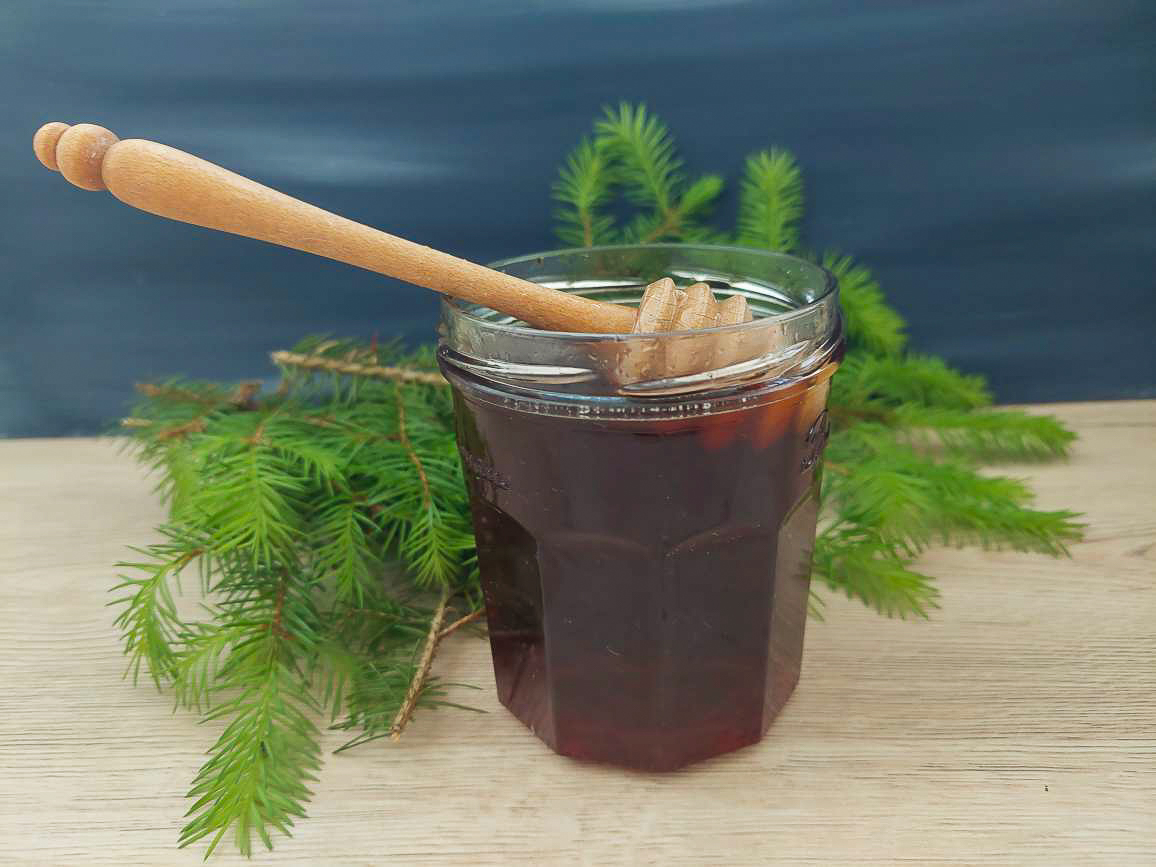
Every spring, the firs and spruces grow new, light green tips filled with the fresh scent of the forest. These tender shoots taste surprisingly citrusy – and with a little patience, you can transform them into a delicious golden-rosy syrup known as spruce tip honey.
I have been harvesting spruce tips every spring for years, and this recipe has become my favourite way to preserve their flavour.
This simple recipe captures the flavour of a spring forest and preserves it for the entire year.
🌲 Best harvest time: April–May
⏱ Active cooking time: about 2–3 hours
🫙 Yield: approx. 1.2 kg
🌿 Difficulty: Easy, but slow
🍯 Taste: citrusy, resinous, honey-like syrup
📅 Shelf life: at least 1 year
Is Spruce Tip Honey Real Honey?
Homemade spruce tip honey is not real honey; that’s only made by bees. It is, however, a vegan alternative made from foraged spruce tips and sugar.
The advantage is that we can benefit from all the valuable ingredients in the young spruce tips.
😋Did you know?
You can also make “honey” from dandelion flowers with this easy recipe.
Fir and spruce tips contain a high amount of vitamin C and essential oils that are said to be expectorant, antibacterial and soothing.
What Are Spruce Tips?
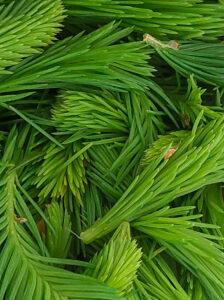
Spruce tips are the young shoots that grow on the ends of spruce tree twigs. They start growing in April through May and can be identified by their light green colour, which distinguishes them from the older, dark green needles.
Spruce tips contain essential oils, but not as much as the older needles and the wood. They taste slightly citrusy and sweet, and you can eat them directly from the tree.
When to Forage Spruce Tips
Only take what you can classify without any doubts. Foraging and using foraged plants is at your own risk. Remember that some plants are toxic.
Children, pregnant women, people under medication and those with chronic diseases should additionally consult with their medical practitioner before consuming foraged plants.
Never forage near busy roads.
Depending on the weather, you can forage spruce tips from mid-April until the end of May, just as long as they are still light green. When they get darker and their colour adjusts to that of the older needles, their content of essential oils decreases, and they become harder and more resinous.
To ensure that we don’t weaken the trees, we only pick 2 – 3 spruce tips per twig – we don’t want to steal all the new needles from the tree. Even better, pick the tips from different trees.
By the way, this is a great project for children, especially as the outcome will be something sweet. 😊
How to Identify Spruce Tips Safely
Spruces (Picea) are common needle trees in Mid- and Northern Europe and Northern Asia, as well as in large parts of North America and Canada.
Their needles grow regularly around the twig (in contrast to firs that grow their needles vertically). When you touch a spruce twig, the needles will prick (again in contrast to firs, which are soft to the touch).
Spruce cones hang down from the twig, whereas fir cones grow upwards.
If you’re completely new to the topic of trees, there’s a slight risk of confusing spruce (or fir) with yew trees, which are highly toxic. To avoid that, check the needles (yews’ are very round, soft and dark green to almost black).
Also, yews don’t have cones but red berries, and they grow bulbous instead of conical.
Spruce tips have been traditionally used in Northern and Central European herbal traditions for syrups, cough remedies, and spring tonics.
Let’s dive into how to make spruce tip honey at home.
Spruce Tip Honey
Ingredients
Yield: about 1,2 kg spruce tip honey
Shelf life: at least one year
300 g spruce tips
1 litre of water
approx. 750 g sugar
1 organic lemon (optional)
How to Know When the Honey is Ready
If you’ve never made spruce tip honey before, it can be a bit tricky to know when it’s ready to fill into jars. Believe me, I know what I’m talking about…
Too early, and it stays runny and will drip off your toast; too late, and it becomes too thick to spread, and you’ve got to hammer it out of the jar.
However, making spruce tip honey is less about timing and more about learning to read the syrup.
There are a few indicators you can observe to check when the honey is ready for filling:
- The syrup’s colour turns to gold or rosy
- The simmering mixture develops a fine bubbling foam on the surface
- The syrup covers the back of a spoon and slowly drips off
- When you pour some drops on a cold (!) plate, it thickens to a honey-like quality
The honey becomes even thicker when it’s cool, so it’s better to fill it sooner rather than later.
Before You Start: Helpful Tips
Once you get the knack of it, spruce tip honey is an easy-to-make staple. Just observe these tips and avoid the following mistakes:
- Forage “clean” plants, that means get into the forest and never forage near busy roads.
- Harvest only soft, light-green tips. Older ones don’t taste as good and are too thick to release essential oils.
- Don’t skip the soaking, cooking and resting time. Each step releases flavour and essential oils.
- Stay near the syrup when you boil it and stir it regularly so that it doesn’t scorch.
- Check your honey for readiness and fill it immediately.
Instructions
1. Sterilise the jars and lids you want to use for your homemade spruce tip honey.
2. Wash the spruce tips and put them into a pot. Pour the water over them and cover them with a plate so that they stay beneath the surface level. Let them rest there for about 12 hours (best overnight). During soaking, the spruce tips release pollen and thus flavour into the water.
3. Cut the lemon into slices and add them to the water and spruce tips.
4. Bring the mixture to the boil and keep it at a low simmer for about 45 minutes. The water will turn cloudy; that’s perfectly normal, it’ll turn transparent again during cooking.
This simmering process slowly releases the essential oils.
5. Let the brew cool down and let it rest for another few hours. I usually let it rest overnight, which is perfectly fine.
6. Now, strain the mixture through a fine sieve or cheesecloth off the spruce tips and collect the liquid. Press the tips out thoroughly.
7. Measure the amount of liquid you gathered and add the same amount of sugar.
8. Bring the mixture to the boil while constantly stirring. Make sure that the sugar has dissolved completely. Let it simmer over a low flame for about 1-2 hours (mine took 1.5 hours). Make sure you stir the mixture from time to time so that it doesn’t scorch.
9. When the mixture starts to form a bubbly foam and gets slightly thicker, check if it’s ready (see “How to know when the honey is ready”) and fill it into the jars.
10. Securely close the twist-off lids and let the honey cool down.
For a printable version with exact measurements, use the recipe card below.
Spruce Tip Honey
Ingredients
Method
- Sterilise the jars and lids you want to use for your homemade spruce tip honey.
- Wash the spruce tips and put them into a pot. Pour the water over them and cover them with a plate so that they stay beneath the surface level. Let them rest there for about 12 hours (best overnight).
- Cut the lemon into slices and add them to the water and spruce tips.
- Bring the mixture to the boil and keep it at a low simmer for about 45 minutes. The water will turn cloudy.
- Let the brew cool down and let it rest for another few hours or overnight.
- Now, strain the mixture through a fine sieve or cheesecloth off the spruce tips and collect the liquid. Press the tips out thoroughly.
- Measure the amount of liquid you gathered and add the same amount of sugar.
- Bring the mixture to the boil while constantly stirring. Make sure that the sugar has dissolved completely. Let it simmer over a low flame for about 1-2 hours (mine took 1.5 hours) and stir it regularly.
- When the mixture starts to form a fine bubbling foam and gets slightly thicker, check if it's ready (see "How to know when the honey is ready") and fill it into the jars.
- Securely close the twist-off lids and let the honey cool down.
Notes
How to Store Homemade Spruce Tip Honey
Once the honey is cool, store the jars in a cool and dark place (like a basement or pantry). There it’ll last for at least one year. I usually store mine in the pantry, where it easily lasts until the next spring harvest.
Boiled sugar syrups can last significantly longer, but, honestly, I can’t tell you from experience how long, as we always eat it up well before the first year’s up.
Once a jar is opened, you can keep it in the pantry (no need for refrigeration). It can crystallise when it stays open for too long, but that’s only a matter of aesthetics and won’t alter the taste.
Uses for Spruce Tip Honey
Spruce tip honey is a wonderful vegan alternative to bees’ honey, and it can be used exactly like that.
- Spread it on a warm buttered slice of bread and enjoy it for breakfast.
- Sweeten your tea with a teaspoon of spruce tip honey. Its essential oils are said to help fight off colds.
- Instead of sugar, add homemade spruce tip honey to salad dressings
- Glaze roasted vegetables with spruce tip honey.
- Use it in marinades for meat and fish. It adds a more complex array of flavours.
- Drizzle it over some yoghurt with fresh fruit.
If you are looking for other ways to use spruce tips, check out this recipe for fermented asparagus with spruce tips.
Frequently Asked Questions About Spruce Tip Honey
1. Is spruce tip honey real honey?
No — spruce tip honey is not made by bees. It is a thick herbal syrup made by extracting flavour from young spruce tips with water and sugar. Because of its colour, texture, and sweetness, it can be used much like traditional honey.
2. When is the best time to harvest spruce tips?
Spruce tips can usually be foraged from April to late May, depending on the weather and altitude. Harvest them when they are still soft, bright green, and easy to pinch off. Once they darken and become firm, they develop a stronger resinous flavour.
3. How do I know if I picked the right tree?
True spruce trees have:
- sharp needles growing individually from the branch
- needles that roll easily between your fingers
- hanging cones (if present)
Always identify trees with certainty before harvesting, as some evergreen species are toxic.
4. How long does spruce tip honey last?
When poured hot into clean jars and sealed properly, spruce tip honey keeps for at least one year in a cool, dark place. After opening, store it in the pantry and use it within several months.
5. Why is my spruce tip honey too runny?
The syrup usually thickens as it cools. If it remains too thin, it likely needs more simmering time to reduce the liquid. You can gently reheat it and simmer a little longer until it coats the back of a spoon.
6. Can I reduce the amount of sugar?
Sugar is essential for preservation and texture. Reducing it significantly may shorten shelf life and result in a thinner syrup. If you prefer a less sweet version, make a smaller batch and store it refrigerated.
7. What can I use spruce tip honey for?
Spruce tip honey is wonderfully versatile. Try it:
- in tea or warm water
- drizzled over yoghurt or porridge
- in salad dressings and marinades
- as a glaze for vegetables or cheese
- as a soothing syrup during the cold season
Spruce Tip Honey – a Cheap Evergreen Staple for Your Pantry
We gardeners, homesteaders, cooks and bakers always try to make the most of all we can harvest. It’s only natural, then, that we want to preserve the flavour of each season to use it all year round.
Making spruce tip honey is more than a recipe — it is a way of bottling spring itself. Long after the fresh green tips disappear from the trees, their bright forest flavour remains in every spoonful.
And whenever you flavour your morning toast or yoghurt with homemade spruce tip honey, when you glaze an array of roasted vegetables with it or when you stir it into your tea on a cold winter evening, you’ll not only remember the wonderful time in spring but also bite into the concentrated flavour of the forest.
More Seasonal Foraging Recipes:
Homemade Woodruff Syrup (Waldmeister Syrup Recipe, Uses & Tips)
For more information about preserving, you can visit my preserving site, and if you’re also interested in gardening, you might want to look at my gardening hub.
0 Comments