
.
Cabbage has been an important part of Bavarian cuisine for centuries. Fermented white cabbage, better known as sauerkraut, was particularly valuable during the long winters, when fresh vegetables were scarce. Red cabbage, traditionally prepared in various ways, can be preserved through the same fermentation process.
Red cabbage tastes wonderful freshly sliced in a salad, cooked with apples and onions or roasted in the oven. But why not try something different? Much as I like to use red cabbage fresh from the garden, I preserve the majority of my harvest by fermenting it.
I’ve experimented with different flavours and combinations, and I’m happy to share my favourite fermented red cabbage recipe for Christmas time: red cabbage with orange and warming spices.
Why You’ll Love This Recipe
This ferment is a festive combination of red cabbage, orange and warming spices. The pairing with oranges brings out the cabbage’s fruitiness, while the spices add festive flavours.
Red cabbage fermented that way is a wonderful addition to a Christmas duck roast, but it also makes a wonderful side dish for a Thanksgiving turkey. I even like it as a salad with goat cheese and walnuts.
Last, but not least, fermenting red cabbage is a great way to preserve your autumn harvest for winter meals.
What Does Fermented Red Cabbage Taste Like?
This recipe combines the tanginess of fermentation and the citrus notes of orange. The orange provides the fruitiness; the spices add warmth and aromatic depth.
The cinnamon, clove and nutmeg give it a distinctive flavour, but do not overwhelm the crunchy cabbage.
Sounds mouthwatering, doesn’t it? Let me show you how to make it yourself:
Fermented Red Cabbage with Orange and Spices
When making this recipe, I recommend wearing gloves, as the red cabbage stains your hands.
If you already have some fermentation equipment, that’s great, but you can also use some basic items from your kitchen, which I’m sure you’ve already got.
Equipment
You need
- a wooden board and a sharp knife to slice the cabbage
- kraut slicer (optional)
- a large bowl for mixing the ingredients
- a kraut pot or several jars with twist-off caps, Mason jars with airlock lids or Weck jars with rubber rings and glass lids
- fermentation weights; glass weights are a good choice, but if you don’t have any, you can also use food-safe freezer bags filled with brine
- a kraut tamper or a clean glass bottle to press the cabbage into the jars. If you don’t have any of those at hand, you can use your fists
Ingredients
For about 5 jars of 1/2 litre / 1 pint of fermented red cabbage, you need
2 kg red cabbage (net weight, that is, after removing the stalk and outer leaves)
zest and juice of 3 organic, unwaxed oranges
1 tsp ground cinnamon
1/4 tsp of ground clove
pinch of ground nutmeg
2 % unrefined sea salt (amount based on weight of ingredients; I show you in the instructions how it’s done)
How to Make Fermented Red Cabbage — step-by-step instructions
First of all, clean the jars and lids thoroughly with dishwashing detergent. It’s not necessary to sterilise them, but make sure they’re perfectly clean.
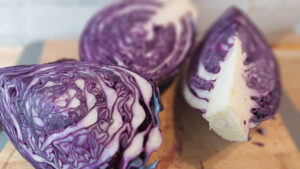
Remove the outer leaves from the cabbage heads. Wash some of the undamaged ones and put them to the side; you’ll need them later to cover the kraut.
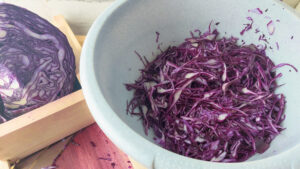
Quarter the cabbage heads lengthwise and cut out the stem. Finely cut the cabbage quarters into slices or slice them with a cabbage slicer.
Weigh the bowl you’ll use for mixing the ingredients and note the weight down.
Put the cabbage slices into the bowl.
Wash the oranges, grate off their zest and press the juice. Add both to the cabbage in the bowl.
Add the ground cinnamon, clove and nutmeg.
Now weigh the bowl with all the ingredients and subtract the weight of the empty bowl. You now have the weight of all ingredients.
Based on that weight, you can now calculate how much salt you need.
For this recipe, I use 2% salt based on the total weight of the prepared ingredients. The salt helps select for desirable fermentation microorganisms and creates conditions in which lactic acid bacteria thrive.
Now, the ingredients rarely have a convenient weight, at least not for a mathematical underperformer like me. That’s why I always have a calculator at hand and let that figure out the salt amount as follows:
Weight of ingredients in grams divided by 100, multiplied by 2
For example: your ingredients weigh 1.8 kg.
Calculate 1800 g/100*2 = 36 g
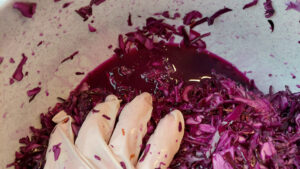
Mix in the salt and start kneading the cabbage slices thoroughly to break down their cell structure and incorporate the salt. This takes some time (the larger the amount of cabbage, the longer), but you can skip the workout on that day.
The slices will lose volume during this process; they’ll lose their usually opaque appearance and become glassy, and brine will form. If you can’t squeeze out enough liquid from the cabbage – after a fair amount of wrestling with it, of course – cover the bowl, let it rest for 15 minutes and knead it again.
Put a handful of the cabbage into the kraut pot or a jar and press it thoroughly down with your fists,
a clean bottle or the kraut tamper until brine is welling up. It’s important to apply sufficient pressure to submerge the cabbage under the brine. Fermentation favours low-oxygen conditions, so anything above the brine is more susceptible to spoilage.
Keep adding cabbage and pressing it in with a bottle or the tamper until there’s about 2 cm (0.8 inch) headspace.
Take one of the outer cabbage leaves you put aside earlier, rinse it and cut it so that it can cover the cabbage in the jar. Put a weight on top and thus fix the cabbage slices and the leaf under the brine.
Close the pot or jars with their lids and put them on a baking tray. If you use twist-off jars, don’t secure the lid too tightly. During the active fermentation process, gas is formed and needs a way to escape. If the lids are too tightly secured, the gas may be trapped inside the jar, which could eventually break.
Fermentation Time and Storage
Put the jars in a place without direct sunlight and at temperatures between 20 and 24°C (68 – 75 °F).
After a few days, the brine begins to bubble and foam, and it usually presses out of the jars and leaves a mess. Hence the tray.
Let the cabbage ferment for 5 – 7 days (the colder the place, the longer it takes), until brine no longer leaks out.
If necessary, fill the jars up with salt brine. For that purpose, mix 1/2 l of water with 15 g of salt and stir it until the salt has dissolved.
Now put the jars in the fridge and let them mature for another 3 – 4 weeks before you eat them. With colder temperatures in the fridge, fermentation slows down. You could eat the kraut after 7 – 10 days, that is, when the bubbling has come to an end, but this additional maturation time will let the kraut develop a more complex flavour.

Fermented Red Cabbage with Orange and Spices
Ingredients
Equipment
Method
- Clean the jars and lids thoroughly with dishwashing detergent.
- Remove the outer leaves from the cabbage heads. Wash some of the undamaged ones and put them to the side.
- Quarter the cabbage heads lengthwise and cut out the stem. Finely cut the cabbage quarters into slices or slice them with a cabbage slicer.

- Weigh the bowl you'll use for mixing the ingredients.
- Put the cabbage slices into the bowl.
- Wash the oranges, grate off their zest and press the juice. Add both to the cabbage in the bowl.
- Add the ground cinnamon, clove and nutmeg.
- Now weigh the bowl with all the ingredients and subtract the weight of the empty bowl. You now have the weight of all ingredients.
- Calculate the amount of salt (2 % of total weight of ingredients).
- Mix in the salt and start kneading the cabbage slices thoroughly to break down their cell structure and incorporate the salt.

- The slices will lose volume during this process, and brine will form. If you can't squeeze out enough liquid from the cabbage, let it rest for 15 minutes and knead it again.
- Put the cabbage in batches into the kraut pot or a jar and press each batch thoroughly down with a tamper, bottle or your fists until there's about 2 cm (0.8 inch) headspace.
- Take one of the outer cabbage leaves you put aside earlier, rinse it and cut it so that it can cover the cabbage in the jar. Put a weight on top to keep the cabbage slices and the leaf under the brine. All ingredients (including the cabbage leaf) must stay under the brine throughout fermentation.

- Close the pot or jars with their lids (in case of twist-off lids, not too tightly) and put them on a baking tray.

- Put the jars in a place without direct sunlight and at temperatures between 20 and 24°C (68 - 75 °F).

- Let the cabbage ferment for 5 - 7 days (the colder the place, the longer the fermentation process takes), until brine no longer leaks out.
- If necessary, fill the jars up with salt brine. For that purpose, mix 1/2 l of water with 15 g of salt and stir it until the salt has dissolved.
- Now put the jars in the fridge and let them mature for another 3 - 4 weeks before eating.




Notes
How to Serve It
To be honest, I love eating this fermented red cabbage right out of the jar. But there’s a lot more you can do with it:
- Add caramelised onions, roasted walnuts and pieces of goat or feta cheese and serve it as a salad
- Cook it and serve it with roasted duck, turkey or a Sunday roast
- Use it as a filling for red cabbage strudel, mixed with sweet chestnuts and pumpkin
- Serve it as a side dish to boiled potatoes or potato gratin
Please note that heating the kraut changes its texture and reduces the number of live microorganisms. The degree of yumminess stays the same, though.
Love Fermenting? Let’s Keep Going!
From classic sauerkraut to colourful vegetable ferments, there’s so much to discover when you start preserving with salt and time.
Join my newsletter for seasonal recipes, fermentation tips and inspiration from my kitchen and garden. You’ll also receive my free Fermentation Starter Checklist to help you get started with confidence.
Troubleshooting
Why isn’t my cabbage bubbling?
Visible bubbles vary and aren’t a reliable measure of successful fermentation.
Why has the brine turned purple?
Red cabbage pigments naturally colour the liquid.
What if the brine level drops?
Add some 2 % salt brine and make sure everything is submerged under the brine.
What if I see mould?
Discard a ferment with visible mould rather than scraping it off. For more information on troubleshooting and fermentation problems, read this article.
Frequently Asked Questions
Can I use white cabbage instead of red cabbage?
You can, but white cabbage produces a different flavour and appearance.
Can I make fermented red cabbage without fermentation weights?
I’ve seen people clamping toothpicks under the glass rim so that the cabbage stays under the brine, and it worked. However, to be sure that nothing floats up, I highly recommend using fermentation weights. If you don’t have any, you can use food-safe freezer bags filled with brine.
How long does fermented red cabbage take?
Preparation time until everything’s in the jar is about 30 – 45 minutes. Fermentation needs 5 – 7 days, and maturation time is 3 – 4 weeks.
Can I cook fermented red cabbage?
Yes, but cooking makes the cabbage softer, and the microorganisms are destroyed. Despite that, cooked fermented cabbage tastes wonderful.
How should I store fermented red cabbage?
Store it in the fridge.
A Little Christmas Magic in a Jar
I love how a simple vegetable like red cabbage can turn into something so special with just a little salt, fruit, spices and time. Whether you serve this festive ferment alongside your Christmas roast or enjoy it straight from the jar (like I often do!), I hope you’ll love its tangy, fruity flavour as much as I do.
0 Comments