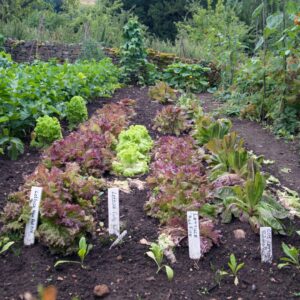
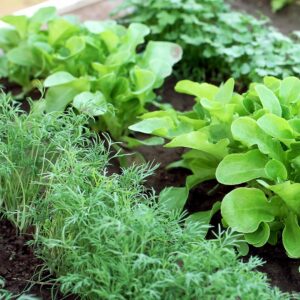
May is certainly one of the most exciting months in gardening! After the last night frosts, all your pre-grown vegetables can be planted out into the patches and all frost-sensitive vegetables can be sowed, as well. Or almost all. In this article I’ll show you what to do in May in the garden, that is what to plant, sow or even pre-grow indoors. But be careful: often there can still be night frosts in May, usually around the 15th. Before they are over you must not plant out your sensitive vegetables.
Beware of the night frosts
Every gardener knows that even if temperatures can be quite warm in April and May, it’s probable that there will be cold spells around mid-May.
These cold spells are due to cold air from the polar region that can cause night frost. Sensitive plants like tomatoes, zucchini, cucumbers or pumpkins must be kept indoors for that reason. If you plant them out too early and a frost hits them, they’ll die from the cold temperatures and your chance to harvest is gone for this year!
In German folklore, we call those days in mid-May when night temperatures can fall below 0°C the “icy saints”. The name comes from the fact that these cold spells often occur during some days in mid-May when we remember certain saints. The weather phenomenon was then linked to the saints and called “icy saints”. According to the calendar they last from May 11 to May 15. But like all things nature this is not always correct. Sometimes the last night frosts occur in April, sometimes we have them at the end of May. Depending on the region you live in, it may be totally different from here.
If temperatures drop, cover your plants with a winter fleece for gardeners. They will protect your plants from frost damage.
What to do after the last night frosts?
After May 15 the weather should become stable and you can finally plant out your sun-loving vegetables. Tomatoes, eggplants, peppers and chillies as well as cucumbers, zucchini and pumpkins can be planted into the garden. The same applies to herbs and summer flowers that are not hardy.
Always bear in mind though that mid-May is just an orientation date and the weather conditions can be quite different, depending on where you live. It’s crucial, therefore, to keep an observant eye on the weather forecast before deciding when to plant your sensitive vegetables.
Now, everything is growing like mad. Alas, that’s also true for weeds. If you have many weeds, it’s best to start ripping them out now before they become too large or even build seeds. Thankfully, I don’t have many weeds in my garden due to the way I made my patches. It saves me a lot of work!
If your plants have reached a height of about 10 cm, you should mulch them. That means that you cover the soil around them with organic material like lawn cuttings, straw, leaves or wood chips. Thus, the water hardly evaporates and you needn’t water often. Mulch also suppresses weeds – another problem solved!
What to do in May in the garden
What to sow indoors
You can sow these plants indoors and thus pre-grow them to plant them out later in the garden:
White cabbage
Brussels sprout
Kale
Broccoli
Kohlrabi
Zucchini
Cucumber
Pumpkin
Sweet corn
Winter leek
Beetroot
Lettuce
What to sow outdoors
Sow these vegetables directly into your patches:
Spinach
Swiss chard
Chicory
Rocket salad
Lettuce
Radishes
Beetroot
(Sugar) Peas
Carrots
Parsnip
Zucchini
Onions
What to sow after mid-May
Bush beans
Runner beans
Pumpkin
Cucumber
Sweet corn
What to plant in the garden
Now you can finally plant these darlings out:
Potatoes
Kohlrabi
White cabbage
Red cabbage
Brussels sprout
Savoy cabbage
Celeriac
Leek
Tomatoes
Cucumbers
Eggplants
Peppers
Pumpkins
Zucchini
Melons
Sweet corn
Lettuce
There’s a lot to do in May in the garden. Let’s get out there and start!
When you want to plant and grow your own tomatoes and want to get a great harvest, it’s important to suitably care for your plants and provide them with optimum growing conditions. In 14 steps, I’ll show you everything you need to know about tomatoes – whether you’ll grow them in the open, in a greenhouse or in pots. Let’s start!
Step #1: Choosing the right tomato seeds
Of course, you can buy pre-cultivated tomato plants from a nursery. Those plants, however, will often be hybrids which means that their seeds are not seedfast. In other words, you cannot take seeds from those plants to cultivate new tomatoes next year as they will not create the same tomato variety. If you’re fine with that, go ahead and buy plants.
If, on the other hand, you want to choose from the immense number of tomato varieties and cultivate some rare types, you’ll want to start your plants from seeds. Make sure that you always buy seedfast seeds that are suitable for your climatic conditions and – of course – your preferences. If you don’t have favourites yet, try out different types: cherry tomatoes for snacking, tomatoes for salads, plum tomatoes for tasty sauces, tomatoes in different colours etc. Note down which ones you liked best and harvest their seeds for next year.
Step #2: Sowing the seeds
When you’ve got your seedfast tomato seeds, sow them into a plastic container with herbal soil. Tomatoes are warmth-loving plants, which means they need temperatures between 18 – 23 °C to propagate.
They also need plenty of (sun-)light. A windowsill facing south or west is good for seedstarting. Alternatively, you can put your planting containers below a plant lamp. Make sure your plants get 14 – 18 hours of light per day, otherwise they will become leggy.
Step #3: Pricking tomato seedlings
As soon as your tomatoes show the first pair of real leaves (not the seed leaves that come first), it’s time to move them into separate planting containers. Fill a pot of about 15 cm in diameter with planting soil and plant the tomatoes deeper by burying them up to the seed leaves. By that, they can grow more roots from the stem and become more robust.
The tomato plants still need warmth and enough light, so let those plant lamps shine.
Step #4: Hardening off
About 14 days before you want to plant out your tomatoes*, you must harden them off to prepare them for the different conditions outside or in your greenhouse. This is an important step as otherwise, your plants could die from the sudden changes in temperature and exposure to sunlight.
To toughen the tomatoes, put them out into the shade on a warm day (10 °C and above) for a few hours each day. Start with 1 – 2 hours and prolong those phases up to 4 – 6 hours. Make sure that on the first days of outdoor hardening off, your plants are protected from direct sunlight and wind. After a few days, you can put them for one hour in the morning sun and a few days after that into the full sun. Always take a look at your plant every hour or so to make sure that they don’t get scorched or suffer in some other way. Get the plants in during the night.
Another thing you can do to harden your tomatoes off is to tenderly brush over them with your hand. This imitates wind and causes minuscule breakings in the stems which the plant can repair and thus becomes harder and stronger.
*If you just asked yourself when’s the right time to plant out your tomatoes: after the last night frosts, better still when night temperatures do not drop below 10 °C. In Central Europe that’s about mid-May. If you have a greenhouse, you can plant them out already starting mid-April.
Step #5: Soil preparation
Tomatoes have a high demand for nutrients. In other words, they eat like a teenager after a rugby match! To give them a good start and plenty of “food”, we must prepare the soil before planting them out. To do so remove all weeds and the mulch. By exposing the soil to the sun it will warm up and, as I said before, tomatoes love warmth.
To enhance nutrient density, work some ripe compost into the soil.
Plant your seedlings outside when all danger of frost is over and the soil has reached a temperature of at least 15 °C.
Dig out planting holes and add some organic tomato fertilizer and a handful of bone meal. As an alternative to the ready-made fertiliser, you can put some stinging nettles into the plant hole. I always put some composted and wet cattle dung into the plant hole and plant the tomatoes directly into it. That way, they not only have fertiliser but also enough moisture to last for the first few days of growing in.
As you did when pricking, plant your tomatoes deeper than before by burying them up to the first leaves. To help them grow more roots and thus become more anchored into the ground, I always plant them at an angle of 45 degrees. That makes sure that additional roots will sprout out of the stem. Remove any leaves that touch the ground.
Plant your tomatoes about 45 centimetres apart.
If you use pots for planting, make sure that you use good-quality pots. Black ones are not great as they’ll heat up too much in summer and by that burn the roots. Wooden, terracotta or plastic pots with a capacity of at least 20 litres are ideal. Put some drainage in so that your plants won’t drown, add the soil – either compost or ready-made tomato planting soil – and plant your tomatoes as described above.
After planting, water your tomatoes thoroughly.
Step #7: Staking
We distinguish between indeterminate and determinate tomatoes.:
Determinate varieties, also known as bush varieties, grow about 60 – 100 centimetres tall. They produce fruit for a relatively short period of time as they tend to provide ripe tomatoes at the same time which makes them great for making sauce and canning. Determinate varieties don’t need any staking and are great for small places or pots.
Indeterminate varieties, or vining varieties as they are often called, produce large tomatoes all summer long, mostly starting mid- to late-season. Indeterminate tomatoes need staking to help them support their weight and height. For that matter, you can put a stake next to each plant into the soil and as the tomato grows, fix it loosely with a twine to it. A possibility you can use in your greenhouse is to fix a twine loosely at the ceiling and fix it around your tomato plant. As the tomato grows you wind it around the twine until it reaches the ceiling.
Step #8: Watering
Most gardener’s favourite activity is watering and that’s great for the first week or so after planting your tomatoes to make sure they root well. Afterwards, however, you can cause real damage to your plants when watering them too much: they will grow only shallow roots and thus not be firmly rooted in the ground and their fruit will taste watery.
It’s best to leave tomatoes out when watering and only water them if they really need it which they show by wilting leaves. Even in the greenhouse, my tomatoes can grow their roots deep enough to tap the water sources deep down in the earth. Don’t spoil your plants but raise them to become healthy, sturdy adult tomatoes with plenty of tasty fruit!
When you must water, however, water them deeply and make sure that the water soaks at least 10 – 15 centimetres into the ground. Always water at the base of the plant and don’t splash the leaves as this might cause diseases.
Step #9: Mulching
I’m a huge fan of mulch and I recommend mulching your tomatoes as soon as the soil is warm enough. Mulch not only helps your plants to retain moisture (see step #8: watering) and prevents soil-bourne diseases from splashing up onto the leaves. It also controls weeds and shades the soil. Did I say that I love mulch? I love mulch!
Step #10: Pruning
If you’re growing vining tomatoes, you must prune, that is: pinch off the suckers. Suckers are those tiny stems that form between the main stem and branches. They will not produce fruit but only take energy from the plant. It’s best to prune or pinch the suckers as soon as you notice them. When they’ve grown large already, it’s hard to just rip them off without damaging the plant. Also, the wound becomes too large and may invite diseases.
You can just use the suckers as mulch or you put them into a glass with water where they’ll soon form roots and thus new plants.
Step #11: Companions
Tomatoes are a sociable lot and love having companion plants around. The right partners will not only fight off pests and diseases but will also prepare the soil ideally for our hungry fellows.
Good vegetable partners are beans, lettuce, celery, cabbages, onions and garlic. Tomatoes also love basil – on the plate as well as in the soil – and if you want to add a pretty eyesight you can plant marigolds.
Step #12: Fertilizing
As I said before, tomatoes are gluttons. To make sure they get all they need, it’s best to give some long-time fertiliser into the plant hole. This can either be some ready-made tomato fertilizer, bone meal, a mixture of horn shavings and rock powder, stinging nettles or composted dung. This year, I’ll try out different methods to compare what works best (for me). I’ll keep you updated.
Nevertheless, during their main period of growth, tomatoes still need some quickly available fertiliser that provides them with nitrogen, potassium and phosphate. I always prepare a “manure” from stinging nettles and comfrey and add about 100 – 200 ml of the ready manure to 10 l water.
Be careful, though, to not over-feed your plants. Too much fertilizer will weaken them and make them produce many leaves but few, tasteless fruit. Fertilizing every four weeks is enough to provide your plants with sufficient nutrients so that they’ll produce a great harvest!
Step #13: Pollinating
During relatively cold summers but also in greenhouses with insufficiently large windows, pollination may be a problem. When it’s too cold, bees and other pollinators won’t be around that much and in the case of greenhouses they may not find their way in. Those wonderful blossoms on your plants will not be pollinated and just fall off instead of transforming into wonderfully tasty tomatoes. That’s a shame!
To support the bees, you can carefully (!) shake the plants a bit so that the pollen gets loose and swirls through the air. Tomatoes have bisexual flowers and can pollinate themselves when the pollen is released – by insects or by shaking the plants.
Step #14: Harvesting
Hooray, the time to harvest has come! Harvest your tomatoes when they have the right colour (depending on your variety this can be red, orange, yellow, blue, violet, white or green in different shades), smooth and firm skin and easily remove from the plant. If you have to pull hard, they’re not ready yet.
If temperatures threaten to drop too low and there are still unripe tomatoes on your plants you can either pull out the whole plant (with roots) and hang it upside down from the ceiling of a cool basement or garage. Or you place the unripe tomatoes into a cardboard box or a paper bag and put it on the counter. With both methods, the tomatoes will ripen and you may have fresh tomatoes till Christmas.
You got more tomatoes than you can eat? No problem! Preserve them for winter by cooking and canning a tomato sauce. Nothing better than some pasta with homemade tomato sauce on a cold winter’s day.
Drying and soaking them in oil is another wonderful way to preserve your tomatoes. Cut small fruits in half or larger into quarters, put them onto a tray and dry them in the oven at 40 – 50 °C until they are dry but still chewy. Put them tightly into small glasses and fill them up with olive oil.
You see, when you observe these 14 steps it’s quite easy to plant, grow and harvest your own tomatoes and they taste sooo much better than the ones from the store. Is there anything yummier than eating warm ripe tomatoes right from the plant? Mmmh….
Are you dreaming of starting a vegetable garden and harvesting fresh produce:? A small vegetable patch is the first step to a whole new quality of life: the best food, fresh air and a contribution to a “greener” world. Let’s take this fantastic step together so that you can make your dream come true!
How to make a vegetable patch
You want to make a vegetable patch, maybe even a whole vegetable garden? You want to dig into the soil with your hands, and inhale this wonderful earthy scent? And you want to harvest vegetables that are fresher and tastier than anything you can buy in a shop?
That’s wonderful!
In this article, I show you step by step how you can create low-maintenance and fertile vegetable patches without tilling, and superfast, too. With a few tricks, it’ll not only be fertile from the beginning but it’ll also stay weed-free.
Let’s dive in.
Why no digging when creating a vegetable patch?
Admit it: when you think about creating a vegetable patch, you first think about digging up the earth, right? I know it was common in most gardens for a long time. Today, however, science tells us that it’s probably better for our soil to not dig at all. Which is great for both, the microorganisms and our backs.
Did you know that there are more microorganisms in a handful of garden soil than human beings on the earth? These tiny invisible helpers are immensely important for fertile soil.
Imagine an earthworm, for example, who usually looks for food at the surface of the earth but has to go hungry if you dig up the soil. He suddenly finds himself out there while his food is three floors below. That’s a catastrophe – not only for the earthworm without any sunscreen but also for soil fertility.
The trick is now to NOT disturb the microorganisms but to work with them from the very beginning. That’s why we create our vegetable patches without digging.
Start a vegetable patch in 5 steps
Let’s create a low-maintenance and high-yield vegetable patch!
Step 1: Prepare the ground
The first step is easy! The only thing you have to do is wait until the grass is long. When the grass is too short it cannot be bent. Then the pointy tips can easily penetrate the cardboard that we put onto the lawn. The cardboard suffocates long bent grass and it dies.
So, the first step in creating a vegetable patch: let the grass grow under your feet 😊!
Step 2: Dig in a lawn edging border
When making a vegetable patch, dig in a lawn edging border along the outer edge of your patch. Weeds and grass must stay outside. With a lawn edging border you make sure that no uninvited guests grow into the patches and reconquer them. To kill to birds with one stone, you can use a metal snail barrier which not only keeps the weeds but also the snails out. I have chosen to use that, as my garden is on a meadow.
Dig a v-shaped hole into the ground and put in the border so that about five centimeters are showing. I prefer this lawn edging border that also works as a slug barrier. It’s made of metal which is more durable than plastic edges that release microplastic into the garden when decomposing.
My patches are all 1,2 m broad because I can work them without contorting. I can reach the middle of the patch from every side without balancing or doing acrobatics.
Step 3: create bed borders (optional)
The lawn edging border is not very appealing and you sometimes may even stumble over them. For that reason, you may conceal it a bit. How about a bed border made from wooden trunks? Stabilize them with small stakes so that they are firmly in place and cannot roll away.
Other possibilities may be stones, boards, tiles, or deadwood. Many things are possible. Just make sure that the bed borders are not too high and throw a shade onto your vegetables.
Step 4: Cardboard, gimme cardboard!
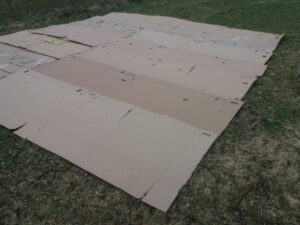
Now you get blank cardboard. It’s important to remove all tapes and staples so they do not get into the soil. Put the cardboard within the bed borders, overlapping at least 10 centimetres.
If you don’t have enough cardboard: ask your local bike shop. They have large cardboard transport boxes from the bikes which are great for a vegetable patch. They are huge and usually without print.
If you don’t want to use cardboard, anti-weed fabrics made of natural fibers that break down without any remnants are a good alternative.
Another possibility is to replace the cardboard with a layer of mulch. Apply 10 cm lawn cuttings or leaves and let it dry thoroughly. Then, distribute compost evenly on it.
Step 5: Spreading compost
Attention, ladies and gentlemen: here comes our star guest: his Royal Highness the Compost honors us with his entry into the garden!
That means you spread a 10 – 15 cm thick layer of mature compost on your beds
If you don’t have enough mature compost (which is likely when you want to start a vegetable garden), ask your local composting plant if you can buy some. It’s usually cheaper than a garden centre. In any case, make sure that the compost is made of organic material. Otherwise, it may contain lots of plastic – and we don’t want that in your vegetable garden!
I recommend using compost from green cuttings.
Bonus: Garden paths
Congrats: you now know everything about how to make vegetable patches. But also keep in mind that you may need garden paths, especially when you are creating several patches. You may separate them with woodchip paths. Plan the paths about 40 cm wide so that you can pass through with a wheelbarrow. Just spread the woodchips onto the cardboard. That way you can create easy-care garden paths in no time.
The patch is ready – what now?
The patch is ready, now it’s time for planting and/or sowing. You can plant or sow directly into the compost beds. The cardboard will decompose very soon so that the plant roots can grow through it without difficulty.
And earthworms, by the way, love soggy cardboard. Don’t worry: they’ll find their way to the surface.
You see: creating a vegetable patch is totally easy. The only thing you have to do is go outside and start! With these tips and tricks, you’ll create a vegetable garden in no time 😊
Mixed cultivation, crop rotation, pre-, main and post-crops… it’s difficult for a beginner to understand how to make a planting plan for your vegetable garden. Where do I plant, what and when can I harvest are some questions that may feel overwhelming at the beginning.
Yet, it’s high time to deal with them and create a planting plan for the upcoming gardening season. It’s not as complicated as it may seem at first. Just follow the steps and you’ll create a planting plan in no time.
Ready to start? Let’s go!
Plan your vegetable garden
First, you draw a layout of your garden. If you have patches already draw them. If you start creating a vegetable garden from scratch, plan patches with a width of 1,20 metres. That way, you can reach every part of the patch without contorting.
If you want to add several patches, they should optimally be 1,20 metres long, but you can make them up to 1,8 metres. Also, add paths between the patches so that you can reach every part of them.
Determine the location
Before creating a vegetable garden, it’s important to determine the best location. Important things to consider are
Distance to the house
Sun
Good soil
Plain or slightly south-bend area
Wind-break
Maybe you won’t find the ideal place for your vegetable garden, but that’s okay! Even if you had only a shadowy backyard for your vegetables, there’d still be some plants that grow well in the shade. Just consider this when planning your garden and you’ll still enjoy planting your veggies. Take what you have and make the best of it.
Once you’ve determined where your vegetable garden shall be, you can start making patches. It’s not too late to make new vegetable patches and plant them immediately. If you want to know how to start vegetable patches from scratch, check out this post.
Have you drawn the patches into your layout? Great, let’s move on.
What to plant
That’s easy: what you like. If you are a beginner, start with plants that are easy to grow. Herbs, lettuce, radishes, chard, beans, summer squash, beets, garlic and leek usually don’t make any problems and produce a good harvest.
Make a list of the vegetables you want to plant and how many you want.
Crop rotation
Different vegetables have different needs regarding soil and fertilization. There are plants with high nutrient demands like tomatoes and cabbage, medium nutrient demands like beets and low nutrient demands like peas and beans.
If you want to plant vegetables with high nutrient demands, it’s important to prepare the soil well, use compost and fertilize the plants. In the second year, you can plant vegetables with medium nutrient demand on this patch. They need less nutrients and profit from the fertilizer of the first year. In the third year, you plant veggies with low nutrient demand.
That said, divide your garden into three sections: one for plants with high, one for medium and one for low nutrient demands. Rotate these vegetables every year and use the nutrients optimally. Another benefit of crop rotation is that you minimize the danger of diseases. Would you plant the same vegetables at the same place year after year, the soil would exhaust, making it easier for pests and diseases to thrive.
So, take your list of vegetables you want to plant and categorize them into plants with high, medium and low nutrient demands. Here’s a list of vegetables and their category. Then determine which plants to grow where in your garden and prepare the soil for the high nutrient-demanding ones.
Mixed cultivation
Now that you know what plants to grow in which part of your garden, you have to determine which plants to pair. This is a bit like putting together a work team and – like in real life – some team members (or plants in that case) work great together and others loathe each other. To bring them together in an optimal way is called mixed cultivation and it’s a great way to hold pests and diseases at bay. Typical examples are carrots and onions: the carrot releases a scent that repels the leek fly and the onions release a scent that repels the carrot fly. Here’s a list of great mixed cultivation partners.
Note down great partners and disaster pairs, decide where to grow them and write them down in your garden plan.
The best is yet to come
Most vegetables don’t need the whole season to grow. Tomatoes for example are not planted before mid-May, that’s enough time to cultivate radishes and lettuce before. Almost any main crop, i.e. a vegetable group that occupies the patch for a long period, leaves time for a pre- or post-crop. Examples of main crops are tomatoes, potatoes, cucumbers and corn. By using the patches before and/or after the main crop for fast-growing vegetables you can harvest twice or even three times!
That’s why you should combine the different main crops with fast-growing pre and post-crops like radishes, spinach, lettuce and kohlrabi. Usually, it’s indicated on the seed bags when to sow which veggies. Using this information you can make a planting plan for the whole year and scale your harvest.
Note down in your plan how long the crops will take until they can be harvested and determine which places to use for pre and/or post-crops. It’s a bit like playing Tetris :-).
Grab your planting plan for your vegetable garden
Taking every of the above aspects into consideration when making a planting plan can lead to overwhelm. I, too, need several attempts until my plan is sound. I’m up to drafting out a planting plan for you, so stay tuned and come back!