.
When I started this overview of common pepper and chilli plant diseases, I felt slightly overwhelmed: there seem to be so many fungi, bacteria and viruses out there that pose a threat to our pepper babies.
Yep, that’s mom-mode kicking in.
The good news, though, is that peppers are quite robust, and only certain environmental conditions make them prone to disease.
By following some basic principles and keeping a close eye on our plants, however, we can prevent most diseases before they ever take hold.
And in the unlikely case our plants get infected, it’s good to determine the cause. The sooner we identify the culprit, the better we can get rid of it.
In this guide, I’ll walk you through the most common diseases that affect pepper and chilli plants, how to identify them, and what to do if they appear. You’ll also learn how to prevent serious infections in the first place — so your plants stay strong and productive throughout the season.
I’ll cover:
- Identification: How to recognise each disease and the damage they cause
- Prevention: Garden practices that reduce disease pressure
- Treatment: Organic, as far as possible
For a better understanding, I’ve grouped the diseases by their cause, that is, whether they’re caused by fungi, viruses, or bacteria. Although they’re technically not diseases, I’ve even included physiological disorders.
Quick Overview: Diseases at a Glance
If you’re in a hurry, this table gives you a quick overview. Scroll down for detailed identification and treatment advice.
| Disease | Type | Main Symptom | Quick Fix |
| Damping-off | Fungal | Seedlings collapse | Remove affected plants, improve air-flow |
| Fusarium | Fungal | Yellow leaves, root rot | Remove affected plants, crop rotation |
| Blossom end rot | Physiological | Dark spot on the fruit end | Water regularly, feed calcium |
| Mosaic virus | Viral | Mosaic leaf pattern | Remove affected plants, control aphids |
| Powdery mildew | Fungal | White powder on leaves | Remove affected plants, spray with baking soda or milk solution |
| Downy mildew | Fungal | Mycelium on leaves’ undersides | Remove affected plants |
| Bacterial Leaf Spot | Bacterial | Spots on leaves | Remove affected plants, spray with copper-based bactericide |
| Sunscald | Physiological | Tannish spots on leaves and fruits | Shade plants, water sufficiently |
| Anthracnose | Fungal | Watery to black lesions | Remove affected plants, spray with copper-based fungicide |
| Bacterial Canker | Bacterial | Brown lesions, discoloured veins | Remove affected plants, spray with copper-based bactericide |
| Grey mould | Fungal | Glassy, moist patches, brown spots | Remove affected plants, disinfect tools |
| Blossom drop | Physiological | Blossoms drop off | Adjust temperature and water regularly |
| Blight | Fungal | Brown to black patches on fruits, leaves and stems | Remove affected plants, disinfect tools, and exchange soil |
| Bacterial Soft Rot | Bacterial | Fruits rot | Remove affected plants |
| Frogeye Leaf Spot | Fungal | Brown spots with a dark ring on leaves | Remove affected plants, spray with copper-based fungicide |
| Root rot | Fungal | Roots die, withering leaves | Let soil dry, repot in fresh soil |
But let’s see first what we can do to prevent diseases from infecting our plants.
General preventive measures against diseases
There are a few things we can do to make it hard for diseases to take root.
Crop rotation
This describes the concept of not growing the same plants or members of the same plant family in the same spot year after year.
By rotating them every season, we not only prevent the soil from leaching out but also make sure that pests and diseases can’t spread easily.
In this guide to crop rotation, I explain the concept in detail.
Only use healthy plants
Before transplanting or buying young plants at a nursery, check their health:
- Colour: The leaves are shiny and equally coloured
- Leaf structure: Firm and elastic, no dry spots or discolourings
- Growth: The plant grows regularly and evenly
- Roots: Healthy root structure is firm and white
- Blossoms: When plants bloom, their blossoms are fresh and firm
Hygiene
One of the most effective ways to prevent diseases from spreading is by washing your hands. Yes, just like in the kitchen.
Furthermore, when plants are already infected, it’s very advisable to disinfect all gardening tools.
Choose resistant varieties
Seed manufacturers advertise resistant varieties, so next time you browse the seed catalogues, look out for that characteristic.
When you’re buying plants in a nursery, ask them what varieties are particularly resistant.
Watering
Peppers and chillies want constantly moist (but not wet) soil. Water them regularly every few days or when necessary, and only in the mornings. That way, the leaves can dry off during the day. Dampness and moisture cause fungal diseases!
Only water the soil around the plant and avoid splashing the leaves.
Good container drainage prevents many diseases — especially when growing peppers in pots.
Good air circulation
Especially in greenhouses, the climate can get very hot and humid on summer days. It’s essential, therefore, to guarantee good air circulation by opening the windows and maybe even the door.
The air not only cools down the temperature but also dries off the dew from the plants.
Spacing and pruning
Observe the right spacing between pepper plants and rows to ensure adequate air circulation.
When peppers and chillies become too dense, prune them to let the air flow freely within the plant.
Check for diseases
Regularly check for diseases. The sooner you spot an infection, the easier you can prevent it from spreading.
In my experience, early detection is far more effective than aggressive treatment.
But are our plants really suffering from a disease? Or is it more likely a pepper plant pest? I’ll show you.
How to Tell Diseases Apart from Pests
I know how it is: on your routine control, you discover a plant that’s obviously suffering from something, but how to know whether it’s from a pest or a disease?
Several signs will put us on the right track.
Signs it’s a disease (not pests)
- No visible insects or slime trails
- Spreading spots or patches
- Wilting despite adequate water
- Mould or powdery coatings
- Rotting stems or fruits without an obvious cause
Signs it’s a pest (not disease)
- Visible holes with clean edges
- Insects visible on the plant
- Sticky residue
- Webbing
- Slime trails
Here’s how to identify diseases and manage the most frequent problems.
How to identify diseases quickly
| Sign | Likely disease |
| White powder on leaves | Powdery mildew |
| Grey mould on fruits | Grey mould (botrytis) |
| Dark spots on fruit’s bottom | Blossom end rot |
| Mosaic pattern on leaves | Mosaic virus |
| Seedlings collapsing | Damping-off |
| Yellow leaves and root rot | Fusarium, Verticillium Wilt, or Root Rot |
| Watery spots on leaves | Bacterial leaf spot or Anthracnose |
Now that we know how to grow healthy plants and tell apart diseases from pests, let’s see which common diseases can affect peppers and chillies. It’s important to identify them as soon as possible so that we can quickly take measures against them.
Fungal Diseases Affecting Peppers and Chillies
Damping-Off
This fungal disease only affects seedlings and young plants. The stems look thin and water-soaked at the bottom, and sometimes white fluffy mould forms at the base. Eventually, the plants collapse at the soil line and die.
Damping-off often spreads very quickly and infects the entire seed tray.
How to prevent it:
- Use sterile seed-starting soil.
- Don’t overwater the seedlings and avoid splashing the seedlings.
- Ensure good air circulation by opening the covering daily.
- Avoid overcrowding seedlings.
- Dust the soil surface with cinnamon powder (cinnamon is a natural antifungal)
How to get rid of it:
- Destroy the infected plants as well as the substrate.
Fusarium
Fusarium is a fungal disease. Severely infected plants should not be consumed and should be removed promptly.
The leaves of Fusarium-infected plants are lighter or yellow and roll up before they wither and die. The roots rot, and white or pink mould forms.
How to prevent it:
- Only transplant healthy and undamaged plants.
- Choose resistant varieties
- Observe crop rotation and leave two years before you plant peppers and chillies on the same patch.
How to get rid of it:
- Immediately remove infected plants and dispose of them in household waste (not compost).
- Unfortunately, there is no effective treatment once plants are infected. Prevention and resistant varieties are key.
Verticillium Wilt
Verticillium wilt is a disease that’s caused by fungi in the soil. It causes young shoots and leaves to die and fall off, and destroys the roots. Verticillium can survive for years in the soil.
How to prevent it:
- Only use healthy plants
- Observe the rules of crop rotation.
- Don’t overwater or over-fertilise your plants.
- Remove all plant debris.
How to get rid of it:
- Remove infected plants and dispose of them properly.
- In the greenhouse, exchange the soil.
Root rot
Root rot is a fungal disease that causes the roots to die. The symptoms are similar to those of Fusarium, that is, yellowing, withering leaves and root rot. Root rot is usually triggered by waterlogged, poorly drained soil.
How to prevent it:
- Plant in well-draining soil.
- Water regularly, but do not overwater.
- Don’t plant too deeply.
How to get rid of it:
- Let the soil dry before watering again. If you’re unsure, poke a finger in the ground and check if the soil is still moist.
- Repot in fresh soil.
Powdery mildew
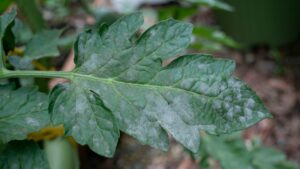
Powdery mildew is also a fungal disease which is primarily distributed through wind and water splashes. The spores get on the leaves and build a mycelium, much like a fungal highway. They penetrate the plant, suck out the sap and build a mycelium that’s white at first and brownish later.
Infected plants show a floury, whitish, removable coating on the surface of leaves and fresh shoots.
How to prevent it:
- Choose resistant varieties
- Keep the plants at an appropriate distance
- Don’t overfeed them with nitrogen
- Make sure not to spray the leaves when watering
- Mulch the soil between the plants
- Regularly check for infection
- Strengthen the plants with plant manures, for example, from field horsetail
How to get rid of it:
- Remove infected plant parts and dispose of them properly.
- Spray the plants with a baking soda solution (dilute 1 tsp of baking soda in 1 litre of water)
- Spray the plants with diluted milk spray (1 part milk with 10 parts water)
- Spray the plants with potassium bicarbonate solution (1 part potassium bicarbonate to 40 parts of water)
Downy mildew
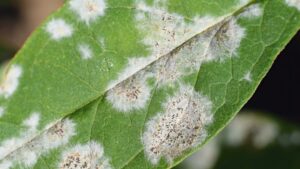
The fungal threads of downy mildew grow into the leaves and build a mycelium on the leaves‘ undersides. Downy mildew is specifically active when the weather is moist and cool, that is, in autumn and spring.
Infected plants show a whitish-grey to brownish mycelium on the underside of the leaves. (If it’s on the upper side, it’s most probably powdery mildew). The leaves show yellowish to brown patches, and infected parts die off eventually.
How to prevent it:
- Keep leaves dry
- Observe the right planting distance and only water the ground
- Don’t overfeed the plants with nitrogen
- Choose resistant and tolerant varieties
- Spray preventively with garlic tea
How to get rid of it:
- Remove infected plants and dispose of them properly.
- In case of a strong infection, spray the leaves‘ undersides with a fungicide.
Anthracnose
Anthracnose is a group of different fungal diseases that not only affects vegetables but also fruits, trees and flowers and shows in similar ways: It forms round, watery lesions on the fruits, blossoms, shoots, leaves and stems, which sink in later and become black. Sometimes a white mycelium forms. Even the roots can be infected, which will eventually kill the plant.
How to prevent it:
- Make sure the soil for your plants is well-drained.
- Use healthy, resistant varieties.
- Only water the ground around your plants, not the plant itself and definitely not the leaves.
- Keep ripening fruits from touching the soil.
- Remove all plant debris after harvesting, as the fungus can survive in plant parts for a long time.
- Observe the rules of crop rotation.
How to get rid of it:
- Remove infected plants and dispose of them properly.
- Spray your plants with a copper-based fungicide according to label instructions. Be careful, though, not to overdo it, as copper may build up to toxic levels for microorganisms in the soil.
- Wash your hands and disinfect garden tools.
Grey mould (Botrytis cinerea)
Grey mould is especially active when temperatures are mild (20 °C / 68 °F), and humidity is high. You can detect it from glassy, moist patches on pepper fruits, leaves and blossoms. Later on, brown spots of decay eventually get covered with a grey mycelium. The leaves and shoots wither and eventually die.
How to prevent it:
- Air your greenhouse regularly to make sure that the leaves dry off quickly.
- Water regularly but not excessively, and avoid splashing the leaves with water.
- Observe the right planting distance between pepper and chilli plants.
- Prune your peppers and chillies, paying special attention to removing superfluous leaves in the middle of the plant.
How to get rid of it:
- Remove infected plants and dispose of them properly.
- Disinfect your gardening tools and wash your hands after handling infected plants.
Pepper Blight (Phytophthora capsici)
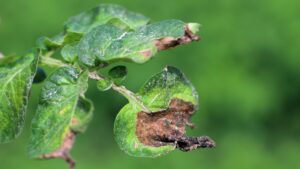
You may have encountered blight on tomatoes, but it can affect all members of the nightshade family, that is, potatoes, eggplants and peppers. It especially spreads under warm, humid conditions and shows brownish to black patches on the fruits. Eventually, the leaves, as well as the stems, become greyish. The leaves wither, despite the soil being moist, which shows that the roots have died off.
Sometimes, the stems turn brown or black, occasionally showing reddish discolouration before the roots begin to die. The pathogen can survive in the soil for more than a decade.
How to prevent it:
- Only use healthy plants
- Observe the rules of crop rotation
- Make sure that the conditions in the greenhouse are as dry as possible.
- Only water the soil around your plants and avoid splashing the leaves.
How to get rid of it:
- Remove infected plants and dispose of them properly.
- Disinfect gardening tools and your hands.
- Solarise the soil by covering it for 4 – 6 weeks with a clear plastic sheet in the summer heat. The soil will heat up under the cover and kill fungi.
- After the growing season, thoroughly disinfect the greenhouse.
- Exchange the soil in your greenhouse.
Southern Blight (Sclerotium rolfsii)
Fungi living in the soil cause this disease, which we can detect from white fungal growth on the stems at the soil line. Later, sclerotia that look like mustard seeds form.
Southern blight is more common in warm climates. If your hardiness zone is below 8, it’s unlikely to be a problem in your garden.
How to prevent it:
- Only use healthy plants
- Observe the rules of crop rotation
- Make sure that the conditions in the greenhouse are as dry as possible.
- Only water the soil around your plants and avoid splashing the leaves.
How to get rid of it:
- Remove the infected plants and the soil around them
- Solarise the soil.
- Disinfect gardening tools and your hands
- After the growing season, thoroughly disinfect the greenhouse.
Frogeye Leaf Spot (Passalora capsicicola)
Source: Wikipedia
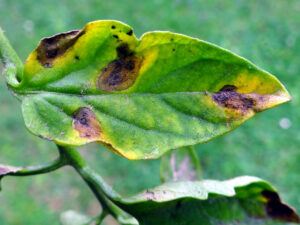
The leaves get round to oblong spots, which are watery first and later turn brown with a dark ring around them (like a frog’s eye). The leaves wither and eventually die.
Cercospora Leaf Spot, another disease, causes similar symptoms to frogeye leaf spot, but it’s caused by a different pathogen.
How to prevent it:
- Choose resistant varieties
- Only use healthy plants
- Observe the rules of crop rotation
- Only water the soil around the plant and make sure that you don’t splash on the leaves.
- Observe the right planting distance between peppers and chillies.
How to get rid of it:
- Remove infected plants and dispose of them properly.
- You may spray with a copper-based fungicide, but avoid copper buildup in the soil
Bacterial Diseases Affecting Peppers and Chillies
Bacterial Leaf Spot (Xanthomonas campestris)
At first, the infection shows as watery, dark spots on the underside of the leaves. Gradually, these spots become larger and can spread to all parts of the plant. Bacterial leaf spot spreads particularly fast under warm and humid conditions.
How to prevent it:
- Choose resistant varieties
- Only use healthy plants
- Observe the rules of crop rotation.
How to get rid of it:
- Remove infected plants and dispose of them properly.
- Spray the plants with a copper-based bactericide
- Disinfect your tools
Bacterial Canker (Clavibacter michiganensis)
Source: Wikipedia
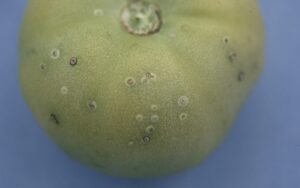
Bacterial canker infects the plant via its roots or injuries and causes gradual wilting. It shows through brown lesions on the leaves and discoloured veins. The fruits get crater-like spots. Bacterial canker often starts from the bottom leaves or from one side, gradually infecting the whole plant and can affect all members of the nightshade family.
How to prevent it:
- Choose resistant varieties.
- Only use healthy plants.
- Observe the rules of crop rotation.
- Only water the soil around the plants and avoid splashing the leaves.
How to get rid of it:
- Remove infected plants and dispose of them properly.
- You may spray with a copper-based bactericide, but avoid copper buildup in the soil.
Bacterial Soft Rot (Pectobacterium carotovorum)
Bacterial rot thrives under warm, humid conditions and lets the fruits rot quickly. The bacteria penetrate the fruit through microscopic wounds, causing the tissue to degrade, which eventually leads to rot.
How to prevent it:
- Plant in well-drained soil.
- Observe the rules of crop rotation.
- Don’t overfertilise or overwater your plants.
How to get rid of it:
- Remove infected plants and dispose of them properly.
Viral Diseases Affecting Peppers and Chillies
Mosaic Viruses
Source: Wikipedia
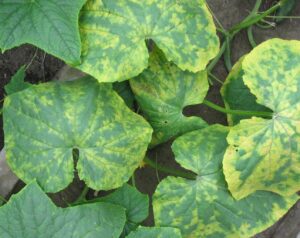
Mosaic viruses are a group of viruses, among them the tobacco mosaic virus (TMV), pepper mild mottle virus (PMMoV) and cucumber mosaic virus (CMV). As their various names suggest, mosaic viruses can also befall cucumbers, tomatoes, pumpkins and other vegetables. The pepper mild mottle virus is a highly infectious viral disease that occurs mostly on plants in greenhouses.
Its appearance depends on how old the plant is: sometimes it only shows as a yellowing of leaves, but often we can detect a pattern of dark and light mosaic-like patches on young leaves. The fruits are smaller and sometimes curled, and the overall growth is stunted.
There’s nothing to be afraid of, though. While mosaic viruses sound alarming, they’re manageable with proper hygiene and prevention.
How to prevent it:
- Choose resistant pepper and chilli varieties
- Viruses are passed on through plant sap. It’s important, therefore, to regularly clean and disinfect your garden tools.
- Remove all plant debris at the end of the growing season. Viruses can survive in plant parts for months.
- Observe the rules of crop rotation.
- Control insects that spread the disease, especially aphids.
How to get rid of it:
- Remove infected plants and dispose of them properly.
- Disinfect garden tools after every use.
- Closely monitor nearby plants.
- Wash your hands after handling the plants.
Physiological Disorders (Not Diseases)
Not every problem is caused by a pathogen. Some issues are stress-related or nutritional imbalances.
Blossom end rot
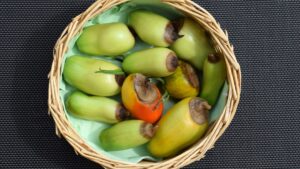
Blossom end rot is not a disease but a deficiency symptom. It shows that our plants do not take up enough calcium. Now, this could be due to a lack of magnesium in the soil, but more often it’s caused by irregular watering.
Another (rarer) cause is damaged roots, which could be caused by pepper pests.
Blossom end rot is easily identified by a dark, sunken, leathery spot on the tip of the fruit.
Don’t worry, though: you can still eat the peppers and chillies, just cut off the brown end.
How to prevent it:
- Water your pepper and chilli plants regularly and cover the soil with mulch to keep it moist.
- Avoid over-fertilising the plants with nitrogen; this will weaken them and make them more prone to infections.
- Fertilise with a well-balanced fertiliser that also contains secondary nutrients like calcium, magnesium and sulfur.
How to get rid of it:
- Water regularly.
- Add calcium by working crushed eggshells or bone meal into the soil.
- Some gardeners also use diluted milk sprays, although consistent watering is usually more effective.
Sunscald
„Sunscald“ is pepper-language for sunburn, and yes, plants can be affected, too. They get tannish spots and, in severe cases, the fruits won’t develop properly.
How to prevent it:
- Protect your peppers and chillies from the sun with a shade or – if you grow them in pots – provide temporary shade during extreme heat, especially in the afternoon.
How to get rid of it:
- Remove the fruits that are severely damaged, as they won’t recover. Fruits that are only slightly damaged are still edible.
- Prune your plants selectively to allow some leaf cover over the fruits
- Increase watering during heat waves
Blossom drop
When peppers and chillies drop off buds and blossoms, the temperature is usually not right for them. When temperatures get over 32 °C (90 °F) or fall below 13 °C (55 °F), the plants get stressed and throw off all their blossoms.
Other reasons for blossom drop can be inconsistent watering or over-fertilisation, especially when you feed your plants too much nitrogen.
When you grow peppers and chillies in the greenhouse, make sure to keep the door and windows open when it’s sufficiently warm so that pollinators can get in. Blossoms also fall off when they’re not pollinated.
How to prevent it:
- Make sure temperatures are in the right range
- Water regularly
- Don’t overfertilise.
- If necessary, hand-pollinate. This is explained in detail in my comprehensive pepper growing guide.
How to get rid of it:
- If it’s too hot, shade your plants
- Water regularly.
Frequently Asked Questions About Pepper Plant Diseases
✔️ How do I know if my pepper plant has a disease or a pest problem?
Diseases cause issues without visible culprits: yellowing leaves without bugs, wilting despite adequate water, mouldy or powdery coatings, spreading spots, or rotting stems.
Pests cause visible physical damage you can see: holes in leaves or fruits, visible insects (even tiny ones), sticky residue, webbing, or slime trails.
Quick test: If you see actual bugs or bite marks, check my pepper plant pests guide. If plants look sick without visible insects, you’re dealing with a disease (this article).
✔️ Can I eat peppers from a plant with blossom end rot?
Yes, absolutely! Simply cut off the brown, leathery part at the bottom and use the rest normally.
✔️ My seedlings are collapsing at the soil line. What’s happening?
This is almost certainly damping-off, a fungal disease that affects seedlings. Remove them immediately, along with the soil they’re growing in, to prevent it from spreading to healthy seedlings.
✔️ Should I use chemical fungicides on peppers I’m going to eat?
Most pepper diseases respond well to organic and cultural methods when caught early. Chemical fungicides should be a last resort, and if you do use them, always follow label instructions carefully and observe the waiting period before harvest.
✔️ Can pepper plant diseases spread to my tomatoes?
Yes, many can. Peppers and tomatoes are both nightshades (Solanaceae family) and share many of the same diseases, for example, blight, fusarium, mosaic virus and others.
✔️ My pepper leaves are turning yellow. Is it a disease?
It depends on the pattern:
Lower leaves only: Usually normal ageing OR nitrogen deficiency—not a disease. Feed with balanced fertiliser.
Yellow between veins (veins stay green): Magnesium deficiency. Add Epsom salt solution (1 tablespoon per 4 litres of water).
Yellowing + wilting + root problems: Could be Fusarium, Verticillium, or root rot—these ARE diseases requiring removal of infected plants.
Yellowing + mosaic patterns: Likely a viral infection (mosaic virus).
Yellowing + visible insects: Check for aphids or whiteflies—see my pest guide instead.
Start by ruling out nutrient deficiencies and watering issues before assuming disease.
✔️ I think my plant has a fungal disease. Can I save it?
It depends on how far the infection has spread. In the early stages, removing infected plant parts and applying further methods can be enough. If the disease has spread too far, however, recovery is nearly impossible.
The Three Keys to Disease-Free Peppers
Growing peppers and chillies doesn’t mean you’ll never encounter a disease.
But you can stack the odds heavily in your favour by following three core principles:
#1 Start with Healthy Plants
Everything starts with good care from the beginning: well-draining soil, proper spacing, consistent watering, and balanced fertilisation.
Healthy, vigorous plants have natural defences that protect them from diseases.
Most of the diseases in this guide prey on weakness. Don’t give them an easy target.
#2 Stay Vigilant
Check your plants regularly — every few days during the growing season. Look at both sides of the leaves, inspect the fruits, and watch for early warning signs. A small yellowing spot caught today is far easier to manage than a widespread infection discovered next week.
Now, this isn’t paranoia; it’s good gardening.
#3 Act Swiftly
When you spot a problem, don’t wait to see if it magically goes away. Because it won’t.
Remove infected plant parts immediately. Dispose of them properly—never in the compost. Disinfect your tools.
The faster you respond, the more plants you’ll save and the less the disease can spread.
These three principles appear again and again throughout this guide.
Because they work.
They’re not complicated or expensive. They’re simply habits that separate gardeners who occasionally lose plants from gardeners who consistently harvest abundantly.
Diseases will happen. But with these practices in place, they’ll remain minor setbacks rather than season-ending disasters.
A healthy garden isn’t one without problems.
It’s one where the gardener knows what to look for — and what to do next.
And now, so do you.
Want more pepper-growing guidance? Check out these related articles:
- How to Grow Peppers and Chillies from Seed — Build healthy, disease-resistant plants from the start.
- Pepper Plant Pests: Identification, Prevention and Control — Learn the difference between pest and disease problems.
- How to Grow Peppers and Chillies in Pots (Complete Container Growing Guide) — Get a great harvest, even if you don’t have a garden
0 Comments