
.
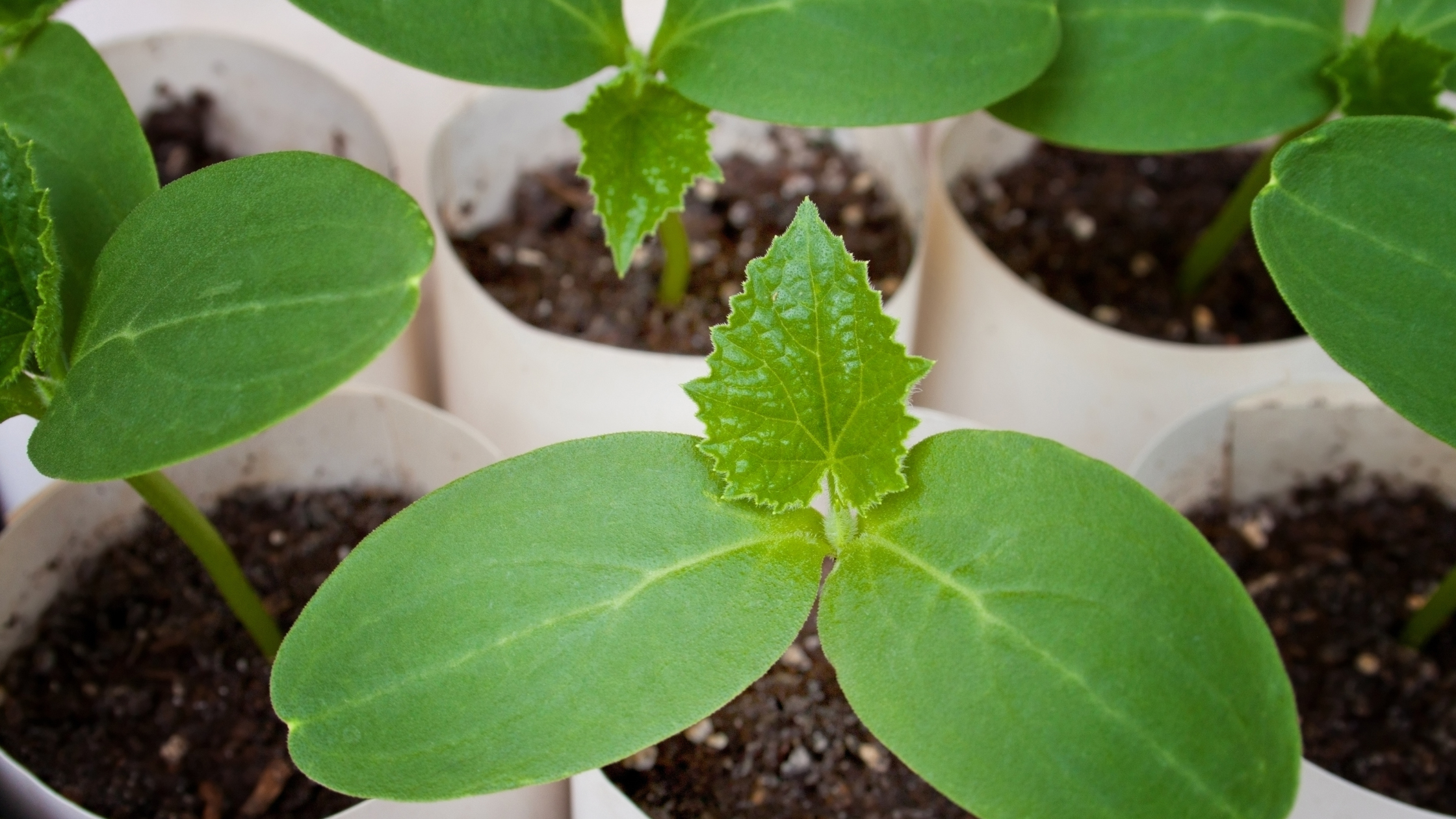
Vegetable garden, greenhouse, balcony, or patio: Cucumbers thrive in many environments and brighten your summer with crisp, fresh fruit. And they are a vegetable that can be easily seed-started indoors. Let’s have a look at how it works.
Cucumber varieties
Depending on where they grow, there are different varieties of cucumbers. Snack and pickling cucumbers grow well outdoors and even in pots, while snake cucumbers prefer to be cultivated in a greenhouse.
(Psst: Is a greenhouse on your wishlist, but you think it’s too expensive? Look how I built mine from scratch and for only 1300 €!)
Seed-starting cucumbers for greenhouse cultivation
Many cucumbers for the greenhouse produce only female flowers, which makes them more productive.
Cucumber varieties with only female flowers are called “parthenocarpous”. That means that they don’t need male pollen for fertilisation and don’t produce seeds.
If you choose a parthenocarpous cucumber variety, make sure that you don’t plant other varieties with male flowers in the vicinity. Otherwise, bees could bring in male pollen – and you‘ll get a smaller harvest.
Seed-starting cucumbers for outdoor cultivation
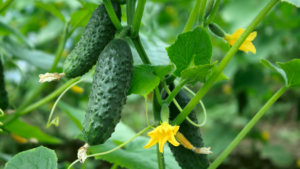
Outdoor cucumber varieties are often smaller and have less smooth skin, but they often taste more aromatic and stay fresher and crispier.
If you want to cultivate your cucumbers in an unprotected place, I recommend the robust outdoor varieties. They are not as prone to mildew as the more sensitive greenhouse cucumbers.
But cucumbers are not only for fresh consumption. There are several varieties, especially for preserving. My favourite variety for pickles and ferments is „Boston Pickling“. Its fruits stay smaller, and they grow well outdoors.
The right time
At the beginning of April, you can seed-start cucumbers indoors. I also recommend sowing cucumbers in several batches between April and mid-June. This succession planting will make sure that you can harvest cucumbers throughout the whole season.
Seeing that sometimes older plants get infected with (real or false) mildew, a further batch provides you with fresh fruits.
Seed-starting Cucumbers: 8 Steps for Healthy Seedlings
. To make sure seed-starting will be a success, let’s go from sowing to transplanting step by step!
#1 How many cucumber plants do I need?
If you want to be self-sufficient with cucumbers, I recommend cultivating one to two plants per household member. For pickling and fermenting, you can even calculate some more. That way, you can preserve cucumbers for the winter months.
#2 Equipment
Fortunately, there’s not much equipment you’ll need:
- pots of about 10 x 10 cm (4 x 4 inches)
- matured compost or cultivation soil
- cucumber seeds
- a small watering can or a ball shower
Wondering if you could really sow in compost? Yep, that’s possible, BUT only in mature compost. If it looks dark and smells like a forest, it’s ready for seed-starting.
#3 How to sow cucumbers
Take your pots, fill them with mature compost or cultivation soil and make a hole of about 2 cm in it. There, you put in two seeds. Unfortunately, there’s always the risk that some seeds won’t germinate. By putting two seeds into the pots, we minimise that risk. If both germinate, rip out the weaker plant (even if it’s hard for you).
Now cover the seeds with soil, press it slightly and water the pots with the watering can or ball shower.
#4 Do NOT thin out cucumbers
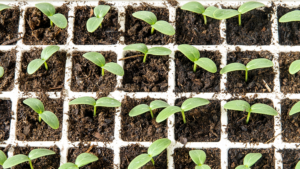
Cucumbers don’t like it when their roots get messed with. For that reason, we seed-start them in pots that are large enough for them to grow until they’re transplanted outdoors or into the greenhouse without being uprooted.
#5 Temperature and light
Cucumbers like it hot, about 25 °C (77 °F), for germination. I usually place the pots above the radiator, or I use a heating mat to create a cosily warm atmosphere for my cucumber babies.
When they have germinated and peek out of the soil, they need less temperature but more light. At that stage, I move them to the guest toilet, where it’s a few degrees colder (18 – 20 °C / 64 – 68 °F). Now they need more light to grow, about 12 – 16 hours per day and at best special wavelengths.
It’s difficult to get that amount of light at the beginning of April, which is why I have several plant lamps installed. The right light is essential for sturdy growth. If there’s too little, the plants will get leggy and weak.
Want more tips about successful seed-starting of vegetables? Here is a comprehensive article on seed starting for beginners.
#6 Fertilisation
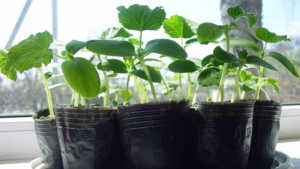
When your cucumbers are 2 – 3 weeks old, they need their first dose of fertiliser. It’s best to use a liquid fertiliser that you dilute with water (I usually use half the amount indicated on the package) and water your plants with it.
At that stage, cucumbers need a small dose of nitrogen to get them going and induce healthy growth.
#7 Watering
You shouldn‘t water any seedlings from above but rather into the saucer or holder. That way, the water can be absorbed up into the pot and the seedlings can take what they need. It’s the simplest and best way to water seedlings, and you can even fertilise them that way.
But be careful: don’t over-water your seedlings! A short period with a slightly drier soil helps them to develop strong roots.
#8 Hardening off
Before planting your cucumbers outdoors (here, that’s around the middle of May), you must harden them off to get them used to the harsher conditions. About a week before the „great day“, start putting them outside in a protected, shady place for 2 – 3 hours. Prolong that time over the next few days, and also put them into the sun. After about 7 days, they are hardened off enough to get transplanted outdoors.
Now you can also sow cucumbers directly into the patch.
Have fun seed-starting your cucumbers! If you want to read on, here are some articles you may also like:
How to plant, grow and harvest tomatoes in 14 steps
10 Surefire Companion Planting Pairs for First-Time Gardeners
What to Sow and Plant in April: Kickstarting Your Vegetable Garden
Or simply browse my complete gardening library for step-by-step guides on every aspect of vegetable growing, from planning to harvest.
0 Comments