
.
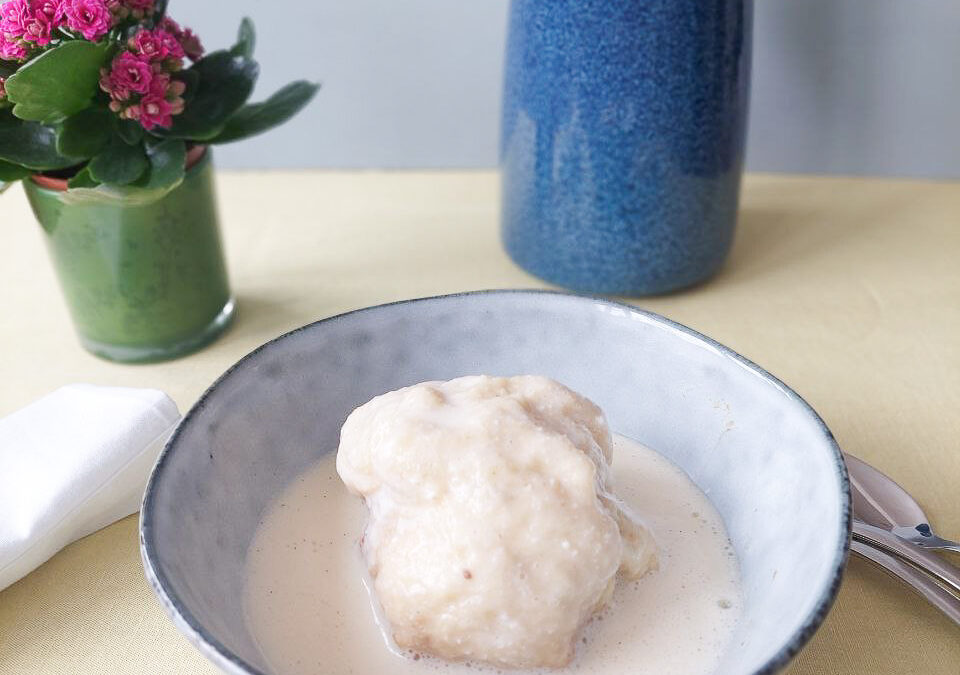
Dampfnudeln, those fluffy Bavarian steamed dumplings with a golden caramelised bottom, were my Oma’s speciality — and today I’m sharing her recipe so you can master them too. In this recipe, I’ll show you how to make traditional Bavarian Dampfnudeln step by step — including all the tips that ensure they turn out fluffy with that signature caramelised crust.
When Oma cooked for our family – usually during harvest when Mom and Dad were in the fields all day – she often made Dampfnudeln. She waited until the four of us children had gathered around the table, making sure our hands were washed. Every one of us already had a plate in front of them, along with two forks and a tablespoon. We had already grabbed the forks and held them like swords.
Finally, Oma brought the large pot and put it in the middle of the table. The lid was still closed, its edges covered with dishcloths to trap the steam, but we could already smell the sweet scent of the steamed Dampfnudeln. Although we could hardly wait, none of us would dare to open the lid, knowing that Oma would give us a good rap on the knuckles (I‘ll soon explain why).
She brought the large jug of vanilla sauce and finally, finally, opened the lid from the pot, releasing the steam that had been trapped in it. And oh, the smell!
She carefully dug out one Dampfnudel after the other, and we could see the brown, caramelised crust underneath. As she’d placed them on our plates, we eagerly pulled them apart with our forks (hence two) and poured lukewarm vanilla sauce over them. It was pure bliss on a plate!
Aren’t familiar with Dampfnudeln? Let me explain what it is, where it originates from, and – last but not least – how to make the perfect Dampfnudel.
What is a Dampfnudel?
Basically, a Dampfnudel is a dumpling made from sweet, enriched yeast dough that’s steamed instead of baked. It’s a common dish popular across Southern Germany, Palatinate, Austria, Switzerland and the Alsace and is either served sweet or savoury as a main course.
The German word “Dampfnudel” translates as “steam noodle”. Now, “noodle” seems a strange word to describe what looks nothing like noodles, but it is actually an old word for “dumpling”.
Dampfnudeln (plural) are a traditional comfort food here in Bavaria, and they’re often served with sweet sauces like vanilla sauce or savoury sauces like mushroom sauce. They may sound like a dessert (and you can eat them as that), but in fact, they’re mostly served as a main dish, as they’re very filling. A pot of dampfnudeln and a jug of sauce can easily feed a whole family.
Where’s the Origin of Dampfnudeln?
Seeing as I’m from Bavaria, I’d love to say that Dampfnudeln originate here, in the heart of the land of mountains and lakes. But I can’t legitimately make that assertion, particularly as Rhineland-Palatinate, a state in the mid-West of Germany, claims that they’ve invented the Dampfnudel.
There’s a story about the village of Freckenfeld in Rhineland-Palatinate: During the Thirty Years’ War, the Swedes were threatening to plunder and burn down the village if the people wouldn’t pay an immense sum of money. The villagers persuaded the Swedes to spare them, and in return, they’d feed their soldiers abundantly.
The baker of Freckenfeld, a Mr Muck, was assigned the task to fulfil this promise. I’m sure he felt no pressure at all that he alone was responsible for the life or death of a village full of people.
He probably broke out in a sweat – and started to work.
It is said that Muck, with the help of his wife and his apprentice, made 1286 Dampfnudeln for the hungry soldiers (why anyone would want to count them is beyond me) and served them with enough sauce to feed, well, an army.
The village was spared, and the grateful villagers erected the “Dampfnudel-Tor” (Dampfnudel gate), consisting of the described 1286 Dampfnudeln (this time in stone) in commemoration of this event. The gate still stands, and if you ever come to Freckenfeld, go visit.
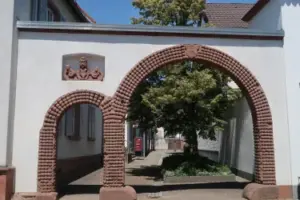
The Dampfnudel Gate in Freckenfeld (picture: pfalz.de)
In Bavaria, we don’t have a similar story, but we enjoy Dampfnudeln at least equally. The main difference between Bavarian and Palatinate Dampfnudeln is that we in the South usually enjoy them with a sweet sauce, fruit sauce or canned fruit. The people in the Palatinate, on the other hand, usually eat them with savoury sauces like mushroom or béchamel sauce.
Why You’ll love this German Dampfnudel recipe
Basic ingredients
Dampfnudeln may seem difficult, but in fact, you’ll only need a few ingredients to make these delicious dumplings. In fact, it’s just a sweet yeast dough, enriched with butter, milk and eggs that makes the basis for Dampfnudeln. You’ll find the full list of ingredients in the recipe section.
Low cost
Seeing as the ingredients are very basic, you’ll see that this dish is very budget-friendly. You can feed a whole family with Dampfnudeln for only a few euros.
The same goes for the sauces or preserved fruits you’re gonna serve them with. Neither vanilla sauce nor mushroom sauce is complicated or expensive. Or you can just take a jar of homemade apple sauce or dry-canned apples from your pantry and serve them with a staple you made yourself.
Comfort
The best thing about Dampfnudeln, though – no matter if served sweet or savoury – is that they’re a real comfort food from autumn to spring. They’re warming, hearty, and pair beautifully with preserved pantry staples you’ve been putting up all summer. Their fluffy dough, drenched in sauce, is like a caress for the soul. Up to now, I have not come across anyone who wouldn’t love Dampfnudeln, and I promise you: your family will, too!
But enough talk. Head for the pantry, grab the ingredients for Dampfnudeln and let’s get started!
How to Make Dampfnudeln (Step-by-Step)
Prefer watching? Here’s how to make Dampfnudeln step by step.
You are currently viewing a placeholder content from Default. To access the actual content, click the button below. Please note that doing so will share data with third-party providers.
More InformationAdd ingredients for the dough.
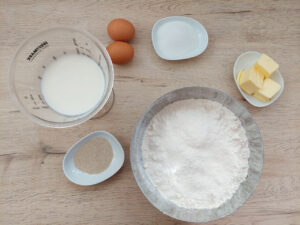
Put the flour, sugar, salt and dried yeast in a bowl (see recipe card for quantities).
Warm the milk to hand temperature and melt the butter in it.
Add the eggs to the dry ingredients and slowly pour in the milk. Stir all together to make a soft but not sticky dough and knead it thoroughly until it becomes pliable and the surface turns smooth and silky. If the dough is too sticky, add some flour; if it’s too dry, add some milk.
Knead the dough
You can either knead the dough by hand (which is my preferred method) or with the hook of a stand mixer. In either case, knead it for about 4 minutes until the dough gets the desired texture.
Proof
Put the dough in a bowl and cover it with cling film or a dishcloth. Set it in a warm place and let it rest for 60 – 90 minutes or until the dough has risen to twice its size.
Shape the dumplings
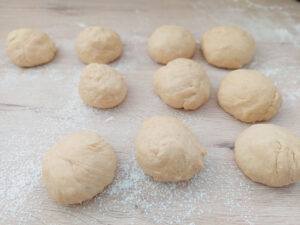
Get the dough out of the bowl and onto a lightly floured board, the kitchen counter or a table. Knead it gently and cut 8 – 10 equally large pieces out of it.
Roll the pieces to form dumplings, squeezing the seams together. Lay them on the floured surface, cover them and let them rest in a warm place for another 30 – 60 minutes.
Prepare the pot
In the meantime, take a large, heavy-bottomed pot or pan with high sides and put it on the stove. The pot should be large enough to hold all the Dampfnudeln. I, for example, use one with a diameter of 25 cm (10 inches). Put the sugar and butter in it and pour in the milk. Slowly heat the mixture and stir it until the butter has melted and the sugar dissolved.
How to steam Dampfnudeln
When the dough balls have risen considerably, carefully put them into the pot with the warm milk. Make sure they have enough room to rise, so don’t squash them too tightly.
Close the pot with a lid, ideally made of glass, so that you can look into the pot. Bring the milk to a simmer on low. You want your Dampfnudeln to be steamed, not cooked. If the temperature is too high, the Dampfnudeln will burn while still raw in the middle. To trap the steam in the pot, you can wrap two dishcloths around the rim, just like Oma did.
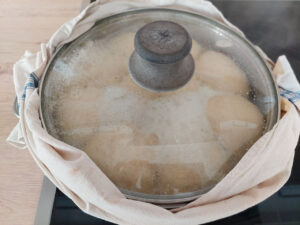
From now on, do not open the lid until the Dampfnudeln are fully done!
This is essential. When you open the lid, even just a tiny bit, the Dampfnudeln will crumble down.
Set the timer and let the Dampfnudeln steam for 30 – 35 minutes. You’ll know they’re done when they don’t move anymore, as the bubbling liquid has been absorbed. As a result, their shape has become stable. The simmer gentles down, and condensation increases.
When they’re done, carefully open the lid. As they’re cooked through now, they won’t crumble.
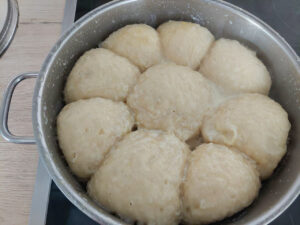
Freshly steamed Dampfnudeln. Let them cook for another few minutes until the moisture is absorbed and the crust starts to form.
Form the crust
Increase the temperature to medium and let the Dampfnudeln simmer for another few minutes until the milk is completely absorbed. When you can hear a slight sizzling, the crust is forming.
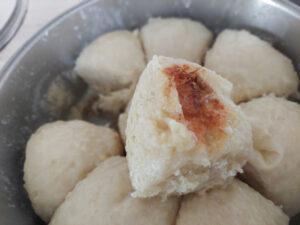
Immediately remove the pot from the stove to prevent the Dampfnudeln from burning and serve them right away, ideally with homemade vanilla sauce. (In this post about apple strudel with vanilla sauce, I’ll give you my favourite recipe).
Why Dampfnudeln get crust (and why you mustn’t open the lid)
During cooking, the liquid evaporates and steam forms. That steam is trapped in the pot and cooks the dough gently and evenly. That’s the reason you must never open the lid during the steaming process. The steam would get out, and cold air would flow in, ruining the result.
The butter in the mixture not only adds some flavour (fat is a flavour carrier) but also prevents the dough from sticking to the pot. With the help of butter, the Dampfnudeln can brown in the end instead of getting scorched.
When at the end of the steaming process, all the liquid is absorbed and evaporated, the sugar concentrates on the bottom of the pot and caramelises. Only after steaming is finished, the caramelised Dampfnudel crust forms. Additionally, the milk proteins and the sugars cause what’s known as the Maillard reaction, which gives browned food its distinct flavour.
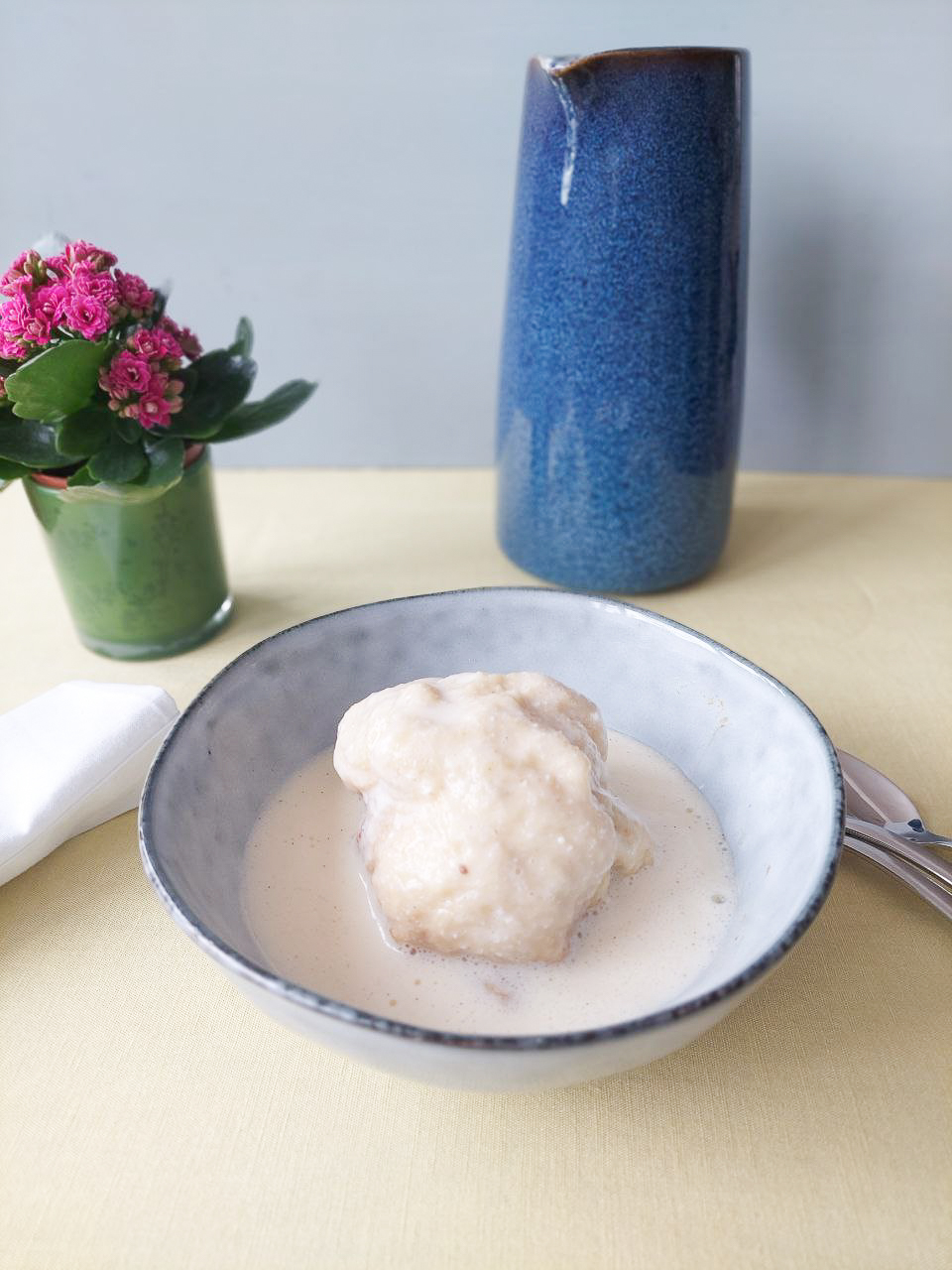
Ingredients
Method
- Put the flour, sugar, salt and dried yeast in a bowl.
- Warm the milk to hand temperature and melt the butter in it.
- Add the eggs to the dry ingredients and slowly pour in the milk. Stir all together to make a soft but not sticky dough and knead it thoroughly until it becomes pliable and the surface turns smooth and silky. If the dough is too sticky, add some flour; if it’s too dry, add some milk.
- Knead the dough for about 4 minutes until it gets the desired texture.
- Put the dough in a bowl and cover it with cling film or a dishcloth. Set it in a warm place and let it rest for 60 – 90 minutes or until the dough has risen to twice its size.
- Get the dough out of the bowl and onto a lightly floured board, the kitchen counter or a table. Knead it gently and cut 8 – 10 equally large pieces out of it.
- Roll the pieces to form dumplings, squeezing the seams together. Lay them on the floured surface, cover them and let them rest in a warm place for another 30 - 60 minutes.
- In the meantime, take a large, heavy-bottomed pot or pan with high sides and put it on the stove. The pot should be large enough to hold all the Dampfnudeln. Put the sugar and butter in it and pour in the milk. Slowly heat the mixture and stir it until the butter has melted and the sugar dissolved.
- When the dough balls have risen considerably, carefully put them into the pot with the warm milk.
- Close the pot with a lid. Bring the milk to a simmer on low. To trap the steam in the pot, you can wrap two dishcloths around the rim.
- From now on, do not open the lid until the Dampfnudeln are fully done!
- Set the timer and let the Dampfnudeln steam for 30 – 35 minutes. When they're done, carefully open the lid.
- Increase the temperature to medium and let the Dampfnudeln simmer for another few minutes until the milk is completely absorbed. When you can hear a slight sizzling, the crust is forming.
- Immediately remove the pot from the stove to prevent the Dampfnudeln from burning and serve them right away, ideally with homemade vanilla sauce.
The Secret to Perfect Dampfnudeln (Troubleshooting)
If you enjoy traditional recipes like this and want more seasonal inspiration straight from my kitchen, join the Seasonal Simple Life newsletter below.
It took me years to make perfect Dampfnudeln that are fluffy on the inside and have a crispy, caramelised crust. After testing various methods and many batches of (sometimes failed) Dampfnudeln, I’ve learned my lessons. Let me show you.
The Dampfnudeln are raw inside.
This is a common occurrence when the temperature for simmering is set too high. That way, the Dampfnudeln are cooked instead of steamed, and the milk evaporates too fast.
Next time, make sure that you only let them simmer on very low heat.
The bottom is burned
This could either be a pan, timing or measuring issue:
Make sure you use a heavy-bottomed pot.
When the Dampfnudeln are ready, and you open the lid and let them cook a bit more on the stove, listen carefully. When they start to sizzle, the crust is done, and you must immediately remove the pot from the stove.
Measure the amount of milk or water for the pot carefully, and don’t use too little.
The Dampfnudeln have no crust.
You probably used too much liquid that wouldn’t evaporate fully, even after the lid was opened.
Carefully measure the liquid.
The Dampfnudeln have collapsed.
That’s a classic case of curiosity and impatience. You opened the lid too soon, that is, before the Dampfnudeln were completely steamed through. The steam escaped while at the same time, colder air got inside the pot and caused the Dampfnudeln to collapse.
Keep the lid closed during steaming! Even a slight opening is too much for the sensitive dumplings.
The Dampfnudeln are heavy and dense
Several reasons can lead to dense and heavy Dampfnudeln.
The most common mistake is that the dough was too dry in the first place. Make sure the dough is soft and pliable, and add some milk if necessary.
Another reason can be that the dough wasn’t kneaded enough for the gluten to develop. The yeast in the dough creates gas, which must be trapped within the dough for it to rise. When the gluten structure is insufficiently developed, it can’t hold the gas, and the dough won’t rise properly. Knead the dough until it is soft and pliable and has a smooth and silky surface.
Speaking of rising: give the dough enough time to proof. It must approximately double in size. Now, depending on the temperature the dough is left in, this takes longer or shorter. Don’t stick too close to the clock; rather, watch the dough.
Lastly, when the cooking temperature is too high, the outer dough will set too fast, and as a result can’t rise during steaming. Always simmer Dampfnudeln on very low heat.
The dough didn’t rise.
This can be due to yeast problems: When the yeast is too old, it sometimes gets weak and doesn’t produce enough gas for the dough to rise properly. Check that your yeast hasn’t expired.
Also, if the milk you add to the dough is too hot, it can kill the yeast. Make sure the milk is not hotter than 38 °C (100 °F).
Don’t worry, though. Even experienced cooks have these mishaps from time to time. Just remember that practice makes perfect.
Serving Ideas for Dampfnudeln
Dampfnudeln are incredibly versatile and can be eaten with sweet or savoury sauces. While sweet Dampfnudeln are the Bavarian classic, savoury versions are especially popular in the Palatinate.
Sweet Dampfnudeln (German classic)
- Dampfnudeln with vanilla sauce:
The classic (and in my opinion, most authentic) way to eat Dampfnudeln is with vanilla sauce. - Fruit: But, of course, you can also serve them with apple sauce or fruit compotes like these dry-canned apples. Oma, for example, always liked to add preserved elderberries or plums to the (obligatory) vanilla sauce.
- Butter and sugar: Some people like to pour brown butter on top or dust them with poppy seed sugar, although that’s more common with Germknödel, a filled Dampfnudel variation (more on that below).
Savoury Dampfnudeln Ideas
- Mushroom sauce: In Palatinate, it’s more common to steam Dampfnudeln in salted water instead of sweet milk and then serve them as a savoury dish, for example, with a creamy mushroom sauce.
- Vegetables: Another delicious way to eat hearty Dampfnudeln is as a side dish to homemade sauerkraut, spinach or other vegetable sauce and soup.
- Meat: Serve Dampfnudeln as dumplings with goulash.
Make Ahead and Storage
How to prepare Dampfnudeln in advance
The yeast dough for Dampfnudeln can well be made ahead. Just don’t let it proof in a warm place, but put it in the fridge instead. There, it’ll rise as well, but slower due to the low temperatures. When you plan to make Dampfnudeln in the evening, you can make the yeast dough in the morning or even the evening before and let it proof in the fridge.
Before shaping the Dampfnudeln, take the dough out of the fridge and let it warm up for 1 – 1.5 hours.
Another way to prepare Dampfnudeln ahead is by freezing the raw dumplings. Cut off equal pieces from the yeast dough and roll them into dough balls. Instead of letting them sit to proof, put them in a bag and then in the freezer. Dampfnudeln can be stored in the freezer for up to three months.
Before you cook them, take the dumplings out of the freezer and let them defrost in the fridge overnight.
How to store Dampfnudeln
You can store cooked Dampfnudeln in a closed container for two days at room temperature, 3 – 4 days when you put the container in the fridge.
Alternatively, freeze Dampfnudeln. Just make sure they’ve completely cooled down, then put them in a bag and store them in the freezer. Before eating, take them out of the freezer and let them defrost in the fridge overnight. The next day, you can heat the Dampfnudeln in a microwave or the oven.
How to reheat Dampfnudeln
You got your Dampfnudel out of the fridge or freezer, but how to reheat it so that it becomes that fluffy ball again? There are a few different methods:
- Microwave: Moisten or even rinse the Dampfnudel, put it on a plate and let it steam in the microwave for 3 – 4 minutes (600 W)
- Pot: Heat some water in a pot, hang a tight-meshed sieve, steaming basket or dishcloth in it (the water mustn’t touch it). If you use a dishcloth, tie it loosely to the pots’ handles so that it forms a slight hollow. Now put the Dampfnudel in whatever device you’re using, close the lid and let it slowly reheat in the steam for 15 – 20 minutes.
- Oven: If your oven has a steam function, wonderful! Use that. If not, you can use a roasting pan and an oven rack. Preheat the oven to 160 °C (320 °F), bring some water to the boil and pour it into the roasting pan in the oven. Moisten or rinse your Dampfnudel, put it on the oven rack and push it into the preheated oven. Let the Dampfnudel steam for 20 – 30 minutes and make sure that the water doesn’t evaporate completely.
- Steam cooker: Preheat the steam cooker and let the Dampfnudel steam for 15 – 25 minutes in the steaming basket.
Dampfnudel Variations (Traditional and Modern Recipes)
You’ve learned the traditional way to make Dampfnudeln now, but there are a few variations that I’d like to show you, as well.
Sourdough Dampfnudeln
This variety is wonderful as a side dish to goulash or a hearty soup.
Leave out the eggs and milk, and instead make the Dampfnudel dough with sourdough or sourdough discard (alongside the yeast) and water. They must proof a bit longer, around 1.5 – 2 hours, but the steaming process is the same. Put them into a pot with warm water, salt and butter and steam them for 30 – 35 minutes.
Wholemeal flour Dampfnudeln
You can substitute the all-purpose flour with the same amount of wholemeal flour to make Dampfnudeln. You may want to add a bit more milk or water to the dough as wholemeal flour tends to absorb more water. Also, proofing time may be a bit longer. Just give the dough enough time to double in size. Wholemeal flour Dampfnudeln can be either made sweet or savoury.
Filled Dampfnudeln (Germknödel)
A classic Austrian Germknödel, the Austrian version of a filled Dampfnudel, is traditionally filled with plum jam. When you cut the dough into pieces, pull the pieces a bit so that they become flat(ish). Now, place a large teaspoonful of plum or any other jam you like on the dough and close it around the filling. Press the seams together so that the filling is safely tucked inside, and roll the dough into a ball.
When all dumplings are made, leave them to proof, just like regular Dampfnudeln, before steaming them. Germknödel are usually served drizzled with melted brown butter and sprinkled with poppy seed sugar.
Vegan Dampfnudeln
The sourdough Dampfnudeln I mentioned earlier are a good vegan alternative for a salty version. But you can also make vegan sweet Dampfnudeln: Leave out the eggs, replace the milk with oat, almond or soy milk – whatever you prefer – and use margarine instead of butter. You will want to add about a third more margarine than in the traditional recipe, since you have to replace the eggs.
Vegan Dampfnudeln can be just as fluffy as traditional ones, but the crumb is usually slightly lighter and less rich because eggs and dairy add tenderness, structure and moisture.
Here are answers to the most common questions about making Dampfnudeln.
Frequently Asked Questions
Why are my Dampfnudeln dense?
You most probably haven’t kneaded the dough enough and/or given it enough time to rise. Other reasons are that the dough was too dry or you cooked the Dampfnudeln at too high a temperature.
Can I make Dampfnudeln without egg?
Absolutely. Leave the eggs out of the recipe and add more butter (or margarine, if you prefer a vegan version) and, if necessary, more liquid.
Can I make Dampfnudeln without a special pot?
Yes — any heavy pot with a lid works (pan, Dutch oven and so on)
Why must you not open the lid?
When you open the lid before the Dampfnudeln are cooked through, the trapped steam gets out of the pot while cold air gets into it, causing the Dampfnudeln to collapse.
Are Dampfnudeln the same as Buchteln?
Not quite, but close. The (sweet) yeast dough is the same, but while Dampfnudeln are steamed, Buchteln are baked.
Can I use fresh yeast instead of dry?
Absolutely. Use three times the amount of fresh yeast compared to dry yeast.
Can I make Dampfnudeln in the oven?
Yes. Put the (proofed) dough rolls in a greased casserole, fill the casserole with a mixture of warm milk, sugar and butter (like in the traditional recipe) and let the Dampfnudeln bake for 25 minutes at 180 °C (355 °F). Please note that the texture will be different: while traditionally steamed Dampfnudeln are soft on the surface, the baked version will be crisp on the outside.
Why don’t my Dampfnudeln brown?
When they’re cooked through, open the lid and let them cook until all the moisture is absorbed and evaporated. The crust forms after the steaming process.
Seasonal Simple Life Tips
Dampfnudeln are a wonderful Bavarian comfort food. Imagine coming home on a cold autumn day, where you’ve cleaned up your garden, to a steaming plate of Dampfnudeln with vanilla sauce. Pure bliss!
Alternatively (or additionally, if you prefer), serve the Dampfnudeln with homemade fruit preserves, like apple sauce, dry-canned apples, preserved elderberries (as Oma used to), plums or cherries. Try different fruit preserves; there’s no limit to your imagination.
Dampfnudeln are not only delicious, but also a traditional slow food. You need patience to let the dough proof twice, and especially during the steaming process. No lifting the lid, remember?! Take that time deliberately, to make a special, nourishing dish for your family.
While you’re at it, think about making a double batch and either freezing the raw dumplings or the steamed Dampfnudeln. That way, you’ll have a meal prepared that you only have to take out of the freezer the night before and just reheat.
From Oma’s Kitchen to Yours — Ready to Make Your First Dampfnudeln?
Do you remember the beginning of this article, where we four children were sitting at the table, forks raised like swords, waiting for Oma to open that lid?
I’d love for you to create that moment in your own kitchen.
It doesn’t matter if it’s your children, your partner, your friends or just yourself — there’s something deeply satisfying about setting a steaming pot of Dampfnudeln on the table, knowing you made them from scratch with a handful of simple ingredients. And yes, your first batch might not be perfect. The lid might have been lifted just a tiny bit (we’ve all been there), or the crust might not have formed quite right. Don’t worry. Even imperfect Dampfnudeln are delicious — and the next batch will be better.
That’s the thing about traditional recipes like this one: they reward patience and practice. Let the dough take its time. Don’t rush the proofing. And whatever you do — don’t open that lid.
This recipe shows you exactly how to make traditional Dampfnudeln with a fluffy crumb and caramelised crust — step by step.
Guten Appetit! 🥟
If you love traditional comfort food, you might also enjoy these seasonal favourites from my kitchen:
Savoury Rouladen: Germany’s Timeless Beef Rolls That Tell a Story
Authentic Spaetzle Recipe: German Egg Noodles in 20 Minutes
Bavarian Sauerkraut Strudel Recipe (Easy & Authentic)
Authentic Bavarian Apple Strudel (with Vanilla Sauce)
This Dampfnudeln recipe is part of my growing collection of traditional, seasonal dishes. Browse the full recipe archive here and find your next comforting kitchen project.