.
Woodruff syrup — known as Waldmeistersirup in German — is a traditional Central European spring speciality. As the name indicates, it’s made from sweet woodruff (Galium odoratum), a woodland herb famous for its delicate scent of hay, vanilla, and almonds. In Germany, it’s known as Waldmeister and used for lemonade, desserts, and May wine. In this article, I’ll show you how to make it naturally at home — without artificial green colouring.
🌿 The Complete Guide to Woodruff
Modest in appearance, but impossible to ignore once it’s in bloom — let me introduce you to woodruff.
Why I Fell In Love With Woodruff
When I was a kid, woodruff sherbet powder was totally en vogue! Sometimes, when my friends and I were walking back from school, we went to the local store and bought some of it as a treat. There was also a “woodruff” jelly of an almost neon-green colour and overly sweet taste, but my mum refused to buy “this purely chemical sh…stuff” (she didn’t say “stuff”). So for a long time, the only reference I had about how Woodruff tasted was the sherbet powders.
Real woodruff, however, has a far more complex flavour than anything that was artificially produced.
One day, while taking a stroll through the woods with my boys, I found some lovely flowers growing in the half-shade. I picked some and brought them home, where I wanted to put them into a vase.
Which I forgot to do.
When I remembered the plants, they had already wilted – and were spreading the most wonderful scent of hay and vanilla (nothing chemical about that). We had accidentally found woodruff!
Today, I grow woodruff in my herb garden, and every spring I make woodruff syrup to preserve its extraordinary scent. No chemical taste, no green colour, just four simple ingredients for a wonderfully herbal syrup with notes of hay and vanilla.
If you enjoy seasonal recipes, garden harvests and simple homemade traditions, you might like my newsletter.
What is Woodruff (Waldmeister)?
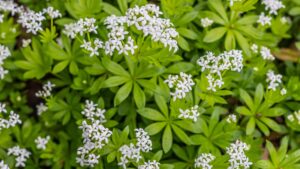
Woodruff (Galium odoratum) is a herb of the cleaver family. It mainly grows in deciduous forests of the temperate regions in Europe and Asia. It’s not native to the US but grows there as a neophyte.
How To Identify Woodruff
Woodruff is a perennial wintergreen herb that grows to a height of 5-50 cm (2-20 inches). It has an unbranched, smooth stalk with lance-shaped leaves in whorls.
Depending on the location, woodruff blooms from April to May, sometimes June, with small, white, star-shaped flowers. It’s used as a medicinal and condiment plant, for example, in May wine and desserts.
An inexperienced forager may confuse woodruff with white cleaver, which is safe to consume as well. Some sites state that woodruff can also be mistaken for lily of the valley (which is poisonous), but honestly, that’s highly unlikely.
If unsure, check the scent: fresh woodruff doesn’t smell but develops its characteristic scent only after wilting.
What Does Woodruff Taste Like?
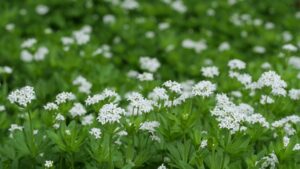
How do you describe the taste woodruff releases once it has wilted? The first comparison I find is hay. Whenever I dry woodruff in my home, it smells so strongly of hay that I sometimes invite people intentionally to share that scent with them.
But it isn’t hay alone — otherwise I could simply use hay. Woodruff’s fragrance also bears a strong undercurrent of vanilla and almond, which adds sweet and slightly bitter notes.
Mix that with the scent of freshly mowed grass, and you have the soft herbal sweetness of woodruff in a nutshell.
Why Is Woodruff Often Bright Green?
Well, it isn’t – at least not naturally. When you buy ready-made woodruff syrup or jelly, it’s always artificially flavoured and coloured.
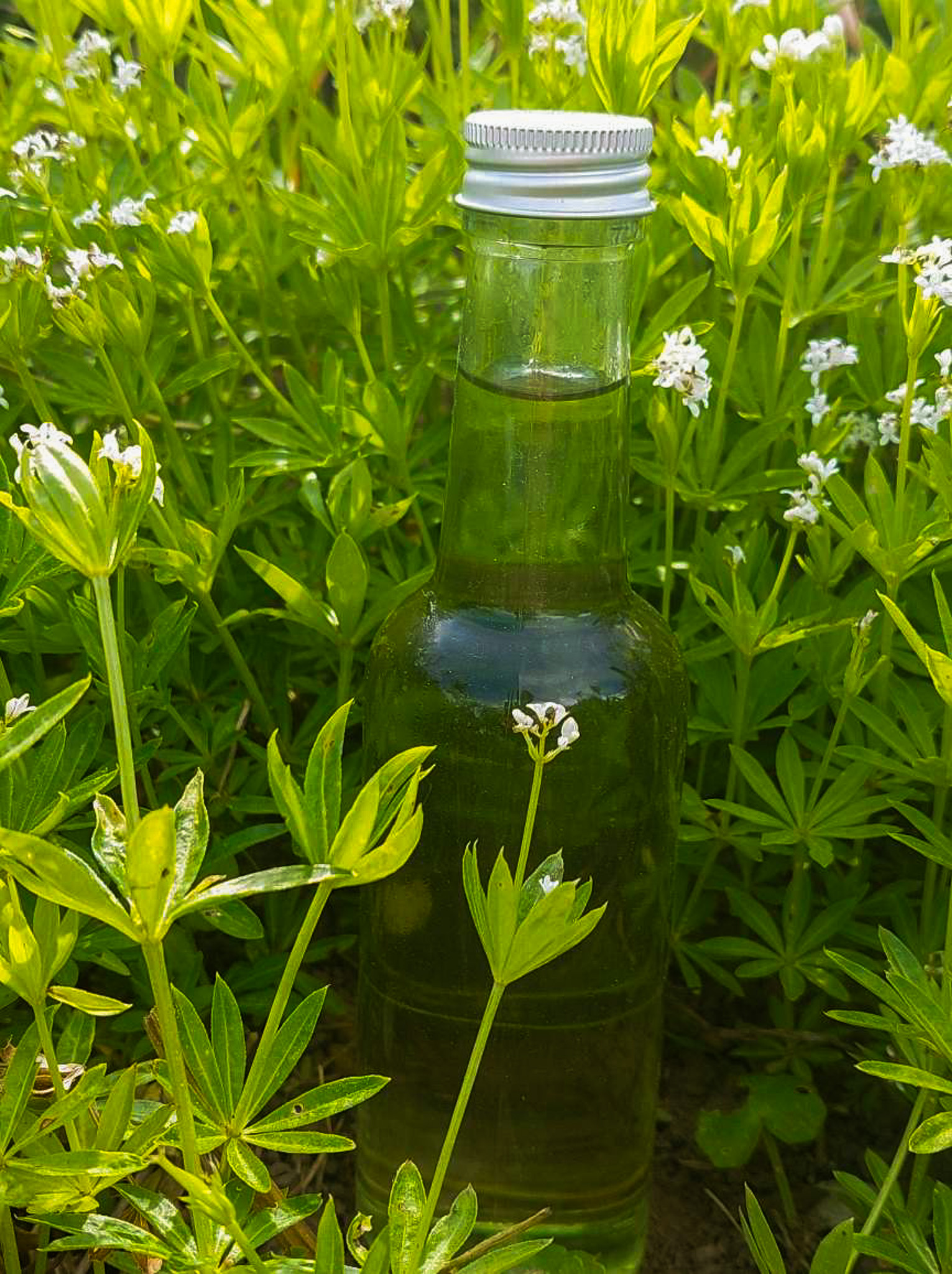
Homemade woodruff syrup is colourless to pale yellow.
Is Woodruff Safe? (Coumarin Explained)
The small amount of woodruff used in this recipe stays well within safe traditional consumption levels. Enjoy woodruff syrup occasionally, just as it has been used in Central Europe for generations.
The most famous ingredient of woodruff is coumarin, the stuff that makes it smell so good when it’s wilting.
However, coumarin can be slightly toxic when consumed in abundance. The German Federal Institute for Risk Assessment (BfR) states a tolerable daily intake (TDI) of 0.1 mg of coumarin per kilogram of body weight.
What does that mean for our syrup?
Woodruff emits about 1 % coumarin from dry mass. The average weight of dry mass is about 14.5 % of fresh weight. For this recipe, we use 8 – 10 stalks of dried woodruff, which amount to about 3 – 3.5 grams. With that, the amount of coumarin will not exceed 5 mg/l and would be within the TDI the BfR recommends. Additionally, syrup is always diluted, which even minimises the coumarin amount.
In short: woodruff syrup is considered safe when consumed in normal culinary amounts. As always with aromatic herbs, moderation is key — woodruff syrup is meant to be enjoyed diluted and occasionally, not consumed in large quantities.
Can You Grow Woodruff At Home?
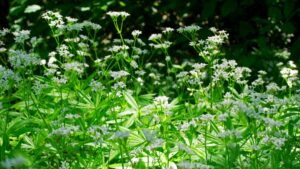
Absolutely, I’ve been doing so myself for years. Seeing as woodruff is a herb that grows in the forest, though, we must consider that it grows best in partial shade. When it has found the right place, though, it spreads readily. So, you can use it as a perennial groundcover if you like. It’s the perfect herb for woodland gardens.
When To Harvest Woodruff For Syrup?
The coumarin content in woodruff is the highest when the plant is in full bloom, which makes the best time to harvest woodruff shortly before the flowers burst into bloom. Here in Bavaria, that’s from mid-March to the end of April (in cold springs up to the beginning of May).
If you gather woodruff in full bloom, I recommend using it for other purposes, for example, as a decorative bouquet in fragrant sacs that you hang in your closet.
To harvest woodruff, cut it off directly above the soil, leaving the roots in the earth. From there, it will grow out again.
When you’ve harvested woodruff, you can’t use it immediately but must let it wilt first. I’ll show you why:
Why Woodruff Must Wilt Before Use
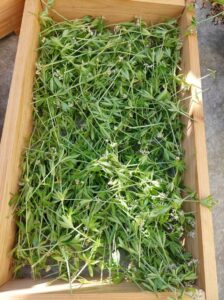
In fresh woodruff, the coumarin is bound to sugar and doesn’t smell of anything. Only when the cell walls are destroyed – by wilting, drying or freezing – an enzyme splits off the sugar and releases the now free coumarin. That’s when the typical flavour appears.
| Fresh | Wilted |
|---|---|
| little aroma | full aroma |
| coumarin bound | coumarin released |
Traditional Uses Of Woodruff
The best-known use for woodruff is as an ingredient in May wine (our German “Maibowle”), where wilted woodruff is used to infuse white wine and topped off with prosecco. This is a very traditional German spring drink.
Next in line comes our syrup, which is the basis not only for different drinks but also for cakes and desserts.
Further, woodruff is used in natural and folk medicine (although there’s no scientific evidence for its use) as an anti-inflammatory, anti-spasmodic, blood-cleansing and calming herb. However, it’s not advisable to use woodruff as a home remedy. The coumarin can damage the liver if consumed in high amounts.
I’m sure you know lavender sacs that you can put on your pillow, but did you know that you can also sew woodruff into sacs that you hang in the closet? They will slightly scent your clothes and even keep moths away.
Once the woodruff has wilted and released its fragrance, the rest of the process is beautifully simple.
Woodruff Syrup
Ingredients
Method
- Pick the woodruff and let it wilt for at least 4 - 6 hours, better overnight, until you can clearly smell its scent.
- Sterilise the bottles and caps and let them dry.
- Combine the sugar and water in a saucepan and bring to a boil, stirring constantly until the sugar is fully dissolved.
- Cut the lemon into slices and add them to the mixture.
- Let the sugar syrup cool down. When it reaches room temperature, add the woodruff and leave it there for 2 - 3 days.
- After that time, remove the lemon slices and the woodruff, bring the syrup to the boil. Fill the syrup into bottles while it's still hot and seal them immediately.
Notes
Want more seasonal recipes like this? Sign up for my newsletter:
How Long Does Woodruff Syrup Last?
Store unopened bottles of woodruff syrup in a cool and dark place, and it’ll last for at least a year.
Once a bottle is opened, store it in the fridge and consume it within a few weeks.
If the syrup gets cloudy, develops mould or smells funny, it’s spoiled, and you must throw it away.
How To Use Woodruff Syrup
The first use, of course, is to dilute woodruff syrup (or any other syrup for that matter) with water and enjoy it as a drink. But there are so many more ways to enjoy it! Let me show you:
More Homemade Syrups to Try:
Lilac syrup
Homemade Elderflower Syrup (simple recipe)
Drinks
- Add woodruff syrup to sparkling water in a ratio of 1 part syrup and 3 parts water, and enjoy it as a spring lemonade
- Fill about an inch of woodruff syrup in a champagne glass, top it off with prosecco and serve it as an aperitif
- Add woodruff syrup to kombucha for a second fermentation
Desserts
- Drizzle it over strawberries and serve them with whipped cream as a dessert
- Flavour panna cotta with it
- Add woodruff syrup instead of sugar to whipped cream desserts
- Sweeten rice pudding with this syrup instead of sugar
Baking and Preserving
- Soak a cake with the syrup and add a very unique flavour to it
- Flavour strawberry jam with it
Frequently Asked Questions
Can I Use Fresh Woodruff Instead Of Wilted Woodruff?
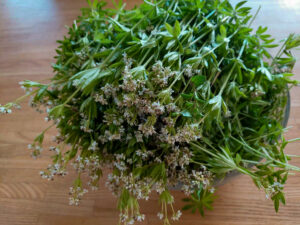
No. The scent only develops when the woodruff has wilted for at least several hours, and only then can you use it to infuse the syrup.
Can I Reduce The Sugar?
Yes, but just slightly. Sugar is a preservative and makes sure our syrup doesn’t spoil when stored. Instead of using 1 kg of sugar in 1 litre of water, you could reduce the amount to 800 grams.
What Does Woodruff Syrup Taste Like?
The taste is a mixture of hay, vanilla, almonds and freshly mowed grass.
Can I Freeze Woodruff?
Yes, freezing will also make it release its fragrance.
Why is commercial woodruff syrup green?
It’s an artificial colour added to the product.
Can I Dry Woodruff For Later Use?
Absolutely. Store the dried herb in a closed container and use it when you’re ready.
Ready to try Woodruff?
Woodruff syrup is one of those small spring rituals I look forward to every year — a way of bottling a moment before it disappears again for another twelve months. If you’ve never tasted real woodruff before, I hope this recipe surprises you as much as that forgotten bunch of wilted flowers once surprised me.
👉 While you wait for your syrup to infuse, enjoy more spring favourites:
0 Comments