
.
When the days grow short and St. Martin’s geese are finished, it’s finally time for Christmas cookies. While I love trying new recipes each year, some are non-negotiable in our family. Vanillekipferl top that list.
Compared to American Christmas cookies with their frosted sugar and chocolate dips, these pale crescents tell a quieter story. But don’t be fooled—they’re far from bland. One bite releases the flavour of vanilla sugar and toasted almonds, and those delicate half-moons crumble on your tongue in the most satisfying way.
Vanillekipferl are essential to German and Austrian Christmas celebrations, passed down through generations. My great-grandmother made them, my grandmother made them, my mother made them—and now I do too. When Mum baked Vanillekipferl each December, their vanilla scent filled the house. My brother and I could barely wait for them to cool. Mum would dust them with powdered sugar while still warm, and we’d sneak one. Or ten.
One year, we’d really overdone it—half a tray gone. Mum, naturally, scolded us thoroughly until my brother protested, “But how come Daddy can eat them?” She turned just in time to catch my dad finishing off the last Vanillekipferl from the tray…
Well, that’s the thing about Vanillekipferl: they disappear fast. Their buttery texture and subtle vanilla-almond flavour make them dangerously addictive, and making them has become as much a part of my December ritual as the eating. Let me show you how to make these beloved Austrian Christmas cookies so you can start your own tradition.

Vanillekipferl (Austrian Vanilla Crescent Cookies)
Ingredients
Method
- Put the flour, sugar, almonds, salt and the vanilla seeds in a bowl.
- Cut the cold butter into small cubes and add it to the ingredients in the bowl.
- Quickly but gently mix the ingredients with your hands until just combined - overworking makes the cookies tough.
- Form rolls from the dough (see blog section for why rolls) and put them in the fridge for at least 1 hour, better overnight.
- Cover a baking tray with parchment.
- Remove the rolls from the fridge and cut off pieces of about 1 cm.
- Roll each piece into a small rope of 5 - 6 cm, tapering the ends.
- Shape into crescents by bending the ropes and set them onto a baking tray.
- Chill the tray with the kipferl for 15 - 20 minutes (see blog section on chilling the cookies).
- Preheat the oven to 140 °C (285 °F) upper-lower heat or 120 °C (250 °F) circulating heat.
- Bake the Vanillekipferl in the hot oven for 15 - 20 minutes. They're ready when you can lift them easily from the tray and they're still pale, don't let them brown!
- Right after removing them from the oven, roll the kipferl in vanilla sugar OR dust them with vanilla or icing sugar.
- Let the kipferl cool down completely and layer them into a cookie box.
Notes
Great tips for even greater Vanillekipferl
There are a few things you need to observe to make really great Vanillekipferl:
Be quick
You must be quick when mixing the pastry dough. Take the butter directly from the fridge and cut it into small cubes. Then, quickly mix the ingredients with your hands until they’re well combined and the dough is homogeneous. Overworking activates the gluten, which makes cookies tough instead of tender.
Use powdered sugar
You can use granulated sugar, but powdered or icing sugar makes the dough finer and the cookies more tender in the end.
Form rolls
You can, of course, refrigerate the dough in a ball shape, but I find it more convenient if you form rolls. That way, you can cut off slices of roughly the same size and form them into the typical Vanillekipferl crescent.
Cooling the dough
I know it can be tempting to skip the cooling part of the dough, but the dough must be refrigerated for at least one hour (and preferably longer). Otherwise, the cookies will spread during baking, and instead of beautiful crescents, you’ll get flat, unshapely “pancakes”. So, when you plan to bake cookies with your family on Saturday, prepare the dough on Friday evening and let it rest in the fridge overnight.
Forming the cookies
Cut slices of about 1 cm from the cooled cookie rolls and roll them into a ball.
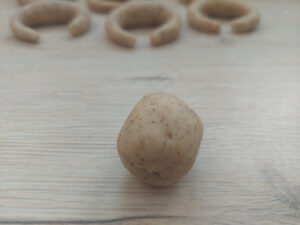
Then, roll them gently into a rope about 5 – 6 cm long and taper the ends.

Form the typical crescent by bending the rope.
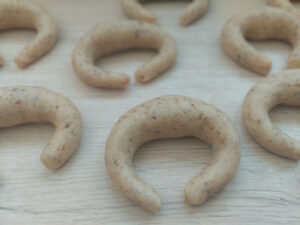
Sometimes, the dough falls apart during rolling. In that case, press it all together and knead it slightly until it becomes more pliable.
Cooling the cookies
While forming the Vanillekipferl, the dough naturally becomes warm again. To prevent the cookies from spreading, cool the cookies before baking. As it’s usually cold outside, I normally put the trays with the ready-to-bake Vanillekipferl on my balcony to cool for about 15 minutes. During that time, I preheat the oven and clean up the kitchen.
Preheating the oven
Baking temperature must be right from the start. That’s why you must preheat the oven to the required 140 °C (285 °F) and only put the trays in when the oven has reached this temperature.
Stay close
Each oven is different and the baking time can only be an estimate. Therefore, stay close to your ovenand watch the Vanillekipferl while they bake. They should be light-coloured in the end. If they’re golden-brown, they’ve been in the oven for too long.
Homemade vanilla sugar
Don’t throw the vanilla pod you used earlier for the dough away. Instead, carefully dry it in the oven or a dehydrator and mix it with sugar in a food processor. The result is a wonderfully fine, vanilla-flavoured sugar you can use to dust the Vanillekipferl with!
Covering with sugar
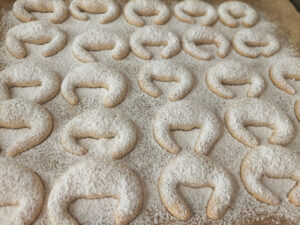
When you dust the Vanillekipferl with powdered or your homemade vanilla sugar while they’re still warm, the sugar will stick better to the cookies. To dust, you can either sprinkle the sugar on the cookies with a sieve or you can carefully roll the Vanillekipferl in a bowl with vanilla sugar.
How long can Vanillekipferl be stored?
Let the cookies cool down completely after baking before you put them in an airtight container (cookie box or jar). In a cool and dry place, the Vanillekipferl store well up to 6 weeks, but honestly, they won’t last that long.

Already one missing!
If you start baking your Christmas cookies really early and want your Vanillekipferl to be at their best when serving them, you can freeze the baked cookies. Just don’t dust them with icing sugar.
By the way: you can also freeze the cookie dough. When you finally want to bake the cookies, put the dough out of the freezer and let it defrost at room temperature.
Vanillekipferl variations
Now that you know the classic, traditional Vanillekipferl recipe, you can get creative if you like:
- Go nuts: Swap the almonds for ground hazelnuts or walnuts.
- All things chocolate: Replace 50 g of flour with 50 g of baking cocoa for a chocolaty version of Vanillekipferl
- Dark coat: dip the ends of the Vanillekipferl in melted chocolate; this is also a great way to add to the chocolate kipferl
- Cinna-licious: Coat the Vanillekipferl in cinnamon sugar (powdered sugar mixed with cinnamon) instead of vanilla or pure icing sugar.
- Add like crazy: Add pistachios to the dough, or freeze-dried strawberries or raspberries, or replace the almonds with ground poppy seeds. Add lemon or orange zest to the dough or – if you like it hot and spicy – 1/2 a teaspoon of ground chillies!
The tradition continues…
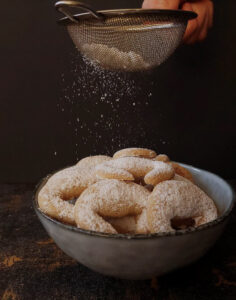
Making Vanillekipferl connects me to generations of women in my family who also baked these delicious Christmas cookies before me – and all the men who loved eating them (looking at you, Dad!). Now, I’d love you to start your own tradition, and it doesn’t matter if you have German or Austrian roots or have just discovered this recipe for the first time.
Admittedly, Vanillekipferl take some patience with the forming and double cooling, but the payoff is so worth it: while baking, your house will smell of vanilla and roasted almonds, and there are only a few things more satisfying than seeing the perfectly shaped little crescents on a cooling rack and powdered vanilla sugar on your fingertips.
Early December is the perfect time to bake your first batch of Vanillekipferl, and if you manage to keep them away from all the sweet tooths, you can proudly present your own Vanillekipferl at Christmas.
Whether this becomes your new December tradition or reminds you of your own family’s cookie rituals, I hope these little crescents bring you as much joy as they’ve brought mine.
0 Comments