
Ingredients
Equipment
Method
- Wash the lemons in cold water and dry them.

- Cut off the fruits' ends (about 5 mm).

- Make two lengthwise cuts (about two-third of their length) in all but one lemon. If you've done it right, your lemons have four wedges that are held together at the bottom.

- Squeeze the juice from the remaining lemon
- Weigh the lemons and the juice and calculate the amount of salt based on their weight. I recommend using 7 - 9 %, but not more than 10 %. For example, if your lemons (plus juice) weigh 750 g, I'd use about 70 g of salt, but definitely not more than 75 g.

- Slightly open the lemons and hold them over the jar. Now sprinkle some salt into the cuts. That way, the salt you'll inevitably spill will conveniently land in the jar.

- Put the salted lemons in the jar and add the lemon juice and the remaining salt.
- With a tamper or just your fist, press the lemons into the jar so that they're submerged under the brine. If the lemons are not completely covered, add some lemon juice. Put a weight on top of the lemons and close the jar.
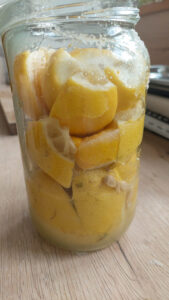
- Put the jar onto a tray and let the lemons ferment for 21 - 30 days at room temperature without direct sunlight. (I put mine in the pantry or a cupboard.) Check from time to time if they are still covered with brine and fill it up with a 7 - 9 % solution of lemon juice and salt, if necessary.
- After 21 days, transfer the salt-preserved lemons to a cool place, for example the fridge or - if you have - a cool basement where they can be stored for at least 6 months.
Notes
The longer you let fermented lemons mature, the better they become. Over time, the brine and fruit pulp will become more gelatinous, almost jam-like.